Document Translation Services Uscis: A Practical Buyer’s Guide for Immigration Documents
Published Wed Sep 02 2026 | 17 min read
Compare document translation services USCIS applicants use, from certified human translation to AI-assisted workflows, with checks for accuracy, format, and del
Choosing document translation services uscis applicants can rely on is not simply a language decision. Legal teams, employers, universities, and families must select a workflow that produces a complete English translation, preserves the evidence in the source document, includes the required certification, and can be reviewed before filing. This guide helps you decide whether a human translator, an AI-assisted document platform, a specialist agency, or a hybrid process fits the document, risk level, deadline, and budget.
The practical question is not “Which translator is cheapest?” It is what level of control does this document require, and who will be accountable for the final submission? A one-page civil certificate and a 180-page court record may both need English translations, but they do not create the same review burden, formatting risk, or privacy exposure.
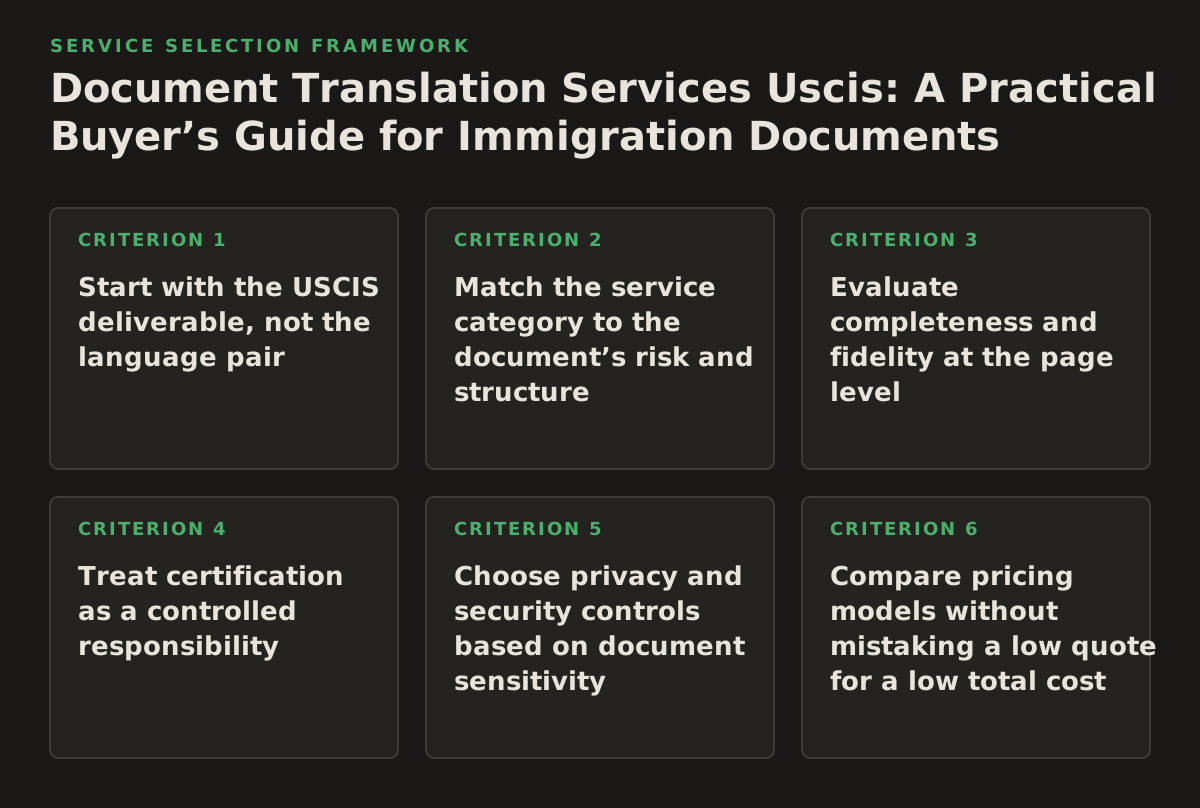
1. Start with the USCIS deliverable, not the language pair
For many immigration filings, the output is more than translated text. USCIS guidance generally requires a complete English translation when a foreign-language document is submitted, together with a translator’s certification that the translation is accurate and complete and that the translator is competent to translate. The applicable form instructions and current USCIS guidance control, so verify the requirement for the specific filing in 2026 rather than relying on a vendor’s generic claim. See the USCIS Policy Manual’s translation requirements for the governing context: USCIS Policy Manual, Volume 1, Part E, Chapter 6.
A translated file is not automatically a certified translation. A platform may produce a polished English document while leaving your legal team to arrange certification, check every page, and confirm that names, dates, stamps, and handwritten notes were handled correctly. Conversely, a translator may provide a certification page but deliver a layout that makes it difficult to connect the translation to the original evidence.
Define the acceptance package
Before requesting quotes, write down what the filing team needs:
- The original-language file and whether it is searchable, image-only, handwritten, or partly illegible.
- The target language, dialect or jurisdictional convention where relevant, and whether names should remain transliterated or be preserved exactly.
- A complete English translation, including seals, marginal notes, headers, footers, tables, stamps, and visible handwritten content.
- A certification statement and signature process that your attorney or filing team has approved.
- A final PDF or other required format, plus a review copy that can be compared with the source.
- A record of unresolved text, uncertain characters, abbreviations, and translator questions.
Use the filing instructions as the acceptance test. If the requested service cannot explain how it handles certification, unreadable passages, page numbering, and source-to-translation correspondence, it is not yet ready for a USCIS-sensitive workflow.
Failure mode: treating “USCIS accepted” as a permanent vendor credential. USCIS does not turn a private translation company into an approved provider merely because its marketing uses that phrase. Ask what the provider actually supplies and have counsel assess the final package.
Implementation example: An immigration team translating a foreign birth certificate creates a one-page acceptance checklist: all names match the passport, every seal is represented, dates retain their meaning, the translation is labeled, the certification is attached, and the reviewer initials the source-to-output comparison. The same team uses a longer checklist for a criminal disposition or court record.
2. Match the service category to the document’s risk and structure
“Translation service” covers several distinct operating models. The right choice depends on whether the document is text-rich or image-heavy, whether formatting carries evidentiary meaning, and whether a qualified person must certify the result.
| Buyer need or document condition | Service type to consider | Why it fits | Main trade-off |
|---|---|---|---|
| Short civil document with clear printed text | Human translator with certification | Direct accountability and straightforward review | Less efficient when many similar documents must be processed |
| Large searchable PDF, report, or contract | AI-assisted document translation with human review | Can accelerate first-pass translation while retaining layout for review | Certification, terminology control, and quality review remain separate decisions |
| Scanned certificate, court file, or photocopy | OCR plus human translation and visual comparison | Combines text extraction with inspection of stamps, marginalia, and page images | OCR errors can silently change names, dates, and numbers |
| Highly consequential court, medical, or identity evidence | Specialist human translator or hybrid workflow | Allows domain judgment, queries, and documented review | More coordination and potentially higher cost than an automated pass |
| PowerPoint training deck or internal presentation | Document-preserving translation workflow | Maintains slide structure, tables, notes, and visual context for business review | Text expansion may require manual layout correction |
| EPUB or long-form educational material | Structured-content translation with editorial review | Better suited to chapters, headings, links, and repeated terminology | More editorial decisions than a simple form or certificate |
When each model makes sense
- Human-only translation: choose it when ambiguity, legal terminology, handwriting, or certification accountability outweighs throughput.
- AI-assisted translation: choose it for a large volume of readable material when a qualified reviewer can inspect the output before filing or publication.
- OCR-first translation: choose it when the source is a scan, but treat extracted text as a draft representation—not as proof that the page was read correctly.
- Agency-managed translation: choose it when you need coordination across languages, reviewers, certification, and a single delivery manager.
- Internal workflow: choose it only when your organization already has language expertise, secure file handling, and a defined certification path.
Failure mode: selecting an automated workflow because the file extension is familiar. A searchable PDF can still contain a poorly encoded text layer, a table can split names from their associated dates, and a scan can hide a seal that OCR never recognizes.
Implementation example: A university immigration office receives 40-page academic records as searchable PDFs and two low-resolution civil certificates. It uses a document-preserving translation workflow for the records, but sends the certificates through OCR, page-image inspection, and human review. The service decision follows document condition rather than applying one method to the entire case.
3. Evaluate completeness and fidelity at the page level
Translation quality for immigration evidence has two dimensions: linguistic accuracy and document fidelity. Linguistic accuracy covers meaning, names, dates, and terminology. Document fidelity covers whether the output makes the original evidence understandable and traceable.
A reviewer should be able to answer: Which translated paragraph corresponds to this original paragraph? Where did the translator represent the seal? Was the handwritten correction included? Did a table row disappear? A fluent translation that omits a marginal note can be less useful than an awkward-looking but complete translation.
Build a source-to-output review
- Confirm page count and order before translation.
- Compare every source page with the corresponding translated page.
- Check names against the identity document that governs the filing.
- Check all numbers separately: dates, case numbers, addresses, amounts, grades, and registration identifiers.
- Inspect stamps, seals, signatures, handwritten notes, crossed-out text, and annotations.
- Review tables for row alignment and column meaning.
- Record uncertain or illegible content instead of silently guessing.
- Confirm that the certification covers the delivered translation and is attached in the intended place.
Preserve visual evidence where it carries meaning. For a scanned certificate, the reviewer may need to see the source image alongside the English text. A workflow that can translate scanned PDFs is useful when the original has no reliable text layer, but the resulting English should still be checked against the image.
For text-based PDFs, preserving headings, tables, and page order reduces the chance that the filing team loses context during review. A workflow designed to translate PDF documents can help organize a reviewable deliverable, but formatting preservation does not replace human verification.
Failure mode: relying on spell-check as quality control. Spell-check can approve a wrong surname, a plausible but incorrect date, or a valid English word inserted where a legal abbreviation belongs.
Implementation example: A law firm translates a 22-page court disposition. The reviewer marks every proper noun and number in a comparison copy, checks that every seal is described, and keeps a separate issue log for two illegible lines. The translator resolves the questions or labels them as unreadable rather than inventing text.
4. Treat certification as a controlled responsibility
Certification is often the point where buyers discover that translation and filing support are different services. Ask whether the translator or agency will provide the certification, whether the named person actually reviewed the entire translation, and whether the certificate identifies the language combination and translator competence in the form your legal team expects.
Separate translation approval from certification authority. An attorney, accredited representative, employer, or internal language reviewer may approve wording for a case, but that does not necessarily make that person the certifying translator. The final process should identify who translated, who reviewed, who certified, and who authorized submission.
Questions to resolve before ordering
- Who will sign the certification?
- Does the certification cover the complete translation, including translated descriptions of stamps and handwritten material?
- Will the provider certify an AI-assisted translation, or must a human translator independently review and adopt it?
- How are corrections handled after certification?
- Will you receive a revised certification if the translation changes?
- Can the provider explain its treatment of names, dates, titles, and untranslatable official terms?
Failure mode: attaching a generic statement copied from an unrelated job. A certification should correspond to the actual translation delivered. If a reviewer makes substantive changes after the certificate is signed, the team should determine whether recertification is needed.
Implementation example: A corporate mobility team adds a certification checkpoint to its case-management system. The case cannot move to filing until the signed certification, final translated file hash or version label, and reviewer approval are stored together. This does not guarantee an agency decision; it prevents the team from submitting mismatched files.
5. Choose privacy and security controls based on document sensitivity
Immigration files can contain passports, birth records, financial information, medical details, criminal history, and addresses. The service evaluation therefore needs a data-handling conversation, not just a language conversation. NIST’s AI Risk Management Framework provides a voluntary framework for managing risks in AI systems, including governance, measurement, and ongoing management; it is a useful structure for questions even when a provider does not claim formal compliance. See the NIST AI Risk Management Framework.
For health-related records, ask counsel or the organization’s privacy officer which rules apply. HHS explains that the HIPAA Privacy Rule protects certain individually identifiable health information held by covered entities and business associates; applicability depends on the parties and transaction, not merely on the fact that a document is medical. The official overview is available from HHS on HIPAA privacy laws and regulations.
Request specific answers
- Is the uploaded content used to train a general model, and can that use be disabled or contractually prohibited?
- How are files encrypted in transit and at rest?
- Who can access the source and output, and are access events logged?
- How long are files, extracted text, previews, and backups retained?
- Can the organization delete data on request, and what evidence is provided?
- Where are subcontractors or external reviewers located?
- What happens if a file is uploaded to the wrong case?
- Is there an incident-notification process and a named security contact?
Do not confuse confidentiality language with a security specification. “Private” is a marketing adjective unless the contract or policy explains retention, access, training use, deletion, and incident handling.
Failure mode: uploading the complete case file to evaluate a service. Start with a redacted sample that preserves the difficult features—tables, stamps, handwriting, and layout—then obtain written answers before processing identifiable evidence.
Implementation example: A hospital immigration program creates a redacted test packet and requires the provider to document retention and deletion for the test. Only after the privacy officer approves the workflow does the team process identifiable records, using case-specific folders and restricted access.
6. Compare pricing models without mistaking a low quote for a low total cost
Translation vendors may quote by source word, target word, page, file, hour, project, or subscription. A platform may charge for usage, processing, or a plan with included capacity. Do not assume what is included: ask for a written scope that covers OCR, tables, formatting repair, certification, revisions, rush handling, and source-file cleanup.
Questions for the budget owner
- What is the billing unit, and how is a scanned page counted?
- Are blank pages, duplicate pages, stamps, tables, and handwritten notes included?
- Is OCR included, and is human correction of OCR included?
- Does the quote include certification and one or more review rounds?
- What triggers a surcharge for poor scans, rare languages, rush delivery, or complex formatting?
- Are minimum charges, account fees, export fees, or cancellation terms involved?
- What happens when the source document changes after work begins?
Calculate total review cost, not just translation cost. If a cheap output requires an attorney to reconstruct tables, compare every number, and obtain a separate certification, the apparent saving may disappear. Conversely, paying for full human handling of a clean, repetitive, low-risk file may add work that does not improve the filing.
Use an illustrative internal policy rather than pretending there is a universal budget threshold. For example, a legal department might require human-first handling for identity, court, and medical evidence; permit AI-assisted first drafts for long, readable business records; and require a documented review for both. That is a governance choice, not an industry price benchmark.
Failure mode: comparing a per-page quote with a per-word quote without normalizing scope. One provider may include certification and layout repair while another prices only raw translated text.
Implementation example: A publisher translating an immigration-supporting book excerpt asks three providers to quote the same 10-page sample and list inclusions separately. The buyer compares base translation, OCR, formatting, certification, revision, and rush charges as separate line items before selecting a workflow.
7. Test the provider with a controlled sample and interview
A sample should resemble the hardest part of the real job. Sending a clean paragraph tests vocabulary; it does not test whether the service can handle a seal, a two-column court page, a faint scan, or a table containing dates and names.
Use a representative evaluation packet
Prepare a small, redacted packet containing:
- One clear page with names and dates.
- One scanned or skewed page.
- One page with a seal, stamp, signature, or handwritten note.
- One table with numbers and merged cells.
- One page containing the terminology that matters to the case.
Score the output against observable criteria:
- Nothing visible on the source page is omitted without explanation.
- Names and numbers match the source and governing identity documents.
- Tables remain interpretable.
- Uncertainty is flagged instead of guessed.
- Page order and labels make comparison easy.
- Certification responsibilities are explicit.
- The output can be revised without losing version control.
Vendor interview checklist
- Which parts are automated, and which are reviewed by a qualified human?
- How do you detect and correct OCR errors?
- How do you represent seals, marginal notes, and illegible text?
- Who reviews proper names, dates, and numbers?
- Who signs the certification, and what does it cover?
- Can you preserve tables, page order, and images in the delivered format?
- How do you handle a correction discovered after certification?
- What are your retention, deletion, access, and model-training policies?
- What exactly is included in the quote?
- What information do you need from our attorney or case manager?
- Can you provide a version label and a change record for revisions?
- What is your escalation route when a translator cannot interpret a passage?
Require evidence rather than reassurance. A credible answer identifies a process, responsible role, deliverable, and exception path. “Our AI is accurate” does not explain what happens when a blurry number is read incorrectly.
Failure mode: accepting a polished sample as proof of production quality. Ask the provider to annotate uncertainties and explain decisions; the quality of its exception handling may matter more than the fluency of ordinary sentences.
Implementation example: A nonprofit assisting asylum applicants scores sample outputs on completeness, names and numbers, formatting, certification, privacy answers, and correction handling. It selects the service that meets its mandatory criteria, even if another sample sounds slightly more elegant.
8. Establish measurable acceptance criteria and red flags
Quality becomes manageable when the buyer defines what can be checked. “Good translation” is too vague for a legal operations process. Write criteria that a second reviewer can verify without guessing what the first reviewer intended.
Useful acceptance criteria
- Completeness: every source page and visible element is represented or explicitly marked as unreadable.
- Identity consistency: names, dates, places, and document numbers agree with the case record.
- Structural fidelity: tables, headings, labels, and page relationships remain understandable.
- Terminology control: recurring legal, medical, academic, or organizational terms are translated consistently.
- Traceability: reviewers can connect output passages to source locations.
- Certification match: the certification identifies the delivered version and responsible translator.
- Privacy handling: access, retention, deletion, and external review are documented.
For a high-risk matter, an illustrative starting policy might require two-person review of names, numbers, and dispositive legal language. For a low-risk internal report, one qualified reviewer may be sufficient. Label such rules as internal starting policies and adjust them to counsel’s advice, document complexity, and organizational risk.
Red flags that should stop the purchase
- Promises of guaranteed USCIS approval or “USCIS-certified company” status.
- No clear answer about who certifies the translation.
- Refusal to explain whether uploaded content is retained or used for training.
- Quotes that exclude OCR, stamps, tables, or revisions without saying so plainly.
- Instructions to guess unreadable text or omit non-text elements.
- No method for correcting a certified file.
- Samples that remove difficult formatting instead of solving it.
- Pressure to upload sensitive records before contract and privacy review.
USCIS filing outcomes depend on the entire submission and applicable law; a translation provider cannot guarantee approval. For proceedings before the immigration courts, requirements and procedures may differ, so consult the relevant Executive Office for Immigration Review materials rather than assuming a USCIS workflow applies. The EOIR Policy Manual is the appropriate official starting point for court-specific procedures.
Failure mode: measuring only turnaround time. A fast file that requires rework, creates a missing-page issue, or cannot be certified is not fast in operational terms.
Implementation example: A government contractor tracks rejected checks by category—omitted content, number error, formatting failure, certification issue, and privacy exception. The categories reveal whether the problem lies in source preparation, vendor output, or internal review.
Implement the workflow in sequence
Use the following sequence for a 2026 procurement or case workflow. It keeps legal requirements, document mechanics, privacy, and cost decisions in the right order.
- Classify the filing context. Identify the USCIS form or proceeding, the evidence type, the filing deadline, and whether another forum’s rules apply.
- Inventory the source files. Record language, page count, file type, scan quality, tables, handwriting, stamps, and sensitive information.
- Set the acceptance package. Specify completeness, certification, output format, naming, page correspondence, and required reviewers.
- Assign a risk tier. Put identity, court, medical, and dispositive evidence into a stricter review path than routine internal material.
- Shortlist service categories. Compare human, AI-assisted, OCR-plus-human, agency-managed, and internal options against the inventory.
- Run a redacted representative sample. Include the document features most likely to fail, not merely a clean paragraph.
- Interview and document vendor answers. Capture certification ownership, privacy controls, retention, pricing scope, revision handling, and escalation.
- Normalize the total cost. Separate translation, OCR, formatting, certification, review, revisions, and rush charges.
- Process the final files with version control. Keep the source, delivered translation, certification, reviewer checklist, issue log, and final approval together.
- Perform the page-level acceptance review. Check every page, name, number, table, seal, annotation, and uncertainty before filing.
- Archive or delete according to policy. Retain only what the case, contract, and organizational rules require, and document deletion where appropriate.
The most defensible recommendation is a risk-tiered hybrid policy: use document-preserving automation where it reduces repetitive work, require human review for immigration-critical content, and treat certification and privacy as explicit deliverables. InOtherWord.AI can support teams that need to translate PDFs, scanned PDFs, DOCX files, PowerPoint presentations, or EPUB books while retaining document structure; review its capabilities against the acceptance checklist above at InOtherWord.AI before using it for a USCIS filing.
Authored with NotFair SEO
Related guides
Keep researching the right workflow
These pages help move from general document-translation research into the specific file format or workflow you need.
A practical workflow for translating scanned PDFs with OCR while preserving enough structure for real review, sharing, and downstream editing.
Explore pageHow to translate PPT and PPTX decks without breaking slide layouts, charts, and speaker-ready formatting.
Explore pageThe best AI PDF translator is not just about language quality. It also needs OCR, layout preservation, and reviewable output for real files.
Explore pageCommercial pages
Ready to translate the actual file?
Jump from the guide into the product page that fits your document type, then continue into pricing when you are ready.
Format page
Translate PDF Documents
Translate PDF files while preserving layout, tables, and page structure.
Explore pageFormat page
Translate Scanned PDFs
OCR and translate scanned PDFs without rebuilding the layout by hand.
Explore pageFormat page
Translate PowerPoint Presentations
Translate PPT and PPTX decks while preserving slide layouts, tables, and speaker-ready formatting.
Explore pageTranslate layout-heavy PDF reports, manuals, forms, and client-ready files while keeping tables, headings, and images readable.
Explore page