Docx Translation Examples For Legal Contracts: Clause-Level Lessons
Published Thu Nov 26 2026 | 9 min read
docx translation examples for legal contracts show how to preserve duties, exceptions, defined terms, numbering, and review history in a bilingual draft.
docx translation examples for legal contracts are most useful when they show how a wording change can affect an obligation, condition, defined term, or review decision. The examples below use fictional clauses to demonstrate what to preserve, how plausible near misses can shift meaning, and how to check the translated DOCX. They are review aids, not approved contract language or substitutes for qualified legal and language review.
Use clause examples that expose what must stay intact
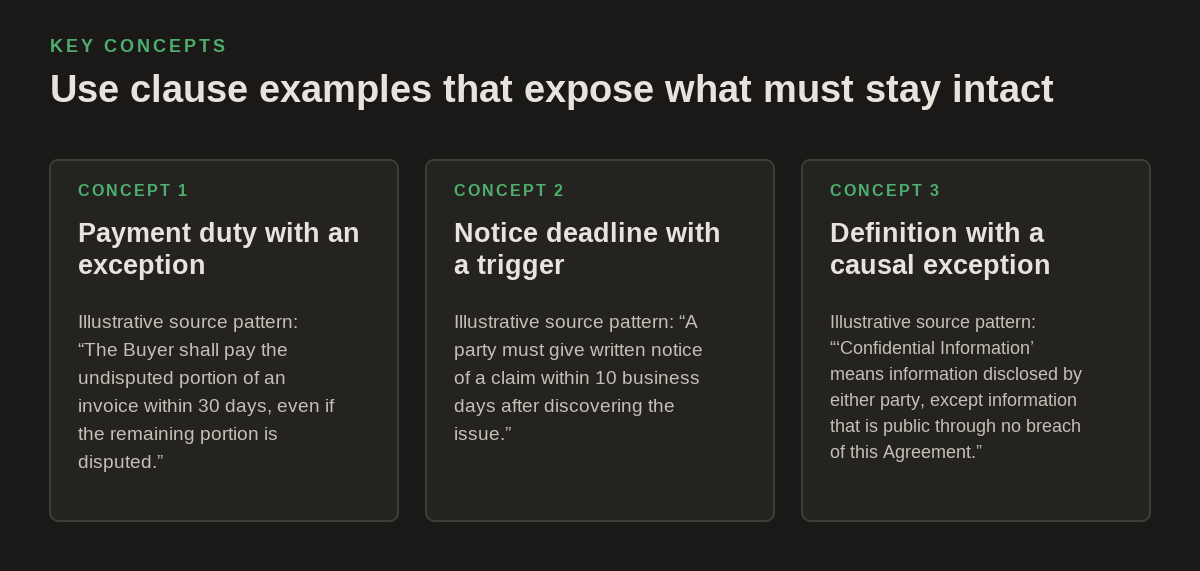
A practical example pairs a source pattern with a specific review question. Rather than asking whether the target sentence “sounds right,” ask whether it gives the same party the same right or duty under the same conditions. The patterns below are deliberately short and language-neutral; the appropriate wording depends on the language pair and the agreement.
Payment duty with an exception
Illustrative source pattern: “The Buyer shall pay the undisputed portion of an invoice within 30 days, even if the remaining portion is disputed.”
Review question: Does the target preserve the duty to pay, limit that duty to the undisputed portion, and state that a dispute over the balance does not suspend it?
This sentence combines a positive obligation with a limit on its scope. If “undisputed” disappears, the target may require payment of more than the source does. If the equivalent of “even if” is weakened or omitted, a reader may infer that a dispute pauses all payment. Adapt the example by marking the actor, required action, object, timing, and carve-out separately before evaluating the full translated sentence.
Notice deadline with a trigger
Illustrative source pattern: “A party must give written notice of a claim within 10 business days after discovering the issue.”
Review question: Are the trigger, counting unit, and required form all clear in the target?
The example’s period is not a recommended deadline. It makes visible three separate elements: the clock starts after discovery, the period is measured in business days, and notice must be written. A target that retains the numeral but loses the trigger can start the clock at a different event; one that changes the counting unit can alter the deadline. Adapt the pattern by checking the trigger, recipient, permitted channel, and day-count wording against the signed source and any instructions from counsel.
Definition with a causal exception
Illustrative source pattern: “‘Confidential Information’ means information disclosed by either party, except information that is public through no breach of this Agreement.”
Review question: Does the target preserve both the defined label and the reason public information is excluded?
The exception is not simply “information that is public.” It excludes information only when its public status did not result from a breach. A translation that loses that causal boundary may broaden the exception. Adapt the example by following the defined term into every operative clause, schedule, and cross-reference where it appears. A consistent label is useful only if the underlying scope remains consistent too.
Map clauses by legal function before reviewing the prose
A clause map makes the agreement easier to review in manageable units. It should describe what a provision does without pretending to decide its legal effect. This helps distinguish an operative duty from a heading, note, or drafting instruction and gives reviewers a quick way to notice a missing actor or condition.
For each provision, record a short source-language summary and identify the words that control its function. “Supplier must notify Customer before using a subprocessor” is more useful as a review label than “Subprocessors,” because it names the actor, action, recipient, and timing relationship. The label is a navigation aid, not a substitute for comparing the actual clauses.
- Obligation or permission: Who acts, and is the action required, allowed, or prohibited?
- Condition: What event must occur before the provision applies?
- Exception: Which cases are carved out, and which rule does the carve-out qualify?
- Consequence: What remedy or other result does the clause state if a requirement is not met?
- Reference: Does the provision point to the same defined term, section, or schedule in both versions?
This approach also helps when neighboring provisions use similar terminology but do different work. A confidentiality obligation, a data-processing instruction, and a security commitment may sound related without being interchangeable. For example, Article 28 of the EU General Data Protection Regulation addresses information and terms for contracts between controllers and processors. Where that provision is relevant, a reviewer can use its stated subjects as a completeness prompt while counsel assesses applicability and wording (GDPR, Article 28).
For a contract involving an international sale of goods, distinguish the agreement’s language choices from rules that may apply under law. Article 6 of the CISG allows parties to exclude the Convention’s application, in whole or in part. It does not, by itself, determine which language version controls or settle every conflict. Treat governing-law and language provisions as questions for jurisdiction-specific legal review, not as matters the translation can resolve on its own (UNCITRAL CISG text).
Compare the source with plausible near misses
A near miss is a target sentence that reads smoothly but changes a relationship, scope, or degree. Put the source feature beside the possible shift and a question the reviewer can answer. This makes the issue visible without declaring a translation correct in isolation.
| Source feature | Illustrative near miss | Reviewer question |
|---|---|---|
| “May” grants discretion | Target wording reads as “must” | Has permission become an obligation? |
| “Unless” introduces an exception | The exception reads like a separate general rule | Is it still limited to the provision it qualifies? |
| “At least” sets a minimum | Target wording conveys an exact amount | Can the amount exceed the stated floor? |
| “And” joins required conditions | The connector may imply alternatives | Must both conditions be satisfied? |
These are review prompts, not universal language rules. A connector that appears equivalent on its own may not express the same relationship in the full sentence. For each flagged difference, read the operative clause in context and ask who gains or loses a right under each plausible interpretation. Then record what evidence would settle the issue instead of smoothing it away as style.
For example, the evidence might be an approved glossary entry, a parallel clause in the same agreement, written instructions from counsel, or confirmation of the intended business rule. If none resolves the choice, keep it as an open query. That is safer than silently choosing one interpretation and allowing a similar ambiguity to be handled differently elsewhere.
Contract formation can make changes to apparently small details consequential. Under CISG Article 19, an acceptance that adds or changes terms may count as a counter-offer, with specified treatment for material alterations. The rule applies within the Convention’s scope; it should not be generalized to every contract or jurisdiction. It illustrates why reviewers should flag changes to matters such as payment, liability, and dispute resolution rather than treating them as stylistic edits (UNCITRAL CISG, Article 19).
- Mark the exact source phrase that prompted the question.
- Describe the two readings without endorsing either one.
- Identify what evidence or decision is needed to resolve the difference.
- Record the resolution and check whether the same choice affects other clauses.
Preserve DOCX structure so the review remains traceable
A DOCX is not just a block of text. Office documents use a package of related parts, which can include document content and supporting components. Microsoft’s Open XML documentation describes this document structure; it is one reason a review of a copied passage alone may miss material in another part of the file (Microsoft Open XML documentation).
Keep numbering and cross-references aligned
Preserve article numbers, nested headings, list levels, and schedule labels where the review requires them to track the source. A clause may be linguistically accurate yet harder to verify if numbering shifts or a cross-reference points to the wrong section. Check internal references after edits, including references inside tables and annexes. Where numbering must change, verify that each reference in the final document points to the intended provision.
Review tables in context
Tables can carry party names, responsibilities, dates, exceptions, or other operative content. Check that every translated entry remains in the correct row and column and that headings still describe the cells beneath them. A table extracted into plain text can help with comparison, but it cannot show whether content has moved visually or whether the rendered document makes the relationship between entries clear. Inspect both the wording and its position in the final file.
Make revision history deliberate
Microsoft Word’s Track Changes guidance explains how to display, accept, and reject tracked changes. A translated draft may contain source-language edits, target-language edits, comments, or a mixture. Decide which revision state the reviewer is meant to assess, and check both the marked-up view and the clean text so proposed wording is not mistaken for agreed wording (Microsoft Support: Track Changes in Word).
- Check whether deleted wording remains visible and could be mistaken for operative text.
- Confirm comments and reviewer identifiers are suitable for the intended recipients.
- Compare the accepted text with the version intended for signature.
- Reopen the saved DOCX and inspect tables, headers, footers, footnotes, and page breaks.
Stable numbering and legible revision marks support review by making the disputed language easier to locate; they do not prove that the translation is accurate. When the source is a PDF rather than an editable DOCX, account for extraction and layout checks as a separate part of the workflow. InOtherWord.AI has pages for translate PDF documents and translate scanned PDFs; compare the resulting text and layout with the source before relying on a translated draft.
Turn examples into a review set for the actual agreement
Generic patterns are useful for training, but a review set should reflect the clauses that matter in the contract being translated. Choose provisions with consequential obligations, exceptions, or dependencies and build a clear example plus a plausible near miss for each. The point is not to test whether reviewers recognize familiar terms; it is to see whether they can explain what changed and identify the decision needed.
- Payment: Test whether a dispute affects only the disputed amount or changes the payment duty more broadly.
- Liability: Check whether a limitation, exclusion, or exception attaches to the same parties and claims.
- Termination: Compare the triggering event, notice requirement, and stated consequence.
- Confidentiality: Trace defined terms and exceptions into the operative obligations.
- Notice: Verify the trigger, deadline, recipient, and permitted form of delivery.
- Data processing: Check that the translated clause retains the relevant roles, instructions, and listed terms.
Keep illustrative wording labeled as illustrative. For each example, note the source passage, the issue it tests, the reviewer question, and any unresolved choice. Assign linguistic questions to a language professional, terminology questions to an appropriate subject-matter reviewer, and legal-effect questions to counsel. Distinct responsibilities help prevent fluency from being treated as proof that the parties’ rights and duties remain unchanged.
Use the final pass to verify three things separately: meaning against the source, completeness of the material in scope, and the state of the DOCX that will be shared or signed. InOtherWord.AI is an AI-powered platform for translating DOCX and other document formats while preserving formatting, layout, tables, and images; see InOtherWord.AI for the platform, and have qualified reviewers assess the legal meaning before use.
Authored with NotFair SEO
Related guides
Keep researching the right workflow
These pages help move from general document-translation research into the specific file format or workflow you need.
A practical workflow for translating scanned PDFs with OCR while preserving enough structure for real review, sharing, and downstream editing.
Explore pageHow to translate PPT and PPTX decks without breaking slide layouts, charts, and speaker-ready formatting.
Explore pageThe best AI PDF translator is not just about language quality. It also needs OCR, layout preservation, and reviewable output for real files.
Explore pageCommercial pages
Ready to translate the actual file?
Jump from the guide into the product page that fits your document type, then continue into pricing when you are ready.
Format page
Translate PDF Documents
Translate PDF files while preserving layout, tables, and page structure.
Explore pageFormat page
Translate Scanned PDFs
OCR and translate scanned PDFs without rebuilding the layout by hand.
Explore pageFormat page
Translate PowerPoint Presentations
Translate PPT and PPTX decks while preserving slide layouts, tables, and speaker-ready formatting.
Explore pageTranslate layout-heavy PDF reports, manuals, forms, and client-ready files while keeping tables, headings, and images readable.
Explore page