Cheap Document Translation Services: A Practical Buyer’s Guide for 2026
Published Tue Aug 25 2026 | 15 min read
Compare cheap document translation services by quality, OCR, security, pricing, and workflow fit before you commit sensitive files or deadlines.
Teams searching for cheap document translation services are usually trying to solve a practical constraint: translate a contract, research corpus, report, course pack, or patient-facing document without creating a second project to repair formatting and verify meaning. This guide helps legal, academic, business, publishing, government, and healthcare teams decide which service category fits the document, where low cost creates downstream risk, and how to run a defensible selection process in 2026.
The cheapest quote is not always the lowest total cost. A translation that loses table structure, drops footnotes, misreads a scan, or exposes confidential material can require manual reconstruction, legal review, or a complete retranslation. The useful comparison is therefore cost per accepted deliverable: the amount spent to receive a file that meets the project’s accuracy, layout, security, and deadline requirements.
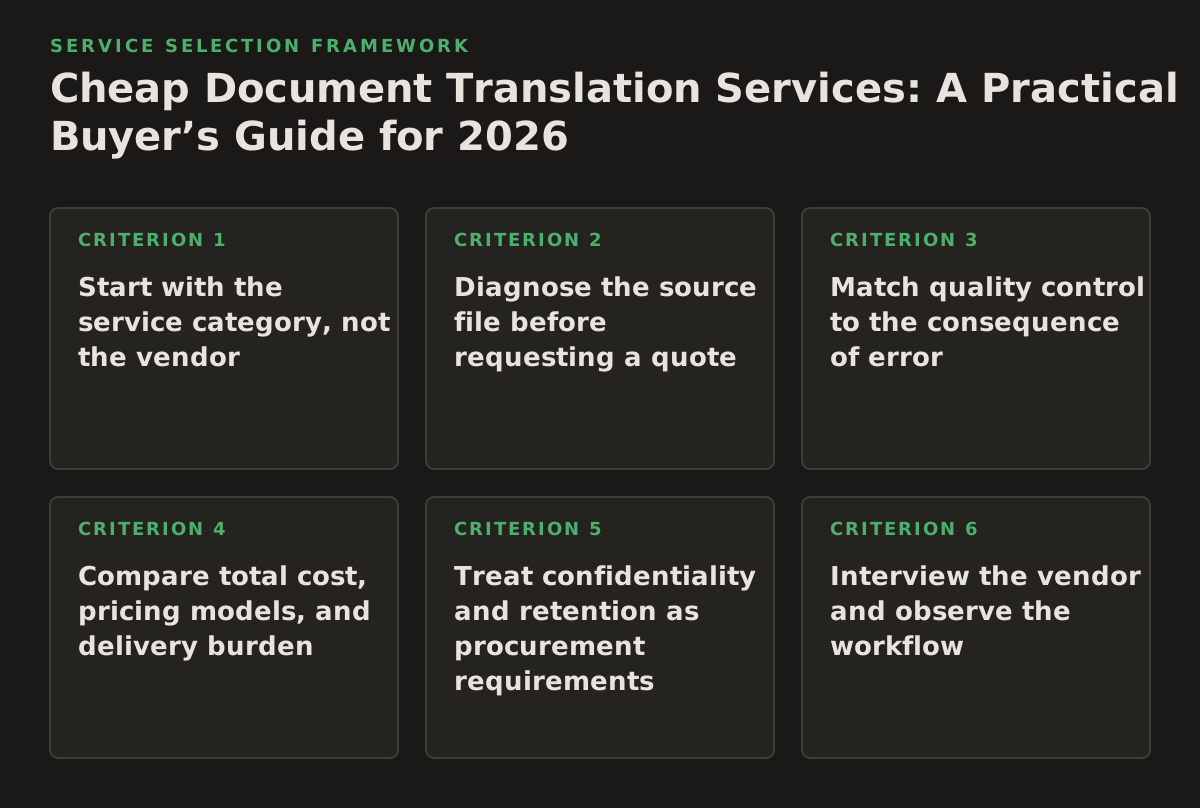
1. Start with the service category, not the vendor
“Document translation” covers several different workflows. A short editable DOCX, a scanned court filing, and a designed multilingual textbook should not be evaluated against the same promise. First classify the job by source condition, consequence of error, and output requirement.
Four categories buyers commonly encounter
- Machine document translation: An automated system translates an editable file and returns a translated document. This suits internal reports, first-pass research, working drafts, and high-volume material where a reviewer can check important passages.
- AI translation with layout preservation: The system processes a document while attempting to retain headings, tables, images, and page structure. This is useful when the output must remain a usable PDF, DOCX, PowerPoint presentation, or EPUB rather than a block of extracted text.
- OCR-assisted scanned-document translation: The workflow first recognizes text in image-based pages, then translates the recognized content. It serves scanned court documents, archival research, government forms, handwritten-adjacent material, and older PDFs.
- Human-reviewed or specialist translation: A qualified linguist reviews or produces the translation, often with terminology instructions and a formal quality process. This is more appropriate for filings, contracts, regulated communications, publication-ready books, and documents where an incorrect phrase changes rights or obligations.
These categories can be combined. For example, a university may use automated translation for a large literature review, then commission human review of the abstract and methodology. A legal team may use OCR and machine translation to triage a production set, while sending the final exhibits and quoted clauses for specialist review.
| Buyer need | Best-fit service type | Trade-off | Acceptance check |
|---|---|---|---|
| Internal understanding of an editable report | Machine or AI document translation | Low implementation burden; terminology and nuance may need checking | Reviewer confirms key figures, names, recommendations, and action items |
| Readable translated PDF with tables and images | Layout-aware document translation | Better usability than pasted text; complex designs may still need repair | Compare page count, table alignment, headings, captions, and overflow |
| Image-only legal, academic, or archival PDF | OCR-assisted translation | Recognition errors become translation errors; noisy scans require extra review | Sample the OCR text against the page image before relying on the translation |
| Contract, filing, consent form, or regulated communication | Specialist human translation or human-reviewed workflow | Higher cost and coordination; stronger control over terminology and meaning | Obtain documented review, terminology confirmation, and final sign-off |
| Large research or publishing corpus | Batch machine translation plus risk-based review | Efficient at scale; requires sampling rules and a glossary | Measure error classes across a defined sample and review high-risk passages |
| PowerPoint used for a live presentation | Presentation-aware translation | Text expansion can alter slide balance and speaker notes | Render every slide and inspect clipping, notes, charts, and labels |
Failure mode: buying the lowest per-page or per-word offer for a source that actually needs OCR, formatting reconstruction, or legal review. Implementation example: classify a 600-page litigation set into native PDFs, image-only PDFs, and exhibits with charts. Price and test each class separately instead of treating the collection as one homogeneous order.
2. Diagnose the source file before requesting a quote
A quote based only on page count hides the work. Two 100-page PDFs may differ radically: one may contain selectable text and simple paragraphs; the other may be a skewed scan with stamps, columns, marginal notes, and tables. Your intake form should record file type, text layer, visual complexity, language pair, and required output.
A practical preflight checklist
- Can you select and copy a representative paragraph, or is each page an image?
- Does the file contain tables, footnotes, annotations, signatures, charts, formulas, or text embedded in images?
- Are there multiple source languages or dialects in the same file?
- Must the output remain editable, searchable, paginated, or visually similar to the original?
- Does the document include confidential personal, health, financial, privileged, or government information?
- Will the translation be read informally, published, filed with an authority, or used to make a decision?
For scanned PDFs, OCR is not a cosmetic step. It creates an intermediate text representation, and every recognition mistake can propagate into translation. Text extraction systems may identify words, lines, forms, and tables differently depending on the document; AWS describes Amazon Textract, for example, as a service that extracts text and structured data from documents, including forms and tables, but that documentation does not make the result a substitute for source verification. See the official overview at AWS Textract documentation.
For a workflow focused on recovering text from image-only pages, see translate scanned PDFs. For a native, text-based PDF where preserving the document’s structure matters, see translate PDF documents. The distinction matters because OCR confidence is not translation confidence; a beautifully formatted output can still contain a wrong number or missing phrase.
Use a representative test set
Do not send only the easiest page. Build a small test set containing the hardest recurring structures:
- one ordinary paragraph page;
- one dense table or form;
- one page with a header, footer, footnote, and citation;
- one scan with skew, stamps, handwriting, or low contrast;
- one chart, slide, or image containing embedded text;
- one passage with domain terminology or legally significant wording.
Failure mode: approving a service after testing a clean first page while the production set contains difficult exhibits. Implementation example: a healthcare team can test a de-identified intake form, a dosage table, and a consent page, then record whether labels, units, checkboxes, and warnings survive in the translated output.
3. Match quality control to the consequence of error
“Accurate” is too vague for procurement. Define what must be right and who is authorized to approve it. A business team translating an internal forecast may prioritize comprehension and speed. A legal team translating a clause must preserve scope, negation, defined terms, dates, and obligations. A publisher may care about voice, consistency, typography, and editorial readiness.
Build a risk-tiered review policy
- Tier 1: comprehension: A bilingual employee checks names, numbers, conclusions, and action items. Suitable for internal background material.
- Tier 2: operational use: A subject-matter reviewer checks terminology, tables, instructions, and layout before circulation. Suitable for research teams, training materials, and business operations.
- Tier 3: consequential use: A qualified linguist or domain specialist reviews the complete document, with a responsible owner signing off. Suitable for contracts, court documents, clinical communications, public notices, and formal submissions.
Use a glossary for terms that must remain stable. Include the source term, approved translation, prohibited alternatives, grammatical notes, and the context in which the term applies. Legal teams should include defined terms and party names; researchers should include technical nomenclature; publishers should include character names and style decisions; healthcare teams should include units and medication names.
A useful acceptance record contains measurable review criteria, not a general statement that the translation “looks good.” For example:
- all pages are present and in the correct order;
- all names, dates, amounts, units, references, and identifiers match the source;
- no table cell, caption, footnote, or slide element is clipped;
- approved glossary terms appear consistently in sampled sections;
- the reviewer logs material errors by category and disposition;
- the final approver is identified for each high-risk document.
For research and publishing teams, the document format itself can be part of quality. EPUB 3 is a web-standardized publication format with structural and accessibility considerations, so an ebook workflow should inspect navigation, reading order, metadata, and reflow rather than only comparing visible pages. The relevant specification is maintained by the World Wide Web Consortium’s EPUB 3.3 specification.
Failure mode: using a single reviewer rule for every file. Implementation example: a university marks a translated journal article as Tier 1 for internal discovery, but upgrades the abstract, consent language, and quoted results to Tier 2 before sharing them with participants or external partners.
4. Compare total cost, pricing models, and delivery burden
Cheap document translation services may quote by word, page, file, character, minute of audio, or a subscription allowance. Some workflows add costs for OCR, complex formatting, language pairs, rush delivery, human review, glossary work, or repeated revisions. Do not assume a low headline unit price includes the same deliverable as a higher quote.
Questions to ask about the commercial model
- What exactly is billable: source words, translated words, pages, files, or processing time?
- How are blank pages, repeated headers, tables, images, and scanned pages treated?
- Is OCR included, and is there a separate charge for difficult scans?
- Does the fee include the translated file in the original format, or only extracted text?
- Are revisions included when the output fails an agreed formatting or terminology requirement?
- Is human review optional, mandatory for a category, or unavailable?
- What happens to unused subscription capacity, and can multiple departments share it?
- Are minimum order sizes, rush fees, export fees, or file-size limits relevant?
Create a simple total-cost model:
Total project cost = processing fee + review labor + formatting repair + coordination time + rework risk.
This is not a universal accounting formula; it is an illustrative starting policy for comparing quotes. If a low-cost output requires a bilingual employee to rebuild every table, the quote is incomplete from the project owner’s perspective. Conversely, paying for specialist review on a low-consequence internal memo may be wasteful if a defined sample check is sufficient.
Failure mode: comparing a machine-only quote with a fully reviewed quote as though they were equivalent products. Implementation example: a publisher requests two line items: automated translation with formatted EPUB delivery, and human editorial review of the complete book. The team can then decide whether review applies to all chapters, selected chapters, or a pilot.
Set a stopping rule before ordering. An illustrative policy might say: if the representative test set fails any mandatory layout check or produces a material terminology error, do not scale the order until the cause and remedy are documented. That is a governance rule, not a claim about an industry benchmark.
5. Treat confidentiality and retention as procurement requirements
Document translation can involve contracts, patient records, research data, source code, immigration files, or internal strategy. Before uploading anything, determine who can access the files, how long they are retained, whether they are used for service improvement, and how deletion is handled. Do not infer these answers from a generic security badge or a provider’s marketing language.
Questions for legal, government, and healthcare teams
- Is the service permitted under your organization’s data classification policy?
- Are files encrypted in transit and at rest, and who controls administrative access?
- Are customer files or translations used to train models or improve systems?
- What is the retention period for source files, output files, logs, and backups?
- Can the provider delete files on request, and is deletion documented?
- Where are data and support operations located?
- Can the provider sign the required data-processing or confidentiality agreement?
- What happens if a subcontractor or external reviewer handles the content?
Government and healthcare buyers should map the service to their own legal and policy obligations rather than treating a public certification list as automatic approval. For information-security risk decisions, NIST’s Privacy Framework offers an official risk-management reference, but it does not certify a particular translation provider. Your privacy, records, procurement, and security teams still need to assess the actual workflow.
Use data minimization during evaluation. Replace names, account numbers, addresses, and direct identifiers where the test does not require them. Keep a separate mapping under the organization’s control. For a court document, however, redaction can remove context needed to test names and defined terms, so document the redaction method and ensure the production workflow handles the unredacted file under the required controls.
Failure mode: uploading a sensitive production file to test quality before the organization approves the data path. Implementation example: a hospital tests translated discharge instructions using synthetic patient details, then asks its privacy officer to approve the retention and reviewer-access terms before considering real records.
6. Interview the vendor and observe the workflow
A vendor interview should test operational specifics, not invite broad claims about “AI accuracy.” Ask the same questions of every shortlisted provider and require answers that can be verified in a sample delivery or contract.
Vendor interview checklist
- Which file types and language directions are supported for this exact workflow?
- How does the system identify a native PDF versus an image-only PDF?
- What happens to tables, footnotes, speaker notes, charts, formulas, annotations, and text inside images?
- Can the output be returned as a translated PDF, DOCX, PowerPoint, or EPUB where required?
- How are OCR errors surfaced or reviewed?
- Can we supply a glossary, translation memory, style guide, or do-not-translate list?
- What is the procedure for correcting a material error after delivery?
- Who performs human review, if purchased, and what subject expertise do they have?
- What file-retention, deletion, access, and model-training terms apply?
- What is the expected delivery format, handoff method, and support process?
- Which aspects of the quote are assumptions that could change after file inspection?
Request a controlled sample using the same representative pages sent to all candidates. Score it on meaning, completeness, layout, terminology, and operational effort. Keep the scorecard separate from brand impressions.
| Criterion | Question | Evidence to request | Red flag |
|---|---|---|---|
| Meaning | Are high-risk terms and negations handled correctly? | Reviewed sample with comments | “Accuracy” is promised without defining review or exclusions |
| Completeness | Are footnotes, notes, tables, and image text included? | Source-to-output checklist | Provider cannot explain omitted elements |
| Layout | Does the returned file remain usable? | Rendered sample in the required format | Only extracted text is delivered when a formatted file is required |
| Security | Who handles files and for how long? | Terms, DPA, retention and deletion explanation | Answers rely on vague assurances or sales language |
| Operations | Can the team repeat the process reliably? | Intake, status, revision, and export procedure | Every exception requires manual support intervention |
| Commercials | What changes the final bill? | Written assumptions and revision policy | OCR, formatting, rush work, or review is undefined |
Failure mode: selecting a provider because its demonstration file was easy and its sales response was fast. Implementation example: a government procurement team scores a difficult form, a scanned page, and a table-heavy report, then requires written answers about retention and correction before moving to contract review.
7. Make acceptance and rollout measurable
Translation quality is easier to manage when delivery is treated as a controlled production process. Establish the source version, output naming convention, glossary version, reviewer, and acceptance date. For recurring work, retain an error log so the organization can distinguish isolated mistakes from systematic problems.
Use a pilot with explicit exit criteria
- Select a representative batch rather than the easiest files.
- Define which pages, terms, and layout features are mandatory.
- Run the chosen workflow without giving the provider unstated assumptions.
- Have the intended reviewer assess the output using a standard form.
- Classify issues as meaning, omission, terminology, OCR, formatting, or security/process defects.
- Decide whether to proceed, change the service type, add human review, or reject the workflow.
For a PowerPoint project, render slides after translation and inspect text expansion, alignment, chart labels, speaker notes, and reading order. For DOCX, inspect tracked changes, lists, headers, cross-references, and page breaks. For PDFs, compare page sequence, searchable text, tables, stamps, and annotations. For EPUB, check navigation and reflow across the reading environments relevant to the audience.
Track indicators that answer the project’s actual question:
- percentage of sampled pages passing mandatory layout checks;
- number of material meaning errors per reviewed sample;
- number of omitted or untranslated elements;
- percentage of glossary terms used correctly;
- review hours required per file or document class;
- percentage of outputs accepted without rework;
- time from upload to approved deliverable.
These are measurement choices, not universal thresholds. An illustrative starting policy might require zero unresolved material errors for a filing, while allowing a documented minor-formatting queue for an internal research corpus. The owner must set the threshold based on consequence, audience, and applicable policy.
Failure mode: measuring only turnaround time. Implementation example: a business team discovers that a fast report translation causes four hours of spreadsheet and table repair. It adds review hours and rework to the scorecard, then chooses the workflow with the lower accepted-deliverable cost rather than the shortest upload-to-download time.
Implementation plan: move from shortlist to approved workflow
Use the following sequence when selecting cheap document translation services in 2026:
- Inventory the work. List file types, source languages, target languages, volumes, confidentiality levels, deadlines, and final-use decisions.
- Separate document classes. Split editable files, native PDFs, scanned PDFs, presentations, ebooks, tables, and high-risk legal or clinical content.
- Assign risk tiers. Decide which material needs comprehension review, operational review, or complete specialist review before ordering.
- Prepare the test set. Include difficult pages, terminology, tables, images, footnotes, and the exact output formats required.
- Issue comparable questions. Ask each provider about pricing assumptions, OCR, layout, review, security, retention, revisions, and delivery.
- Run a controlled pilot. Use the same sample, score the same criteria, and record reviewer labor as part of total cost.
- Negotiate the deliverable. Put file format, glossary handling, review scope, correction obligations, retention, deletion, and acceptance criteria in writing.
- Launch in stages. Start with a lower-risk document class, monitor the error log, then expand only when the workflow meets its pre-set exit criteria.
- Review the policy periodically. Recheck language coverage, data terms, document formats, and recurring error patterns whenever the service or document mix changes.
InOtherWord.AI is an option for teams that need AI-powered translation of PDFs, scanned PDFs, DOCX files, PowerPoint presentations, or EPUB books while retaining formatting, layout, tables, and images; evaluate it with the same sample, security review, and acceptance criteria described above. Start with InOtherWord.AI when you are ready to test a document workflow against your actual files.
Authored with NotFair SEO
Related guides
Keep researching the right workflow
These pages help move from general document-translation research into the specific file format or workflow you need.
A practical workflow for translating scanned PDFs with OCR while preserving enough structure for real review, sharing, and downstream editing.
Explore pageHow to translate PPT and PPTX decks without breaking slide layouts, charts, and speaker-ready formatting.
Explore pageThe best AI PDF translator is not just about language quality. It also needs OCR, layout preservation, and reviewable output for real files.
Explore pageCommercial pages
Ready to translate the actual file?
Jump from the guide into the product page that fits your document type, then continue into pricing when you are ready.
Format page
Translate PDF Documents
Translate PDF files while preserving layout, tables, and page structure.
Explore pageFormat page
Translate Scanned PDFs
OCR and translate scanned PDFs without rebuilding the layout by hand.
Explore pageFormat page
Translate PowerPoint Presentations
Translate PPT and PPTX decks while preserving slide layouts, tables, and speaker-ready formatting.
Explore pageTranslate layout-heavy PDF reports, manuals, forms, and client-ready files while keeping tables, headings, and images readable.
Explore page