Certified Document Translation: What Legal and Business Teams Need to Know in 2026
Published Wed Aug 12 2026 | 16 min read
Certified document translation explained for legal, immigration, academic, and business files—with certification steps, risks, and a practical review workflow.
Certified document translation is a translation prepared for formal submission where the translator or translation provider attests that the translated document is complete and accurate. That sounds straightforward, but the receiving organization may also require a particular format, translator qualification, notarization, apostille, institutional stamp, or separate review. For a legal team translating a contract, a university submitting a transcript, or a healthcare organization transferring records, the real task is not merely converting words between languages. It is producing a translation that the recipient can identify, evaluate, and accept.
What Certified Document Translation actually means
Certification is an attestation about the translation, not a guarantee that every underlying fact in the source document is true. A certification statement usually identifies the translator, names the source and target languages, states that the translation is complete and accurate to the best of the translator’s knowledge, and includes a date and signature. The exact wording varies by jurisdiction, agency, court, university, or business process.
That distinction matters because several services are often confused:
- Translation changes the language while preserving the meaning of the source.
- Certification adds a signed statement about the completeness and accuracy of that translation.
- Notarization generally verifies the identity or signature of the person appearing before a notary; it does not automatically verify linguistic accuracy.
- Authentication or apostille addresses whether a signature, seal, or public document can be recognized for use in another jurisdiction. It is not a substitute for translating the text.
- Transcription converts spoken audio or visible text into written form and may be a separate stage before translation.
For U.S. immigration filings in 2026, the governing regulation says that a foreign-language document submitted to U.S. Citizenship and Immigration Services must be accompanied by a full English translation, and that the translator must certify the translation is complete and accurate and is competent to translate from the foreign language into English. See 8 CFR 103.2(b)(3). This is a concrete example of a receiving authority defining its own requirement; it should not be treated as a universal rule for every court, country, or institution.
What a certification packet normally contains
A recipient may ask for the translated document alone, or for a packet containing several identifiable parts. A careful packet commonly includes:
- The translated text, with the same page order as the source where practical.
- A visible indication of omitted, illegible, handwritten, stamped, or non-text content.
- The translator’s certification statement.
- The translator’s name, signature, date, contact information, and language pair, when required.
- A copy of the source document or a clear reference to the source file, if the recipient requests it.
- A notarization or other authentication step only when the receiving authority specifically requires it.
The word “certified” therefore describes a document-and-attestation workflow, not a single file format or an automatic quality level. A machine-translated PDF can be linguistically useful for internal review, but the fact that software produced it does not by itself create a valid translator certification. If a filing requires a human attestation, the team must arrange that attestation separately.
Why the distinction matters to legal, academic, and operational teams
The cost of an unacceptable translation is often procedural rather than linguistic. A government office can issue a request for evidence. A court clerk can reject a filing package. A university can place an application on hold while it seeks a compliant transcript. A procurement or legal team can create ambiguity by circulating an unofficial version as though it were the controlling text.
Acceptance criteria come from the recipient. Before anyone translates, identify who will review the document and what that reviewer has published. The relevant question is not “Can this provider certify documents?” but “What exactly will this recipient accept for this document and language pair?”
For example, an immigration paralegal may need to confirm:
- Whether a complete English translation is required, including seals, marginal notes, and reverse-side text.
- Whether the certification must be signed by an individual translator or may come from a translation company.
- Whether notarization is requested, optional, or irrelevant.
- Whether the filing portal accepts a combined PDF or requires separate uploads.
- Whether names, dates, addresses, and document numbers must be transliterated, translated, or reproduced exactly.
An academic records office may use a different checklist. It may ask for a sealed envelope, a translator’s statement, a specific evaluation service, or a direct submission from the institution. A business customer translating a supplier agreement may need no external certification at all, but may need a bilingual version with defined terms, clause numbering, and an approval trail.
The American Translators Association describes its certification as a testing program for translators in specific language combinations; it also distinguishes certification from a general claim that every translation product has been certified. Its official certification information is useful when a buyer is evaluating translator credentials in the United States. It does not, however, override the instructions of a court, immigration authority, university, or foreign government.
Certification is not the same as translation quality assurance
A signed statement does not repair a bad source workflow. Certification can make a translator accountable for the submitted text, but it cannot turn an unreadable scan into reliable content or resolve an ambiguous name without evidence. A serious process separates:
- Source control: confirming that the translator worked from the final, complete document.
- Terminology control: deciding how names, legal terms, product names, and institutional titles will be handled.
- Review: checking meaning, numbers, formatting, and omissions.
- Certification: attaching the required attestation after the reviewed translation is final.
- Submission control: verifying that the delivered file and certificate match the version being filed.
For a 14-page employment dispute, for instance, a reviewer should not only ask whether the paragraphs sound natural. They should compare every salary figure, date, exhibit reference, defined term, and signature block. A translation can be fluent and still fail because “termination date” became “date of notice,” or because a negative sign disappeared from a financial schedule.
How the workflow works from source file to certified package
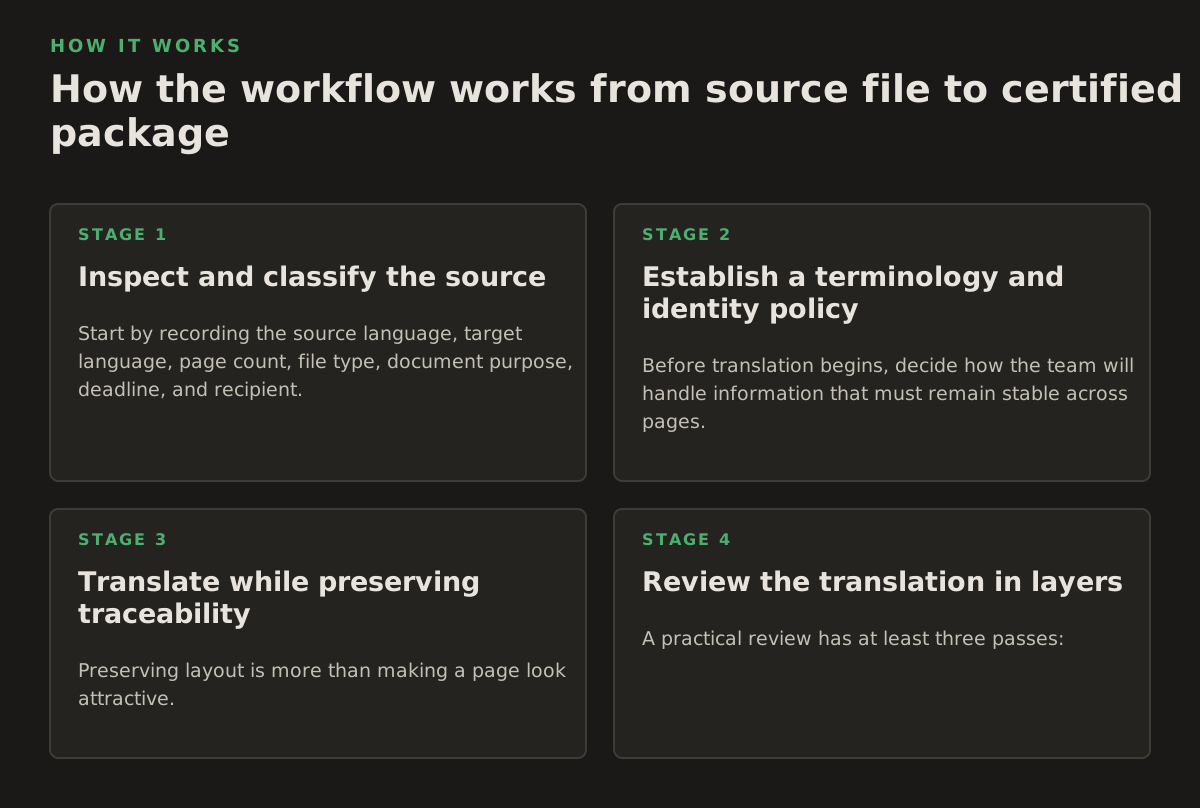
The workflow should be designed around the document’s risk, not around the convenience of the translation tool. A clean DOCX contract, a photographed birth certificate, and a scanned 180-page medical record require different controls.
1. Inspect and classify the source
Start by recording the source language, target language, page count, file type, document purpose, deadline, and recipient. Then inspect whether the file contains selectable text or only images. A searchable PDF and a scanned PDF may look identical on screen, but their processing paths differ.
For a text-based file, preserve paragraph structure, tables, footnotes, headers, and page references. For a scan, optical character recognition can create a working text layer, but the OCR output must be checked against the image. This is where a platform such as InOtherWord.AI can help teams translate PDF documents, while scanned files may require a dedicated translate scanned PDFs workflow before human review.
OCR is an extraction step, not a certification step. It can misread “1” as “I,” confuse accented characters, omit faint stamps, or merge two columns. Treat OCR text as a draft representation of the page until a reviewer verifies it visually.
2. Establish a terminology and identity policy
Before translation begins, decide how the team will handle information that must remain stable across pages. Create a short instruction sheet covering:
- Personal names and whether to preserve the original spelling, transliterate it, or show both forms.
- Dates, currencies, decimal separators, units, and numbering conventions.
- Organization names, addresses, legal entity suffixes, and government offices.
- Defined terms in contracts and recurring medical, scientific, or technical vocabulary.
- Handwritten notes, seals, stamps, signatures, checkboxes, and blank fields.
Do not silently “correct” a source document. If a passport number appears inconsistent with a later page, reproduce it accurately and flag the discrepancy for the responsible professional. Translators may clarify through a note, but they should not act as the lawyer, registrar, physician, or records custodian.
3. Translate while preserving traceability
Preserving layout is more than making a page look attractive. It gives the reviewer a way to map the translated sentence to the source and helps prevent missing content. Keep exhibit labels, article numbers, table rows, footnote markers, and page references aligned where practical.
For a PowerPoint presentation, layout preservation may require checking text overflow, chart labels, speaker notes, and embedded images. For an EPUB, reflow can change page boundaries, so citations based on page numbers may need a different reference method. For a PDF with complex tables, a visually faithful output still needs a content comparison because a misplaced cell can alter meaning.
Traceability beats cosmetic similarity. If the target language expands a paragraph and pushes a signature block onto another page, that is usually preferable to shrinking the text until it is unreadable. The final reviewer should be able to answer: which source page did this target page represent, and where did every material number and label go?
4. Review the translation in layers
A practical review has at least three passes:
- Completeness pass: compare page count, headings, tables, stamps, handwritten content, captions, footnotes, and annexes.
- Meaning pass: review terminology, syntax, ambiguity, negation, modality, and domain-specific usage.
- Production pass: inspect pagination, clipping, font substitution, signatures, certificate placement, and file naming.
For high-consequence material, use a second qualified reviewer or ask the instructing lawyer, registrar, researcher, or clinician to resolve source ambiguities. The second reviewer does not have to rewrite every sentence. Their role can be targeted: verify names and numbers, compare legal terms, inspect tables, and approve unresolved queries.
5. Add certification only after finalization
The certificate should correspond to the exact delivered translation. If the team changes one date, adds a missing page, or replaces a paragraph after signing, the certification should be reviewed and reissued as needed. Maintain a version identifier in the internal record, even if the external recipient does not require one.
A simple internal register can record:
- Source filename and source version.
- Target filename and target version.
- Language pair and page count.
- Translator and reviewer names.
- Certification date and signature status.
- Recipient instructions checked and unresolved questions.
This register is especially useful when a legal matter contains several amended contracts or when a government department translates the same form for multiple offices. It prevents a valid certificate from being attached to the wrong revision.
Where certified translations break down
The most common failures occur at the boundaries between language work, document engineering, and institutional procedure. A team can select a competent translator and still deliver an unusable package.
Scanned pages, handwriting, and visual evidence
Scans introduce uncertainty before translation starts. A seal may cover a line of text. A handwritten correction may have legal significance. A two-column newspaper clipping may be read in the wrong order. A low-resolution image may make a critical digit impossible to identify.
Use an explicit notation policy for uncertain content. Examples include “[illegible],” “[stamp: …],” or “[handwritten note: …]” when appropriate. Never invent a likely reading to make the translation look complete. Ask the document owner for a clearer scan or an authoritative transcription.
Unreadable source text is a source defect, not a translation opportunity. If the recipient requires every visible element translated, the translator must know whether the notation itself is acceptable and whether a replacement scan is necessary.
Names, numbers, and culturally specific references
Names may have multiple legitimate spellings across passports, academic records, and local-language documents. Dates can be ambiguous when the source uses day-month-year notation. Decimal commas, currency symbols, and units can change interpretation. A translator who silently normalizes these details may produce a polished but incorrect record.
For a financial statement showing “1.250,50,” the team should establish whether that means one thousand two hundred fifty and 50/100 in the source convention, rather than copying the punctuation into an English-language context without explanation. This is an illustrative quality-control example, not a universal formatting rule; the recipient’s instructions and the source jurisdiction control.
Legal effect and jurisdictional mismatch
A certified translation does not make a private contract enforceable, authenticate a birth certificate, or establish that a public official actually issued a document. Those are separate legal questions. The U.S. Department of State explains the distinction among document authentication, apostilles, and use of documents abroad in its official authentication guidance. Check the destination country, issuing authority, and receiving institution before ordering an apostille or consular legalization.
Similarly, a receiving authority may require a translator who belongs to a particular professional body, appears on an approved list, or is located in a specified jurisdiction. The existence of a signed certificate does not prove that it meets those local rules.
Machine translation and confidentiality decisions
AI translation can accelerate first-pass work, terminology discovery, and internal understanding. It can also produce confident errors, mishandle context, or expose sensitive content if the organization has not approved the processing environment. A document containing protected health information, privileged legal advice, trade secrets, or personal identifiers deserves a documented data-handling decision before upload.
Do not represent an AI-generated output as certified merely because it has been exported to PDF. If certification is required, a qualified human must perform whatever review and attestation the recipient expects. A sensible division of labor may be:
- AI-assisted extraction or draft translation for low-risk, high-volume material.
- Human terminology and meaning review for important documents.
- Specialist review for legal, medical, financial, or scientific content.
- Human certification only after the final text and formatting are approved.
The more a document will determine someone’s legal status, access to care, academic eligibility, or financial obligation, the less acceptable it is to rely on fluency as the only quality signal.
How practitioners should apply the process
The best workflow begins with a decision, not an upload: is this document for understanding, internal circulation, negotiation, publication, or formal submission? Those purposes can require different translation products even when the source file is identical.
Use a risk-and-recipient matrix
| Use case | Primary risk | Recommended control | Certification question |
|---|---|---|---|
| Immigration or government filing | Rejection for procedural noncompliance | Follow the named agency’s current instructions; verify completeness and identity data | Does the agency specify who may certify and whether notarization is needed? |
| Court exhibit or contract | Ambiguous legal meaning or missing evidence | Legal terminology review, source-to-target comparison, exhibit control | Does the court or opposing counsel require a particular declaration or format? |
| Academic transcript or research record | Institutional rejection or distorted technical meaning | Registrar instructions, specialist terminology review, preserved tables and grades | Is certification sufficient, or is an approved evaluation service also required? |
| Healthcare record | Patient-safety or privacy consequences | Qualified bilingual review, clear uncertainty markers, controlled access | Who is authorized to attest, and what privacy process applies? |
| Internal business report | Wrong decisions caused by numbers or terminology errors | Glossary, data validation, visual review, stakeholder sign-off | Is formal certification necessary, or is an approved internal translation record enough? |
Worked example: a 22-page court submission
Imagine a legal team has a 22-page Spanish-language filing with four exhibits, two tables, handwritten marginal notes, and a signature page. The team’s job is not complete when an English PDF looks readable. A defensible sequence would be:
- Confirm with the court or filing attorney whether a certified translation, translator declaration, or other form is required.
- Separate the main filing, exhibits, and signature page in the source inventory.
- Run OCR only as an extraction aid, then inspect every page image.
- Build a terminology sheet for party names, defined terms, statutes, and exhibit labels.
- Translate the text and mark illegible handwriting rather than guessing.
- Compare all dates, monetary amounts, article numbers, and exhibit references against the source.
- Ask counsel to resolve any ambiguity that could affect the legal position.
- Perform a layout review and confirm that the certificate identifies the final version.
- Deliver the translation, certificate, and any requested source copy in the court’s required arrangement.
The numbers in this example are illustrative workflow inputs, not a recommended universal threshold. A two-page immigration document can be higher risk than a 200-page internal manual if the short document determines eligibility. Risk follows consequence, not page count.
Worked example: a university transcript and diploma
For a transcript, preserve course titles, credit values, grades, dates, seals, and institutional notes. Do not convert a grading scale into an equivalent GPA unless the receiving institution asks for that service and the methodology is authorized. A translator can render the text; an evaluator or admissions office may be responsible for interpreting academic equivalence.
Ask the university:
- Whether it accepts a translator’s certification or requires a designated service.
- Whether the document must arrive directly from the school, translator, or applicant.
- Whether the diploma and transcript need separate translations.
- Whether an unofficial translation may be used for initial review.
- How names should match the application and identity documents.
That conversation prevents a common waste: commissioning a beautifully formatted certificate that cannot satisfy the institution’s submission channel.
Worked example: an internal multilingual report
A business team translating a quarterly report for internal decision-making may not need formal certification. It may need something more operationally useful: a controlled glossary, consistent product names, preserved tables, and a reviewer sign-off on revenue figures and risk language.
In this setting, requiring certification can add administrative work without improving the decision. The team should reserve certified workflows for recipients or policies that actually call for them, while still using document-level quality controls for figures, charts, footnotes, and executive summaries.
A practical intake checklist
Before sending a file to a translator or platform, capture the following in writing:
- Source and target language, including regional variant where relevant.
- Purpose: submission, publication, internal review, negotiation, or recordkeeping.
- Recipient and a link or copy of the recipient’s instructions.
- Required certification wording, signature, notarization, or authentication.
- Required output format and whether layout must mirror the source.
- Names, terminology, units, and formatting that must remain unchanged.
- Known unreadable areas, missing pages, stamps, handwriting, or attachments.
- Deadline, reviewer, and approval owner.
Keep the instruction sheet with the project record. If the recipient changes its requirements, preserve the date of the instruction you relied on and update the delivery plan rather than quietly reusing an old certificate.
Make the recommendation specific: certify only what the recipient requires
For legal, government, healthcare, and academic submissions in 2026, the safest policy is to verify the recipient’s rule before translation, use OCR and AI only within an approved review process, and obtain human certification after the final document is checked. Do not assume that notarization, an agency membership, an apostille, or a vendor label automatically satisfies the receiving authority.
For internal reports, research reading, course materials, and business drafts, use a proportionate workflow: preserve structure, validate critical data, record the reviewer, and add formal certification only when a recipient or governance policy calls for it. This avoids both under-reviewing consequential files and over-processing documents that only need reliable understanding.
InOtherWord.AI supports translation of PDFs, scanned PDFs, DOCX files, PowerPoint presentations, and EPUB books while preserving formatting, layout, tables, and images. Use it to prepare and manage the translated document, then follow the recipient’s rules for any required human review or certification; InOtherWord.AI can point your team to the platform for that document workflow.
Authored with NotFair SEO
Related guides
Keep researching the right workflow
These pages help move from general document-translation research into the specific file format or workflow you need.
A practical workflow for translating scanned PDFs with OCR while preserving enough structure for real review, sharing, and downstream editing.
Explore pageHow to translate PPT and PPTX decks without breaking slide layouts, charts, and speaker-ready formatting.
Explore pageThe best AI PDF translator is not just about language quality. It also needs OCR, layout preservation, and reviewable output for real files.
Explore pageCommercial pages
Ready to translate the actual file?
Jump from the guide into the product page that fits your document type, then continue into pricing when you are ready.
Format page
Translate PDF Documents
Translate PDF files while preserving layout, tables, and page structure.
Explore pageFormat page
Translate Scanned PDFs
OCR and translate scanned PDFs without rebuilding the layout by hand.
Explore pageFormat page
Translate PowerPoint Presentations
Translate PPT and PPTX decks while preserving slide layouts, tables, and speaker-ready formatting.
Explore pageTranslate layout-heavy PDF reports, manuals, forms, and client-ready files while keeping tables, headings, and images readable.
Explore page