Chinese Document Translation Services: A Practical Buyer’s and Implementation Guide
Published Sun Aug 23 2026 | 17 min read
Compare Chinese document translation services for legal, research, business, and publishing work, with selection criteria, workflows, risks, and vendor question
Choosing Chinese document translation services is not simply a matter of selecting Chinese as the target language. A legal team needs an auditable contract workflow; a university needs terminology consistency and readable citations; a publisher needs pages, tables, and illustrations to survive conversion. This guide helps you decide which service category fits the document, how much human review the job requires, and what evidence to request before sending sensitive files to a provider.
The central decision is whether your priority is speed, visual fidelity, subject-matter precision, formal certification, or some combination. A short internal memo may be suitable for automated translation with a quick review. A scanned court filing, clinical report, or bilingual agreement may require OCR validation, specialist editing, and a controlled release process. Treat the work as a document-production project, not as a text box with a language selector.
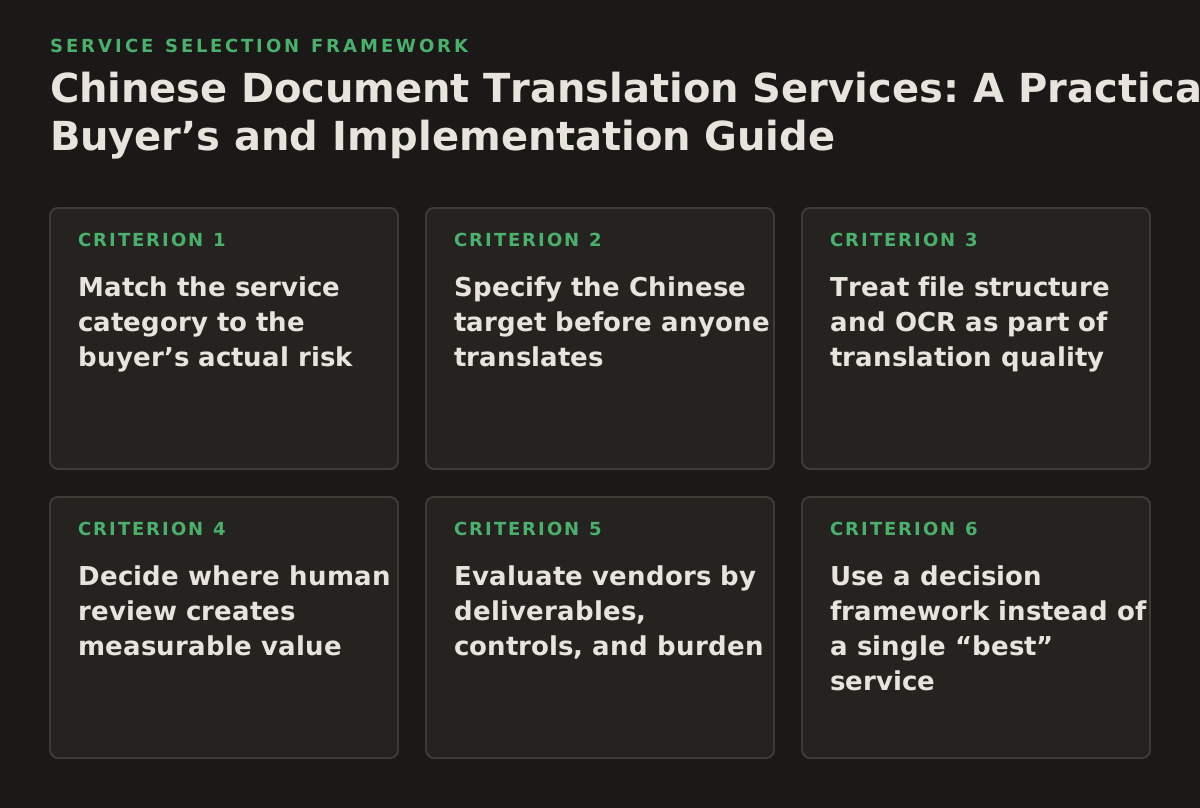
1. Match the service category to the buyer’s actual risk
“Chinese translation” can describe several different services. Before requesting quotes, identify the document’s source language, target variety, file type, audience, and consequence of an error. Simplified Chinese and Traditional Chinese are not interchangeable production targets, and a mainland Chinese business document may require different terminology and formatting conventions from a document intended for Taiwan, Hong Kong, or another audience.
The main service categories
- Automated text translation suits low-risk drafts, internal reading, triage, and large volumes where the first question is “What does this say?” It has the lowest coordination burden, but it may not preserve document structure or resolve ambiguous terminology without additional controls.
- AI document translation with layout handling suits PDFs, DOCX files, presentations, and ebooks where the output must remain usable as a document. The buyer should confirm whether tables, images, headings, footnotes, and page structure are retained rather than assuming that text translation guarantees visual fidelity.
- OCR plus translation serves scanned PDFs, photographed pages, faxes, and image-only records. It adds an extraction and quality-control stage. You can translate scanned PDFs when the source has no selectable text, but still plan to inspect recognition of names, seals, handwritten notes, and low-contrast characters.
- Machine translation with human post-editing fits recurring reports, academic material, operating procedures, and business documents that need a reliable reading copy without the full burden of line-by-line literary adaptation.
- Specialist human translation is appropriate for contracts, patents, regulatory submissions, medical content, public notices, and documents in which wording has legal or safety consequences. Subject expertise matters as much as fluency.
- Certified or formally attested translation serves a receiving authority that explicitly requires certification, a translator declaration, notarization, or another prescribed form. The authority’s rules determine what is acceptable; an attractive bilingual PDF is not automatically a certified submission.
Failure mode: a buyer requests “Chinese translation” for a 180-page scanned litigation bundle and compares providers only on per-word price. The winning quote may exclude OCR correction, page reconstruction, exhibits, stamps, tables, and final legal review. The apparent saving disappears when the team has to recreate the filing manually.
Implementation example: a university research office receives a searchable DOCX survey report for internal planning. It selects AI document translation, supplies a glossary for institutional names, and asks a bilingual researcher to review the executive summary and methodology. For a later grant submission, it routes the final version to a specialist translator and checks the funder’s submission rules separately.
2. Specify the Chinese target before anyone translates
Language selection should be a written project requirement, not a late-stage correction. At minimum, record script, regional audience, source language, and readership. “Chinese” may mean Simplified Chinese, Traditional Chinese, or a regional editorial target. A translation can use technically understandable characters while still sounding wrong for the intended institution, market, or authority.
Terminology also needs an owner. Legal teams should identify defined terms, party names, governing-law references, and phrases that must remain consistent. Researchers should list discipline-specific terms, names of instruments, units, and established translations of theories. Healthcare teams should provide approved names for drugs, conditions, departments, and patient instructions. Publishers should decide how titles, captions, bibliographies, and quoted passages are handled.
A practical language brief
- Source language and any mixed-language passages.
- Target script and intended region or institution.
- Audience: internal staff, court, regulator, patient, student, customer, or general reader.
- Required treatment of names, dates, currencies, measurements, addresses, and identifiers.
- Terms that must remain in the original language, such as product codes or statutory citations.
- Reference files: prior translations, approved glossaries, style guides, and bilingual templates.
- Reviewers who can approve terminology and who can approve final visual presentation.
Internationalization standards reinforce why this detail matters. The W3C Internationalization Tag Set describes mechanisms for identifying language-related information and annotating translatable content, which is useful when a document contains quotations, names, or passages that should not be treated like ordinary prose (W3C Internationalization Tag Set). Unicode’s Common Locale Data Repository also documents locale-sensitive conventions such as date, number, and currency formatting; these are not safe to “fix” by intuition after translation (Unicode Technical Standard #35).
Failure mode: a sales team asks for Traditional Chinese, but the source contains a product catalog used in several markets. The supplier converts characters without resolving terminology, address formats, or customer-support language. The result is legible but not publication-ready.
Implementation example: a healthcare organization creates a one-page language brief that states “Traditional Chinese for Hong Kong readers,” preserves drug brand names exactly as supplied, requires metric units, and flags emergency instructions for clinical review. The brief travels with every file in the project folder.
3. Treat file structure and OCR as part of translation quality
Documents carry meaning through more than sentences. A table column may define a relationship; a footnote may limit a claim; a slide’s position may connect a label to a diagram. For that reason, layout preservation is a quality requirement, not a cosmetic preference. Ask whether the provider works from the original DOCX or PPTX when available, whether PDFs are text-based or scanned, and how it handles embedded images and text boxes.
For a normal digital PDF, you can translate PDF documents while retaining a working document format, but inspect the output rather than trusting the page count. Chinese text can change line breaks, table heights, caption positions, and slide overflow. In a presentation, a single expanded bullet can push a legal disclaimer off the slide. In an ebook, a fixed-page design and a reflowable EPUB require different checks.
Use a file triage checklist
- Open the source and attempt to select, search, and copy text.
- Classify pages as searchable, image-only, mixed, or damaged.
- Inventory tables, forms, footnotes, headers, stamps, signatures, diagrams, and handwritten annotations.
- Identify fonts, text embedded in images, and unusual character encoding.
- Run a small representative sample through the proposed workflow.
- Compare source and output page by page, including blank fields and visual hierarchy.
OCR is an inference step, so it deserves its own acceptance criteria. A recognition error in a person’s name, dosage, case number, decimal point, or negative sign can be more serious than an awkward sentence. Adobe’s overview of optical character recognition explains that OCR converts image-based text into editable or searchable text, which is precisely why the extracted layer must be checked before translation (Adobe: What is OCR?).
Failure mode: a court bundle contains faint scans and red stamps over dates. The translation team sends OCR output directly into machine translation. The final document reads smoothly but contains a wrong exhibit number and an incorrect date.
Implementation example: a legal operations manager samples the first, middle, and worst-quality pages. A reviewer marks every uncertain OCR token, compares names against the case index, and separately checks all dates, monetary figures, reference numbers, and negations before translation begins.
4. Decide where human review creates measurable value
Human review should be assigned according to risk, not distributed vaguely across the whole file. A useful model separates meaning review, terminology review, and document review. A bilingual subject expert checks whether the content says the right thing. A terminology owner checks consistency. A production reviewer checks whether the translated file still works as a document.
Not every page needs the same intensity. An internal meeting agenda may receive spot review. A contract’s definitions, indemnity, termination, governing law, and signature blocks deserve full review. A research paper may need close attention in the abstract, methods, tables, and statistical conclusions. A patient-facing instruction sheet should receive safety-focused review even if the rest of the document is routine.
Build a risk-weighted review plan
- Critical content: names, numbers, dosage, legal obligations, warnings, permissions, dates, and conditions. Review every instance.
- High-visibility content: title, abstract, executive summary, public notice, slide headlines, and customer instructions. Review by a qualified editor.
- Repetitive content: recurring labels, boilerplate, and standard operating steps. Use a glossary and sample-based checks, then investigate inconsistencies.
- Low-consequence content: internal background text or archival material. Set a lower review level only if the owner accepts the limitation in writing.
For formal translation work, ask what quality process the provider follows and what the deliverable includes. ISO 17100 is a standard for translation services that addresses processes and competence requirements; its existence does not certify every supplier, but it gives buyers useful language for asking about roles, revision, and project handling (ISO 17100:2015).
Failure mode: a business approves a translation because the first page sounds natural. The document’s product names drift across sections, and a “may” becomes a stronger obligation in a procurement clause. Surface fluency concealed inconsistent decisions.
Implementation example: a research group assigns one subject expert to review the abstract, key findings, tables, and conclusion; a bilingual editor checks terminology throughout; and a production reviewer checks headings, references, and page breaks. Each reviewer signs off on a separate checklist.
5. Evaluate vendors by deliverables, controls, and burden
A credible evaluation asks what the supplier will do with your files, what it will return, and what your team must do between those steps. Delivery burden is part of the price. A low quote that returns plain text may require hours of reconstruction, while a higher-cost workflow may return an editable, visually checked document that fits the team’s process.
Questions about capability
- Which file types are accepted: searchable PDF, scanned PDF, DOCX, PPTX, and EPUB?
- How are tables, footnotes, forms, diagrams, text in images, and handwritten marks treated?
- Can the project specify Simplified or Traditional Chinese and a regional editorial target?
- Can the buyer provide a glossary, translation memory, reference translation, or style guide?
- What is included in review: automated checks, bilingual editing, subject review, and visual inspection?
- What files are returned: PDF, editable DOCX, PPTX, EPUB, bilingual version, terminology list, or change log?
- How are uncertain source passages and untranslatable elements flagged?
Questions about data and operations
Do not infer security or retention practices from a polished interface. Ask where files are processed, how long they are retained, whether they are used to improve models, who can access them, how deletion is requested, and whether subcontractors are involved. For sensitive legal, government, and healthcare material, ask your security or procurement team to review the answers.
NIST’s guidance on key management illustrates the broader principle: protection depends on how cryptographic keys are managed, not merely on the word “encrypted” in marketing material (NIST SP 800-57 Part 1 Revision 5). You do not need to turn every translation request into a security audit, but you should demand specific answers for confidential records.
Pricing and budget questions
Translation pricing may be based on source words, pages, characters, files, review level, or a project minimum. Some providers separate OCR, formatting, certification, rush handling, and specialist review. Request an itemized quote that distinguishes translation from production and review. Do not compare a per-word number with an all-inclusive document-production quote as though they describe the same work.
Use an illustrative starting policy rather than a universal benchmark: require a fixed quote for the pilot file, a stated method for counting source content, and written approval before any scope change. Ask whether revisions caused by supplier error are included, what happens when a scan is unreadable, and whether the final file is editable. Also budget internal time for terminology decisions, sample review, and acceptance testing.
Failure mode: a publisher accepts a “per page” quote without defining a page. The supplier counts only visible text, while the publisher assumes captions, cover matter, tables, and image text are included. Both parties discover the mismatch after delivery.
Implementation example: a government procurement team sends the same representative sample to three vendors and requests identical line items: OCR, translation, human review, layout recreation, certification if required, file return formats, retention period, and revision policy. It scores operational clarity as well as language quality.
6. Use a decision framework instead of a single “best” service
The right workflow changes with the document’s purpose. Use the table below as a screening tool, then validate the choice with a sample. No service category wins every trade-off; the objective is to make the compromise explicit before the file enters production.
| Buyer need | Best-fit service type | Primary trade-off | Acceptance evidence to request |
|---|---|---|---|
| Fast internal understanding of a clean DOCX or searchable PDF | Automated document translation | Lower coordination burden, but terminology and nuance need review | Sample output, supported file types, editable return file, glossary handling |
| Usable translated PDF with tables, headings, and images | AI document translation with layout processing | Better production workflow, but visual fidelity must be verified page by page | Before-and-after sample showing tables, captions, footnotes, and long Chinese lines |
| Image-only, faxed, or photographed records | OCR plus translation and OCR validation | Additional extraction time and risk around names, numbers, and marks | OCR confidence or exception process, corrected sample, treatment of stamps and handwriting |
| Recurring business or academic material with approved terminology | Machine translation plus bilingual post-editing | More consistency and speed than ad hoc translation, but requires a glossary owner | Terminology test, revision workflow, consistency report, reviewer qualifications |
| Contract, court, regulatory, medical, or safety-critical document | Specialist human translation with independent review | Higher delivery burden, but stronger control over meaning and accountability | Named subject reviewer, issue log, revision scope, complete final-document review |
| Submission to an authority requiring a formal declaration | Qualified translation meeting that authority’s stated rules | Administrative requirements may limit automation or file flexibility | Written confirmation of certification, signature, seal, format, and delivery requirements |
| Book or digital publication | Editorial translation plus composition or EPUB production | Highest coordination across language, style, rights, and design | Style sheet, sample chapter, front/back matter treatment, EPUB validation or print proof |
For EPUB projects, ask whether the supplier validates the resulting package rather than merely placing translated text into a container. The W3C EPUB 3.3 specification describes EPUB as a distribution format with content documents, package information, and a publication structure, so a book workflow has technical requirements beyond sentence translation (W3C EPUB 3.3).
Define success in observable terms. Examples include: all critical names and numbers match the source; every required page is present; no table cell is clipped; headings follow the approved glossary; the target script matches the brief; reviewers can trace disputed changes; and the final file opens in the receiving organization’s software. These are measurable acceptance criteria even when no universal translation score exists.
7. Pilot, inspect, and release in controlled stages
A pilot is not a free sample chosen because it is easy. Select pages that expose the workflow’s weaknesses: a dense table, a footnote-heavy page, a scanned page with a stamp, a slide with a diagram, or a chapter with repeated terminology. Include one difficult passage and one ordinary passage. The purpose is to discover failure modes before the entire document is committed.
A staged execution workflow
- Intake: preserve the original files, record versions, classify pages, and confirm the target Chinese variety.
- Preparation: remove irrelevant duplicates, supply reference material, identify sensitive content, and create the terminology brief.
- Pilot: translate representative pages, inspect OCR, review terminology, and test the returned file in the real downstream workflow.
- Production: lock the source version, approve the glossary, and document who may authorize changes.
- Review: conduct bilingual review for meaning and terminology, then visual review for layout, figures, tables, and pagination.
- Acceptance: run a defect checklist, resolve critical issues, and record accepted limitations.
- Release: archive the source, final output, glossary, review notes, and approval record according to organizational policy.
For scanned documents, separate extraction defects from translation defects. First compare the OCR text with the image. Then compare the Chinese output with the corrected source text. This two-pass method prevents reviewers from blaming the translator for a recognition error or overlooking an error because the translated sentence sounds plausible.
Failure mode: a team reviews only the final PDF on screen and misses that text is no longer searchable, hyperlinks have broken, and a signature block has shifted to a new page. The language is acceptable, but the file fails its operational purpose.
Implementation example: a legal department defines a release gate requiring searchable output where appropriate, intact exhibit labels, no clipped text, verified names and dates, and approval from both a legal reviewer and a document owner. A file that fails any critical gate returns to production rather than being quietly patched by the requester.
8. Make the vendor interview falsifiable
General assurances are difficult to compare. Ask for demonstrations and written answers tied to your files. A vendor should be able to explain not only what it supports, but also what happens when a file falls outside the normal path.
Vendor interview checklist
- Show how you would handle one searchable page, one scanned page, one table, and one page with text inside an image.
- Which Chinese script and regional conventions would you use for this audience, and where is that recorded?
- How do you flag uncertain OCR or ambiguous source wording?
- Who reviews legal, academic, medical, or technical terminology?
- Can we supply a glossary and require exact treatment of protected terms?
- What file formats do you return, and can we edit the translated document?
- What are the review stages, and which defects are covered by included revisions?
- How do you handle names, numbers, units, citations, cross-references, and tracked changes?
- What data is retained, for how long, for what purpose, and by whom?
- What is the pricing unit, what is excluded, and how are unreadable scans or scope changes charged?
- Can you provide a sample issue log and acceptance checklist with sensitive content removed?
- What evidence will we receive at handoff: glossary, bilingual file, final file, review record, or certification paperwork?
Red flags include a provider that cannot state whether it supports your actual file type; treats OCR as invisible magic; promises perfect preservation without asking for a sample; refuses to explain data retention; cannot distinguish Simplified from Traditional Chinese requirements; or gives a price without defining review, formatting, and revision scope. Another warning sign is an answer that relies on “native speaker” alone for a contract, clinical instruction, or specialist publication.
Use a simple scorecard with weighted categories chosen for the job: language and subject competence, file handling, review controls, privacy, delivery burden, price clarity, and evidence from the pilot. The weights are an internal policy decision, not an industry benchmark. For a court document, critical accuracy and traceability may outweigh turnaround convenience. For an internal report, editable output and speed may carry more weight.
Sequence the implementation plan around risk
For most business, legal, research, publishing, government, and healthcare teams, the safest recommendation is a risk-weighted hybrid workflow: automate or use AI where it reduces repetitive production work, add OCR validation for image-based pages, and reserve qualified human review for terminology, critical meaning, and final acceptance. This is more defensible than either sending every file blindly to automation or treating every low-risk memo like a court filing.
- Classify the document: record its purpose, audience, confidentiality, source format, page condition, and consequence of an error.
- Confirm the target: specify Simplified or Traditional Chinese, regional audience, formatting conventions, and terminology ownership.
- Build the brief: attach glossaries, prior translations, reference files, protected terms, and reviewer names.
- Select the service category: choose automated, layout-preserving AI, OCR, post-edited, specialist, or formally certified work according to the decision table.
- Run a representative pilot: include difficult pages and test the returned file in the software and submission process that will actually be used.
- Set acceptance gates: define checks for critical terms, names, numbers, layout, searchability, links, citations, and required certification.
- Produce and review: keep OCR validation, bilingual review, terminology approval, and visual inspection as distinct responsibilities where risk justifies it.
- Release and learn: archive the final package and update the glossary or checklist with defects discovered during the project.
InOtherWord.AI is an option for translating PDFs, scanned PDFs, DOCX files, PowerPoint presentations, and EPUB books while preserving document structure such as formatting, layout, tables, and images; start with a representative sample and apply the review gates above through InOtherWord.AI.
Authored with NotFair SEO
Related guides
Keep researching the right workflow
These pages help move from general document-translation research into the specific file format or workflow you need.
A practical workflow for translating scanned PDFs with OCR while preserving enough structure for real review, sharing, and downstream editing.
Explore pageHow to translate PPT and PPTX decks without breaking slide layouts, charts, and speaker-ready formatting.
Explore pageThe best AI PDF translator is not just about language quality. It also needs OCR, layout preservation, and reviewable output for real files.
Explore pageCommercial pages
Ready to translate the actual file?
Jump from the guide into the product page that fits your document type, then continue into pricing when you are ready.
Format page
Translate PDF Documents
Translate PDF files while preserving layout, tables, and page structure.
Explore pageFormat page
Translate Scanned PDFs
OCR and translate scanned PDFs without rebuilding the layout by hand.
Explore pageFormat page
Translate PowerPoint Presentations
Translate PPT and PPTX decks while preserving slide layouts, tables, and speaker-ready formatting.
Explore pageTranslate layout-heavy PDF reports, manuals, forms, and client-ready files while keeping tables, headings, and images readable.
Explore page