Translation And Literature: A Practical Guide to Meaning, Format, and Document Workflows
Published Sat Aug 29 2026 | 17 min read
Translation and literature meet where meaning, voice, copyright, OCR, and document design matter. Learn how to translate books and complex files reliably.
Translation and literature meet at a difficult boundary: a literary work must carry meaning across languages without flattening the voice, cultural context, rhythm, or structure that make it literature. That problem also appears in practical document work. A university may need to translate a journal issue without damaging its citations; a publisher may need an EPUB with working navigation; a legal team may need a faithful translation of a witness statement whose emotional tone matters as much as its factual content. The right workflow treats translation as both interpretive work and document production.
What Translation And Literature actually involve
Literary translation is not simply the replacement of words in one language with words in another. It is the recreation of a work for readers who do not share the original language. The translator must make decisions about semantic meaning, voice, register, imagery, cultural references, pacing, and sometimes typography. The result should be readable in the target language while remaining answerable to the source.
That last qualification matters. A contract, clinical report, or court filing usually prioritizes controlled equivalence: the target text should preserve defined obligations, facts, and qualifications. A novel or poem has a wider field of acceptable solutions, but it is not unconstrained. A translator cannot freely improve the plot, remove ambiguity, or make every cultural reference familiar without changing the work.
The phrase translation and literature therefore describes two connected activities:
- Literary transfer: recreating a story, poem, essay, memoir, or dramatic work for a new linguistic audience.
- Critical interpretation: deciding what an image, idiom, silence, joke, social register, or narrative voice is doing before choosing target-language wording.
- Document preservation: keeping headings, footnotes, page relationships, tables, illustrations, captions, and navigation usable after translation.
- Publication preparation: producing a clean manuscript, PDF, DOCX, presentation, or EPUB that can be reviewed, edited, distributed, or archived.
Meaning is layered, not singular
Consider a fictional line such as “She kept the door on the latch.” The literal action may be clear, but the sentence can also suggest suspicion, hospitality, poverty, danger, or a period-specific domestic practice. A translator first identifies the likely functions of the phrase, then considers what the target audience can infer. A literal equivalent may preserve the image but lose its social implication. An explanatory paraphrase may clarify the implication but weaken the prose.
A useful working model separates at least five layers:
- Denotation: what the words refer to.
- Connotation: the emotional, social, or historical associations they carry.
- Voice: who appears to be speaking and how that person sounds.
- Form: line breaks, repetition, rhythm, dialogue, page structure, and genre conventions.
- Function: what the passage causes the reader to understand, expect, feel, or question.
These layers explain why a fluent sentence can still be a poor translation. It may communicate the denotation while losing the narrator’s age, a character’s social status, an intentional ambiguity, or a recurring image that later becomes structurally important.
Literary status does not remove operational requirements
A publisher still needs consistent chapter titles. A researcher still needs page references to remain traceable. An educator may need translated course material to retain exercise numbering. A religious institution may need quotations, footnotes, and liturgical formatting preserved. A government archive may need a scanned historical text to become searchable without silently “correcting” its spelling.
This is why literary translation often benefits from the same discipline used in professional document translation: define the deliverable, establish terminology, preserve structure, review the output, and record decisions that another editor can audit.
Why the distinction matters to professional teams
The cost of a translation error is not limited to an awkward sentence. In literature, a repeated mistranslation can alter characterization or undermine a symbol. In law, a small modal verb can affect an obligation. In research, a damaged citation can make a claim difficult to verify. In healthcare, an omitted qualifier can change how a reader interprets risk.
Meaning risk and production risk are separate. Meaning risk concerns whether the target text says the right thing in the right voice. Production risk concerns whether readers can find, read, quote, search, and navigate that text. A workflow that controls only one of these risks is incomplete.
Voice is a controlled variable
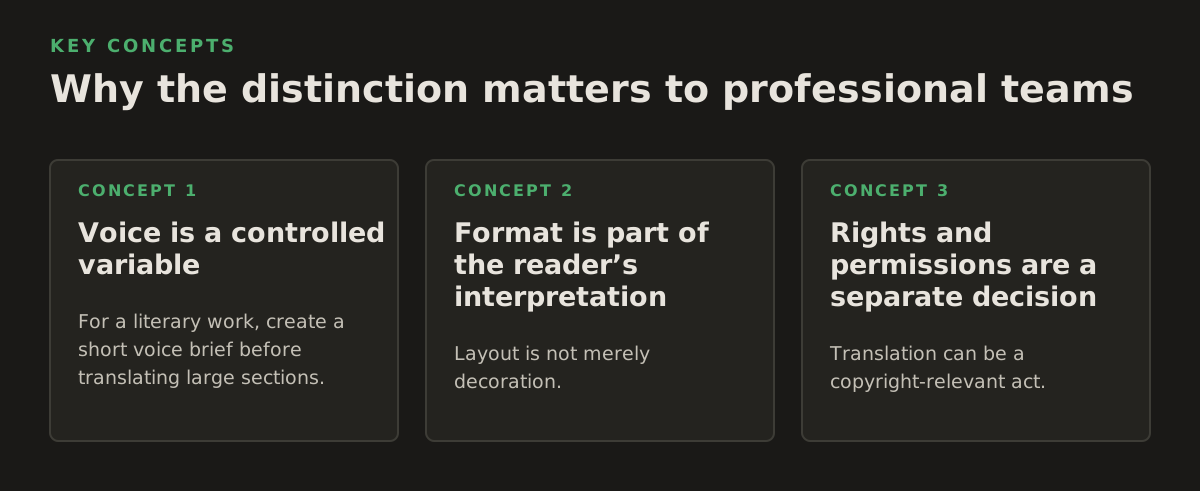
For a literary work, create a short voice brief before translating large sections. It should describe the narrator and major characters in operational terms rather than vague adjectives. “Elegant” is difficult to apply consistently; “formal syntax, restrained emotional vocabulary, occasional archaic legal terms” is more useful.
A voice brief can record:
- the narrator’s apparent age, education, and social position;
- the level of formality in narration and dialogue;
- whether contractions, slang, dialect, or archaic vocabulary are intentional;
- how humor, irony, profanity, and euphemism should be handled;
- recurring images and terms that must remain recognizable;
- which ambiguities must be preserved rather than explained.
For a legal or institutional document, the equivalent may be a terminology sheet and a style guide. It can specify how defined terms, organization names, dates, article numbers, medical expressions, or official titles should appear. The principle is the same: make high-impact decisions explicit before they are repeated hundreds of times.
Format is part of the reader’s interpretation
Layout is not merely decoration. A poem’s lineation can affect emphasis and pause. A play’s speaker labels distinguish voices. A scholarly book’s footnotes separate evidence from argument. A report’s table can show relationships that disappear when its cells are converted into paragraphs.
When a translated sentence expands by 20 or 30 percent, the consequences may include:
- a poem wrapping onto an unintended line;
- a heading pushing a paragraph onto the next page;
- a table cell becoming unreadably dense;
- a caption separating from its illustration;
- a footnote marker losing its position;
- an EPUB navigation entry becoming inconsistent with the visible chapter title.
The exact expansion varies by language, genre, typography, and source material, so a fixed percentage should not be treated as a universal planning rule. The practical recommendation is simpler: review layout after translation, not only before it.
Rights and permissions are a separate decision
Translation can be a copyright-relevant act. The World Intellectual Property Organization’s summary of the Berne Convention identifies translation among the rights generally reserved to the author or rightsholder, subject to the convention’s framework and national law. See the WIPO Berne Convention summary for the international overview. A team should therefore confirm permission, public-domain status, license terms, or an applicable exception before translating and distributing a literary work.
This is especially important when a translated file will be published, sold, placed in a course pack, submitted to a court, or distributed across jurisdictions. A translation workflow cannot grant rights that the organization does not possess.
How an AI document translation workflow works
AI can accelerate the first pass across substantial document collections, but the useful unit is not “a string of text.” It is a structured document with content, hierarchy, visual relationships, and metadata. A sound workflow separates extraction, translation, reconstruction, and review.
1. Identify the source and the intended deliverable
Start by classifying the input:
- Native PDF: text may be selectable, but fonts, columns, footnotes, and reading order still require inspection.
- Scanned PDF: pages are images and require OCR before text can be translated or searched.
- DOCX: paragraphs, styles, tables, headers, comments, and tracked changes may carry meaning.
- PowerPoint: text is distributed across text boxes, charts, speaker notes, and sometimes embedded images.
- EPUB: content is usually divided into XHTML documents with a package, navigation, stylesheets, and media.
Then define the output. “Translate the book” could mean a bilingual review draft, a clean target-language manuscript, a print-ready PDF, an accessible DOCX, or a validated EPUB. Each output requires different checks. If the source is a PDF and the goal is a searchable, editable translation, a workflow for translate PDF documents may be appropriate. If the pages are scans, translate scanned PDFs addresses the additional OCR stage.
2. Extract structure before translating
Extraction should capture more than visible words. It should identify headings, paragraphs, lists, tables, notes, captions, page headers, page footers, hyperlinks, and the order in which a reader is expected to encounter them.
For scanned material, OCR converts image regions into machine-readable text. Optical character recognition is probabilistic: it can confuse similar glyphs, merge columns, lose superscripts, or misread damaged type. Google’s official Cloud Vision documentation describes separate text-detection methods for ordinary text and dense document text, including document-oriented OCR behavior; the Google Cloud Vision OCR documentation is a useful technical reference for understanding that distinction.
Do not treat an OCR transcript as the source of truth without visual comparison. A scan may contain marginalia, stamps, faint punctuation, unusual ligatures, or multiple reading directions. For historical literature, preserve the original page image alongside the extracted text so an editor can resolve doubtful readings.
3. Translate with context and controls
AI translation works best when the system receives enough context to distinguish a title from a sentence, a character name from a common noun, or a recurring technical term from an ordinary word. Segmenting every page into isolated fragments can produce locally fluent but globally inconsistent results.
Useful controls include:
- a glossary for names, places, recurring terms, and institutional vocabulary;
- instructions on whether to preserve or adapt honorifics, titles, and forms of address;
- rules for numbers, dates, currencies, citations, and quotation marks;
- notes about dialect, historical period, genre, and intended audience;
- an exception list for terms that should remain in the source language;
- instructions to flag uncertainty rather than silently inventing missing text.
Context beats isolated fluency. A translation engine may produce an attractive sentence that conflicts with a term used 40 pages earlier. For long works, review a sample from the beginning, middle, and end before committing to a house style. The purpose is not to prove that every later segment is correct; it is to expose recurring decisions early enough to change them cheaply.
4. Reconstruct the document
After translation, the system must place the target text back into the intended structure. This can involve reflowing paragraphs, resizing text boxes, rebuilding tables, reconnecting footnotes, replacing text inside images where appropriate, and regenerating navigation.
EPUB output deserves special care. The W3C EPUB 3.3 specification describes EPUB as a package of web content with defined publication structure and navigation requirements. The official specification is available at W3C EPUB 3.3. In practice, a translated EPUB should be checked not only as a collection of pages but as a navigable publication: title metadata, reading order, table of contents, internal links, language declarations, and media references all matter.
For PDF and DOCX, reconstruction has different failure modes. A translated table may overflow, a text box may clip its final lines, or a footnote may be pushed into the body of the next page. In presentations, a translated heading may cover an image or become too small to read from a distance.
5. Review in two passes
The first pass should assess language and meaning. The second should assess the artifact. Mixing the two can cause reviewers to overlook visible defects because they are concentrating on prose.
A practical review sequence is:
- Source-to-target review: compare meaning, omissions, additions, names, numbers, negations, and ambiguous passages.
- Target-only review: read the translation as a reader in the target language, checking fluency, voice, punctuation, and consistency.
- Visual review: inspect representative pages, dense pages, tables, footnotes, image-heavy pages, and the first and last pages of each section.
- Search review: search for unresolved OCR markers, duplicated fragments, missing headings, broken symbols, and inconsistent proper names.
- Final acceptance: record who approved the text, which source version was used, and which known uncertainties remain.
Where translation systems break down
Automation is valuable precisely when its limits are visible. The most dangerous errors are not always grammatical. They are plausible outputs that conceal a wrong assumption about context, source quality, or document structure.
OCR errors become translation errors
If OCR reads “not” as “hot,” the translator may produce a polished sentence with the wrong meaning. If a superscript footnote marker disappears, the prose may remain readable while the scholarly apparatus becomes unreliable. If two columns are read top-to-bottom instead of left-to-right, the resulting translation can combine unrelated arguments.
Prioritize manual inspection when the source contains:
- old typefaces, degraded pages, handwriting, or low contrast;
- mathematical notation, chemical formulas, phonetic symbols, or musical notation;
- multicolumn layouts, marginal notes, stamps, or overlapping text;
- poetry whose line breaks and punctuation carry meaning;
- names and quotations that must be matched against authoritative records.
OCR confidence indicators, where available, can help prioritize review, but a high confidence score does not establish literary or legal correctness. It generally says something about recognition likelihood, not whether the recognized word fits the argument.
Ambiguity gets over-resolved
Machine-generated prose tends to reward explicitness. Literature often depends on what remains unstated. A pronoun may deliberately leave a character’s identity uncertain. A narrator may use a word incorrectly to reveal limited education. A repeated phrase may acquire a new meaning through context.
Do not automatically “fix”:
- grammatical oddities that characterize a speaker;
- unusual repetitions that form a motif;
- shifts between formal and informal address;
- uncertain pronoun references that the source leaves open;
- culture-specific references that should be handled in an editorial note rather than rewritten.
Preserve meaningful uncertainty. If a choice cannot be resolved from the source, flag it for an editor or translator instead of presenting one interpretation as fact. In a legal, medical, or historical document, uncertainty may also need to be documented in a review log.
Layout can hide semantic damage
A visually attractive output can still be incomplete. Text embedded in a diagram, scanned marginalia, a caption, a chart legend, or a page header may be missed during extraction. Conversely, decorative text may be translated when it should remain unchanged. A reviewer should compare page thumbnails and text inventories, not merely open the translated file and scroll.
PDF reading order is another concern. Adobe’s documentation for Acrobat’s Reading Order tools explains how page regions can be identified and corrected for accessibility and logical navigation; the guidance is available in Adobe’s Reading Order tools documentation. Even when accessibility is not the primary goal, the underlying issue remains relevant: the order in which software extracts text may differ from the order in which a human sees it.
Confidentiality and rights impose workflow boundaries
A team handling contracts, patient material, unpublished manuscripts, or government records should establish an approved data-handling policy before uploading files to any AI service. That policy should specify who may submit documents, what information must be redacted, how outputs are stored, and how translated drafts are deleted or archived. Do not infer security or compliance properties that a provider has not documented for the relevant plan and use case.
Rights management also extends to training and reuse questions. A publisher may be authorized to create one translation but not to distribute source files to every contractor. A university may have permission to translate an article for classroom use but not to publish it online. Keep translation authorization, data governance, and editorial approval as separate checkpoints.
How practitioners apply the method
The best workflow changes according to the job. A literary publisher, a court clerk, and a research librarian may all translate PDFs, but they should not use the same acceptance criteria.
For publishers and literary editors
Begin with a sample that contains dialogue, description, culturally specific references, and any distinctive formal feature of the work. Use it to establish voice, recurring terms, and policies for notes or adaptations. Keep the source-language manuscript available during every editorial stage.
For a book-length project, maintain a decision register containing:
- character names and whether they are translated, transliterated, or retained;
- place names and historical variants;
- recurring metaphors and their approved target-language forms;
- songs, poems, quotations, and passages requiring separate rights review;
- terms that intentionally change as a character’s relationship develops;
- passages where the translator has preserved ambiguity or added an editorial note.
Request a clean manuscript and a review copy with visible page or section references. Editors should be able to point to a target passage and identify the corresponding source location without searching manually through an entire book.
For universities and researchers
Academic translation requires traceability. Preserve section numbering, citation anchors, figure labels, bibliography entries, and page references wherever possible. If the source is a scanned journal article, retain the original scan and check every quotation, number, formula, and proper name against the image.
A translated research document should clearly distinguish:
- the translated authorial text;
- translator notes or explanatory additions;
- editorial corrections to the source;
- uncertain OCR readings;
- references copied from the source rather than independently verified.
Do not silently standardize a historical author’s terminology. If a term has changed meaning since publication, an explanatory note may be more honest than substituting a modern equivalent that makes the original argument appear contemporary.
For legal teams
Legal review should focus on obligations, definitions, exceptions, conditions, dates, numbers, and document hierarchy. Literary elegance is secondary to controlled meaning. Use a source-and-target table for high-risk clauses, especially indemnities, limitations, termination provisions, representations, and governing-law language.
A useful starting policy—illustrative, not a universal benchmark—is to require human review of every defined term, every numeric value, every negation, and every clause that changes a party’s duty or remedy. The policy should also identify whether the output is for internal understanding, negotiation, filing, or execution. Those are different risk categories and should not be labeled simply “translated.”
For government, healthcare, and religious institutions
These teams often manage documents with mixed audiences and high sensitivity. Separate public-facing language from internal annotations. Preserve version identifiers, approval dates, form fields, warnings, references, and contact details. For healthcare content, route clinical terminology and patient-facing instructions through the organization’s qualified reviewers. For religious texts, distinguish canonical quotations, commentary, headings, and local adaptations rather than treating the entire page as undifferentiated prose.
When the source contains a form or repeated template, test the translated output with the actual people who will complete or use it. A translation can be linguistically correct yet operationally poor if labels no longer align with fields, instructions are separated from controls, or a mobile reader cannot locate the relevant section.
A concrete acceptance checklist
The following examples show how acceptance criteria can be made measurable without pretending that one threshold fits every project:
- 30-page scanned monograph: inspect all pages containing footnotes, two-column text, illustrations, or unclear type; search the output for OCR placeholders before editorial review.
- 12-chapter novel: review at least one dialogue-heavy, one descriptive, and one culturally dense passage from every chapter as an illustrative starting policy, then expand review where recurring errors appear.
- 80-page contract: reconcile 100% of defined terms, dates, amounts, section references, and modal verbs before circulation outside the legal team.
- 150-slide training deck: inspect every slide for clipped text, unreadable resizing, altered chart labels, and missing speaker notes; separately review the title slide, agenda, exercises, and final references.
- EPUB course reader: test the table of contents, internal links, chapter order, language metadata, footnotes, captions, and rendering in at least the reading environments required by the institution.
These figures are illustrative examples and starting policies, not quality guarantees. The correct review scope depends on document risk, source quality, audience, publication status, and the consequences of an undetected error.
Make a specific recommendation before you translate
Do not begin with the question, “Which translation setting should we use?” Begin with, “What must remain true in the delivered document?” For a novel, the answer may prioritize voice, motifs, and reading experience. For a court document, it may prioritize clause alignment and traceability. For an academic book, it may prioritize citations and navigability. For a scanned archive, it may prioritize faithful transcription and a visible record of uncertain readings.
Write those priorities into a one-page brief containing the source format, target audience, permitted use, rights status, terminology rules, output format, required human reviewers, and acceptance checks. Then use AI for the repetitive work it handles well—first-pass translation, document-scale processing, and format-preserving reconstruction—while reserving human attention for ambiguity, voice, rights, sensitive content, and high-consequence facts.
InOtherWord.AI is designed for document translation across PDFs, scanned PDFs, DOCX files, PowerPoint presentations, and EPUB books, with attention to formatting, layout, tables, and images. For teams that need a practical starting point, InOtherWord.AI after defining the review policy and output requirements above.
Authored with NotFair SEO
Related guides
Keep researching the right workflow
These pages help move from general document-translation research into the specific file format or workflow you need.
A practical workflow for translating scanned PDFs with OCR while preserving enough structure for real review, sharing, and downstream editing.
Explore pageHow to translate PPT and PPTX decks without breaking slide layouts, charts, and speaker-ready formatting.
Explore pageThe best AI PDF translator is not just about language quality. It also needs OCR, layout preservation, and reviewable output for real files.
Explore pageCommercial pages
Ready to translate the actual file?
Jump from the guide into the product page that fits your document type, then continue into pricing when you are ready.
Format page
Translate PDF Documents
Translate PDF files while preserving layout, tables, and page structure.
Explore pageFormat page
Translate Scanned PDFs
OCR and translate scanned PDFs without rebuilding the layout by hand.
Explore pageFormat page
Translate PowerPoint Presentations
Translate PPT and PPTX decks while preserving slide layouts, tables, and speaker-ready formatting.
Explore pageTranslate layout-heavy PDF reports, manuals, forms, and client-ready files while keeping tables, headings, and images readable.
Explore page