Translation And Copyright: Permissions, Ownership, and Safe Workflows
Published Thu Sep 03 2026 | 16 min read
Translation and copyright explained for legal, research, business, and publishing teams: permissions, ownership, AI workflows, and practical controls.
Translation and copyright become inseparable when a team converts a contract, research paper, book, presentation, or scanned record into another language. The central question is not simply whether a translator or AI system can produce the new text. It is whether the organization has the right to reproduce, adapt, distribute, store, and use the underlying work in that language and format.
That distinction matters because a translation is usually more than a private reading aid. A translated court filing may be submitted to a tribunal. A translated medical protocol may be circulated across hospitals. A translated book may be sold in a new territory. A translated internal report may be shared with a subsidiary. Each use can trigger different contractual, copyright, confidentiality, or regulatory concerns.
What Translation And Copyright actually govern
Copyright law generally gives the rights holder control over specified acts involving a protected work. Translation is commonly treated as an adaptation or transformation of the original, while copying the original pages, images, tables, or layout can involve separate reproduction rights. The exact rules depend on the governing country, the work’s status, the license, and the intended use.
The Berne Convention requires member countries to recognize authors’ rights, including the right to authorize adaptations and translations, subject to the domestic law of each country. The treaty does not create one universal permission system or eliminate local exceptions; it establishes an international framework that national laws implement differently. See the World Intellectual Property Organization’s Berne Convention overview.
A translation can contain several layers of rights
Consider a 40-page technical manual. A team might assume it is dealing with one copyright object, but the working file can include several distinct layers:
- Underlying text: the author’s written expression and any protected selection or arrangement.
- Images and diagrams: photographs, illustrations, charts, maps, icons, and screenshots may belong to different rights holders.
- Tables and data presentation: raw facts may receive limited protection in some jurisdictions, while an original selection, arrangement, or explanatory text may be protected.
- Page design: typography, illustrations, and layout may have separate protection or contractual restrictions.
- Existing translation: a prior translation may be a protected work in its own right, even though it derives from the original.
- Confidential information: information can be contractually or legally restricted even when copyright protection is weak or absent.
These layers produce different questions. Permission to translate the words may not authorize reuse of photographs. Permission to circulate a document internally may not authorize publication. Permission to create a translation may not authorize an AI provider to retain submitted content for unrelated purposes. A rights review should therefore identify the intended acts, not merely ask whether “translation is allowed.”
Translation rights are not the same as ownership of the translated file
A client may commission a translation and receive contractual ownership of the translator’s deliverable, but that does not automatically transfer ownership of the original work or clear third-party material. Conversely, a translator may own copyright in sufficiently original translation choices while still needing authorization from the original rights holder.
The United States Copyright Office describes a translation as a derivative work and explains that copyright in a derivative work extends only to the material contributed by the derivative-work author, not to the preexisting material. Its Circular 14 on derivative works is a useful starting point, although organizations should not treat a U.S. explanation as a worldwide legal rule.
For practitioners, the safe mental model is: permission to translate, permission to use the result, and ownership of new contributions are separate fields in a rights record.
Why the distinction matters for organizations
The consequences usually appear at the moment a translated document leaves the narrow circle that created it. A researcher uploads an article to a public repository. A publisher sells a translated edition. A legal team attaches a translated contract to a disclosure. A healthcare group distributes a translated patient guide. The use changes the risk profile even if the translation itself was accurate.
Distribution, publication, and internal use are different decisions
“Internal use” is not a universal safe harbor. A company might have a broad license for employees but no permission to share a translated report with customers. A university might lawfully access a journal article through a subscription while lacking rights to redistribute a translated copy to an external mailing list. A government body may have statutory powers that differ from those of a private organization.
In the European Union, copyright rules harmonize certain rights, including reproduction and communication to the public, while permitting member states to implement specified exceptions and limitations. The EU Information Society Directive illustrates why teams should check both the relevant EU framework and the law of the country where the act occurs. It is not a substitute for analyzing a particular license or national rule.
A practical rights matrix should capture at least these variables:
| Variable | Question to answer | Why it changes the decision |
|---|---|---|
| Source | Who created or supplied the document? | The supplier may not own every embedded work. |
| Purpose | Is the translation for comprehension, review, filing, training, sale, or public release? | Different uses can require different permissions. |
| Audience | Who will receive or access it? | Internal staff, clients, courts, students, and the public are not interchangeable audiences. |
| Territory | Where will the original and translated versions be used? | Rights, exceptions, and contracts can be territorial. |
| Format | Will the result be a PDF, book, slide deck, web page, or accessible text? | Reformatting may create additional reproduction or distribution acts. |
| Term | How long will the translated version remain available? | A temporary review copy and a permanent archive have different exposure. |
AI translation adds control and evidence problems
AI translation changes the workflow because the document is processed by software rather than only by a human translator. That does not by itself answer whether the input may be processed or whether the output may be published. The organization still needs a lawful basis or permission for the intended use, a contract that addresses the service relationship, and a way to verify the result.
There is also an ownership question. Copyright protection for machine-generated material varies by jurisdiction and depends on human contribution. A lightly reviewed output may not receive the same protection as a translation involving substantial human editorial judgment. Do not promise a client exclusive copyright in every machine-produced sentence unless counsel has examined the applicable law and the actual human workflow.
For sensitive work, document the operational controls rather than relying on marketing labels. Before uploading a file, confirm:
- Whether the organization is authorized to submit the document to a third-party processing service.
- What the service agreement says about retention, deletion, training use, subprocessors, and account access.
- Whether confidential names, health information, trade secrets, or privileged material should be redacted first.
- Who can download the translated file and how long the working copy will remain available.
- Whether a human must review terminology before the result is used in a legal, clinical, or public-facing context.
How a copyright-aware translation workflow works
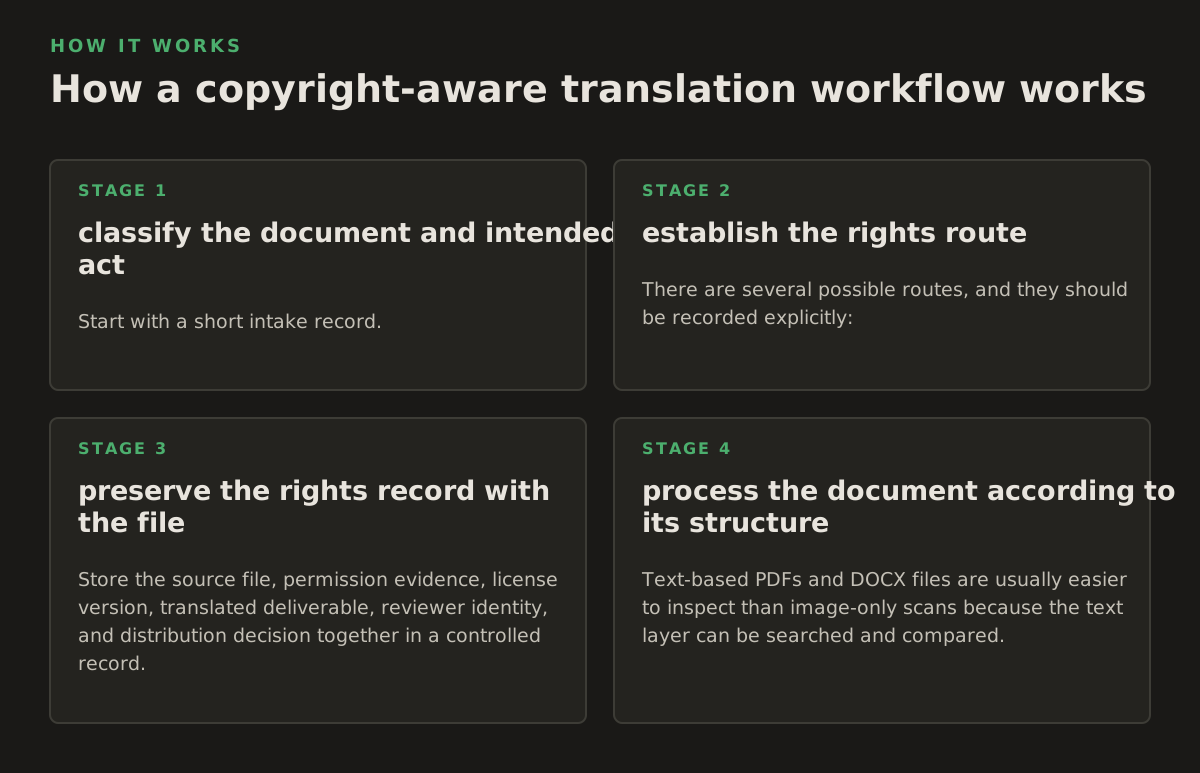
A reliable process separates rights clearance from language conversion, then connects both through an auditable document record. This is particularly important when a platform preserves the source document’s formatting, tables, images, and page structure. Visual fidelity can make a result more useful, but it can also reproduce protected content more completely.
Step 1: classify the document and intended act
Start with a short intake record. Identify whether the file is a contract, court document, academic article, book excerpt, presentation, form, medical record, or internal report. Record the source language, target language, owner or licensor, intended audience, territory, and planned distribution.
Do not use “translation” as the only activity label. Add the acts that will actually occur:
- Temporary upload for language conversion.
- Creation of an editable or fixed-layout copy.
- Human review and annotation.
- Delivery to a client, court, student, employee, or publisher.
- Public posting, sale, archival storage, or further adaptation.
This classification prevents a common failure: obtaining approval for a review copy and then quietly using the same file as a published edition.
Step 2: establish the rights route
There are several possible routes, and they should be recorded explicitly:
- Ownership: the organization owns the relevant rights or created the work within an arrangement that assigns them.
- License: a contract authorizes translation and specifies audience, territory, duration, formats, and distribution.
- Statutory exception: a local law may permit a limited use, such as certain educational, library, accessibility, research, or judicial activities.
- Public-domain status: copyright protection may have expired, although modern editions, annotations, images, or translations can remain protected.
- Permission from a rights holder: a direct authorization covers the proposed act.
Exceptions should be treated narrowly and documented. A research exception in one country may not permit commercial distribution in another. A court or government workflow may have specific authority that does not extend to unrelated publication. When the use has meaningful financial, legal, or reputational consequences, obtain advice from qualified counsel in the relevant jurisdiction.
Step 3: preserve the rights record with the file
Store the source file, permission evidence, license version, translated deliverable, reviewer identity, and distribution decision together in a controlled record. For a legal department, that might be the matter-management system. For a publisher, it may be the title’s rights grid. For a university, it could be the project repository and access log.
Useful metadata includes:
- Original title, author, creator, and source location.
- Copyright notice and known rights holder.
- License or permission reference number.
- Approved target languages and territories.
- Approved audience and channel.
- Whether images, quotations, tables, and appendices were separately cleared.
- Translation date, tool or vendor used, and human reviewer.
- Required attribution, notices, disclaimers, or takedown contact.
Step 4: process the document according to its structure
Text-based PDFs and DOCX files are usually easier to inspect than image-only scans because the text layer can be searched and compared. A scanned PDF first requires optical character recognition. OCR can misread a minus sign, decimal point, footnote marker, handwritten correction, or legal section number before translation begins.
For a scanned filing or historical book, a sensible sequence is:
- Retain an untouched master scan.
- Run OCR and keep the recognized text as a separate layer.
- Review names, numbers, citations, headers, and marginal notes.
- Translate the corrected text while preserving page references.
- Compare the translated layout with the source and inspect images separately.
- Record any unreadable or uncertain passage rather than silently guessing.
Teams working with ordinary PDFs can use a workflow designed to translate PDF documents while still treating permissions, embedded material, and review as separate responsibilities. For image-only records, a process to translate scanned PDFs should include an explicit OCR quality check before anyone relies on the result.
Step 5: review for meaning, rights, and release status
Language review is not the same as legal clearance. The translator or subject-matter reviewer checks meaning, terminology, omissions, and formatting. The rights owner or legal reviewer checks whether the final use remains within the authorized scope. Keep those approvals distinct.
A release checklist can ask:
- Does the translated version include the required copyright notice and attribution?
- Were all quoted, illustrated, or appended materials included within the permission?
- Does the target-language version preserve required warnings and limitations?
- Was the translation reviewed by a qualified person for its intended use?
- Is the recipient list consistent with the license or internal policy?
- Can the organization remove or correct the file if permission changes?
Where Translation And Copyright workflows break
Most failures are not dramatic attempts to pirate a book. They are ordinary process errors: a team mistakes possession for ownership, an analyst includes a chart from a licensed database, or a publisher assumes that buying a foreign-language edition includes translation rights.
Possession is mistaken for permission
Having downloaded a PDF, purchased a book, received a slide deck, or accessed an article through a subscription does not necessarily grant the right to create and distribute a translated version. The document may have been supplied for personal use, a defined institutional audience, or a limited number of users.
For example, a university researcher may translate a six-page article to understand its methodology. That does not automatically authorize uploading the translation to a public course site. A business may receive a vendor’s 25-page manual under a customer license. That does not necessarily authorize translating it for resale to the business’s own customers.
A translation license is read too broadly
Translation agreements often define target language, territory, format, term, edition, and publication channel. A clause authorizing a Spanish print edition may not cover a Spanish EPUB, an accessible HTML version, an audiobook script, or a Latin American distribution campaign. A contract for one title may not cover the author’s appendices or illustrations.
In the United Kingdom, for example, the Copyright, Designs and Patents Act 1988 treats converting a work into another language as an adaptation in its statutory framework; the relevant wording appears in section 21 of the Act. The example demonstrates the importance of reading the applicable statute and contract together rather than assuming that “translation” has one global legal meaning.
OCR and layout preservation create silent reproduction
An OCR system may capture a page that contains a third-party photograph, a proprietary map, a signature, or a watermark. A translation platform that preserves images and layout may carry those elements into the target file. This is operationally helpful for a court bundle or engineering manual, but it can also reproduce material that was never cleared for the new audience.
Before release, inspect the non-text layer:
- Photographs and illustrations.
- Charts, maps, and screenshots.
- Logos and seals.
- Handwritten signatures and initials.
- Embedded audio, video, or QR-code destinations in presentations.
- References, quotations, appendices, and supplied forms.
Machine output is treated as authoritative
AI systems can produce fluent text while mishandling negation, defined terms, dosage instructions, units, names, or jurisdiction-specific legal expressions. Copyright analysis does not make an inaccurate translation safe. In a contract, changing “may” to “shall” can change an obligation. In a clinical document, changing a decimal or dosage can create a serious safety risk.
Set a review level based on consequence, not convenience. A private preliminary translation of a low-risk memo may need a lighter check than a translated patent claim, court exhibit, informed-consent form, or safety procedure. Mark preliminary output clearly so that it cannot be mistaken for an approved version.
How practitioners apply the rules by document type
The best workflow varies by audience and consequence. The following examples use illustrative internal policies, not universal legal thresholds or industry benchmarks.
Legal teams
For contracts, pleadings, discovery records, and evidence, preserve the original file and a verifiable relationship between source and translation. Record whether the translation is for attorney understanding, negotiation, filing, service, or evidentiary use. A court may require a certification or a particular translator qualification; that is a procedural issue separate from copyright permission.
A legal department’s starting policy might be:
- Use machine translation for internal issue spotting only when the matter team authorizes the upload.
- Require human legal-linguistic review before sending language to an opposing party or filing it.
- Keep defined terms in a controlled glossary and compare every occurrence.
- Do not alter signatures, seals, exhibits, Bates numbers, or page references during layout conversion.
- Record the reason for any omitted confidential or third-party material.
The key control is provenance: a reviewer should be able to identify which source page supports each material translated statement.
Researchers and universities
Researchers often need a translation to understand a source, quote it in a publication, or make it available to students. Those are different uses. A research group should distinguish private study, closed classroom access, repository deposit, conference distribution, and publication.
For a 12-page journal article translated for a seminar, an illustrative rights record could state: “One translated copy, 18 enrolled students, password-protected course site, autumn 2026, no public repository upload.” If the instructor later wants to post the translation openly, that is a new release decision, not a minor technical change.
Researchers should also preserve quotations in the original language where precision matters, identify the translator, and disclose when a quotation is their own translation. If an AI system produced a draft, retain the source and revision history so that citations and interpretive choices can be checked.
Publishers and educators
Publishing requires the most explicit rights planning because the translated text may become a commercial edition. Confirm whether the deal covers print, digital, audio, large-print, accessible, classroom, and promotional formats. Check whether illustrations, captions, exercises, permissions, and third-party quotations travel with the license.
A publisher’s rights grid should not merely say “translation rights: yes.” It should specify:
- Target language and permitted regional variants.
- Territory and sales channels.
- Format, including EPUB and accessible editions.
- Term, royalty, and approval provisions.
- Required credit for the original author and translator.
- Permission status for images, extracts, tables, and worksheets.
- Whether the publisher may use AI-assisted translation or must obtain prior consent.
For educators, the equivalent concern is controlled access. Translating a course reading for students may be defensible under a license or exception in one setting, but distributing a translated anthology to the public is a separate publishing activity.
Businesses and internal document teams
Businesses should focus on both copyright and contract confidentiality. A supplier’s report might be licensed only to the contracting entity. A translated board presentation might contain stock images, customer data, or confidential financial information. An internal audience does not eliminate the need to check the source agreement.
For a multinational team translating a 60-slide quarterly report into three languages, an illustrative starting policy could require rights confirmation from the report owner, a restricted processing workspace, review of all financial figures and charts, and distribution only to named subsidiaries. The numbers in this example describe a planning scenario, not a legal or security benchmark.
Government and healthcare teams
Government and healthcare documents combine copyright questions with public-records, confidentiality, accessibility, procurement, and safety obligations. A translated patient leaflet may need clinical approval and a controlled version date. A public agency may need to confirm whether it owns the source, has a government-use license, or is reproducing material supplied by a contractor.
For a scanned medical form, retain the original image, validate OCR character by character for patient identifiers and dosage fields, and have an appropriately qualified reviewer approve the target-language version. Remove unnecessary personal data before processing where policy permits. The goal is not merely a readable translation; it is a traceable, safe, authorized document.
A specific recommendation for 2026 document programs
Adopt a two-gate process: rights clearance before processing and human approval before consequential release. Between those gates, maintain the original file, OCR layer when applicable, translated draft, permissions record, reviewer notes, and final distribution decision. This approach scales better than asking translators to make uncertain legal judgments in isolation or asking lawyers to inspect every low-risk sentence after the fact.
Use a simple risk classification:
- Low consequence: private comprehension of material the user is authorized to access.
- Moderate consequence: restricted internal circulation, teaching access, negotiation, or research collaboration.
- High consequence: court filing, clinical instruction, public release, commercial publication, regulatory submission, or safety-critical use.
For each class, define the permitted tools, reviewer qualifications, retention period, approval owner, and release channel. Treat the classification as a starting policy for 2026 and adapt it to the organization’s contracts, jurisdictions, and professional obligations.
InOtherWord.AI is designed for document translation across PDFs, scanned PDFs, DOCX files, PowerPoint presentations, and EPUB books while preserving formatting, layout, tables, and images. Teams can use it as part of that controlled workflow, provided they separately confirm rights, protect sensitive inputs, and review the translated result before release: InOtherWord.AI.
Authored with NotFair SEO
Related guides
Keep researching the right workflow
These pages help move from general document-translation research into the specific file format or workflow you need.
A practical workflow for translating scanned PDFs with OCR while preserving enough structure for real review, sharing, and downstream editing.
Explore pageHow to translate PPT and PPTX decks without breaking slide layouts, charts, and speaker-ready formatting.
Explore pageThe best AI PDF translator is not just about language quality. It also needs OCR, layout preservation, and reviewable output for real files.
Explore pageCommercial pages
Ready to translate the actual file?
Jump from the guide into the product page that fits your document type, then continue into pricing when you are ready.
Format page
Translate PDF Documents
Translate PDF files while preserving layout, tables, and page structure.
Explore pageFormat page
Translate Scanned PDFs
OCR and translate scanned PDFs without rebuilding the layout by hand.
Explore pageFormat page
Translate PowerPoint Presentations
Translate PPT and PPTX decks while preserving slide layouts, tables, and speaker-ready formatting.
Explore pageTranslate layout-heavy PDF reports, manuals, forms, and client-ready files while keeping tables, headings, and images readable.
Explore page