How to Choose Document Translation Agencies for High-Stakes Files
Published Wed Aug 19 2026 | 15 min read
Compare document translation agencies, AI tools, and hybrid services using a practical framework for quality, security, formatting, cost, and delivery.
Choosing among document translation agencies is not simply a language decision. A legal team needs an accurate contract with controlled terminology; a university needs a readable research paper with citations intact; a publisher needs a book whose headings, images, and page flow survive conversion. This guide helps you decide whether to use a human agency, an AI document platform, an internal workflow, or a hybrid service—and how to test the choice before committing a large or sensitive file set.
1. Start with the document risk, not the language pair
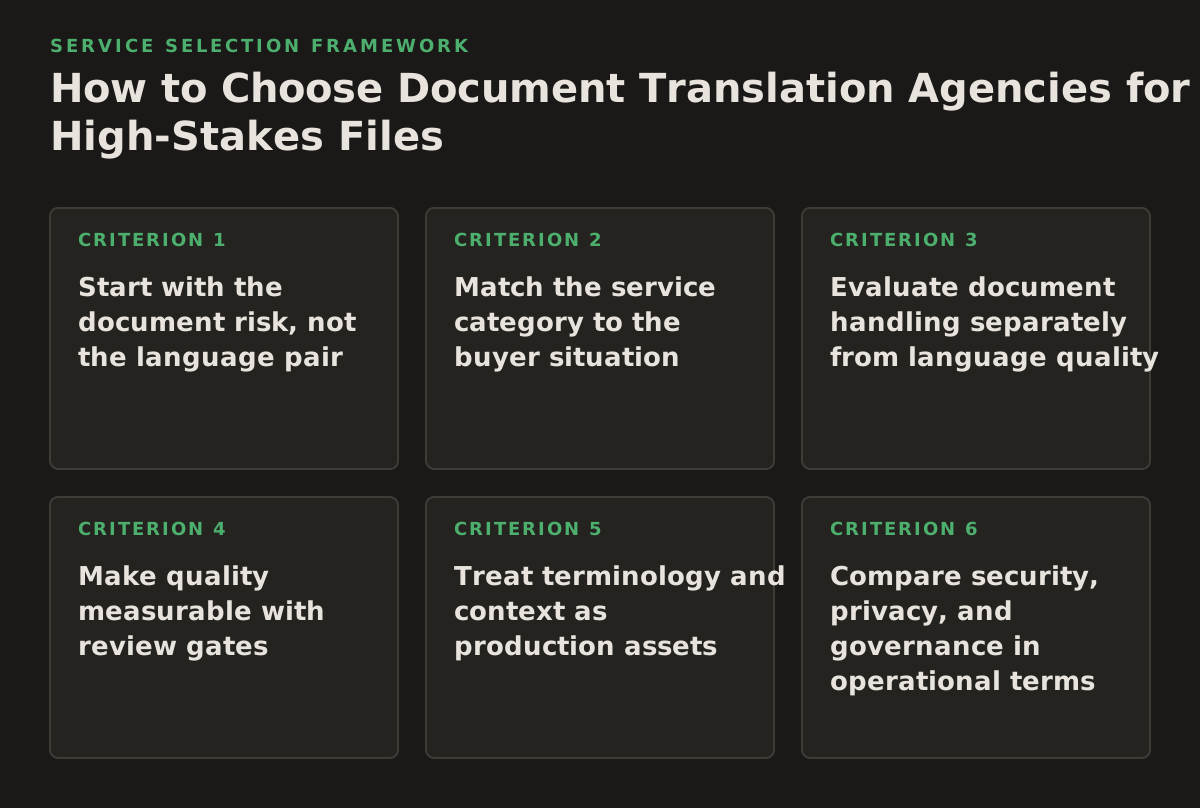
The same language pair can require completely different services. Translating an internal meeting note is mostly a speed and convenience problem. Translating a court filing, clinical document, procurement contract, or government form is a risk and accountability problem. Your first task is to classify what can go wrong and who bears the consequence.
Use four risk dimensions
- Meaning risk: Could a mistranslated term change a legal obligation, medical instruction, research conclusion, or public-facing policy?
- Format risk: Must tables, footnotes, page numbers, signatures, formulas, hyperlinks, images, or slide layouts remain usable?
- confidentiality risk: Does the file contain personal data, trade secrets, patient information, unpublished research, or privileged material?
- delivery risk: Is there a filing date, print deadline, regulatory submission, conference, course launch, or coordinated publication?
Then assign the job a working tier. A low-risk document may be translated automatically and reviewed selectively. A medium-risk file may need terminology controls and a human review. A high-risk file generally needs an accountable translation provider, subject-matter review, and a documented quality process. This is a workflow decision, not a label about AI: even a human agency can fail if it does not inspect the source file properly or verify the final layout.
For security planning, ask what controls the provider applies to the data, access, storage, and deletion process. The EU General Data Protection Regulation’s Article 32 describes security measures in relation to risk, including confidentiality, integrity, availability, and resilience; it is a useful reference point for questions even when the GDPR is not the only rule governing your project. Read Article 32 in the official GDPR text.
Worked example: a multilingual contract bundle
A legal operations team has 40 DOCX contracts and six scanned exhibits. The contracts contain recurring defined terms, while the exhibits contain signatures and handwritten annotations. A sensible classification is:
- DOCX contracts: high meaning risk and medium format risk.
- Scanned exhibits: high meaning risk, high OCR risk, and high evidence-handling risk.
- Internal cover sheets: low meaning risk and low format risk.
The team might use an AI document workflow for the cover sheets, a controlled translation process with legal review for the contracts, and a specialist provider or human reviewer for the scanned exhibits. The failure mode is buying one service for all three categories because the file count looks convenient.
2. Match the service category to the buyer situation
“Translation service” can mean several different operating models. Agencies, software platforms, freelancers, and internal teams solve different parts of the problem. Compare the service boundary—what happens before, during, and after translation—not just the quoted language pair.
| Buyer need | Best-fit service type | Main trade-off | Questions to resolve |
|---|---|---|---|
| Many routine PDFs, DOCX files, presentations, or EPUB books; speed and cost control matter | AI document translation platform | Fast, repeatable processing, but high-risk passages may need human review | Does it preserve layout? How are tables, images, fonts, and page breaks handled? Can reviewers edit and export? |
| Contracts, court documents, medical records, regulated submissions, or official correspondence | Specialist human translation agency | Stronger subject-matter accountability, usually with more coordination and a slower production cycle | Who reviews the work? Can the agency handle source scans, terminology, certification, and final file QA? |
| Large multilingual content programs across departments or markets | Managed localization provider | Useful governance and workflow support, but onboarding and process overhead can be substantial | How are translation memories, glossaries, approvals, vendors, and version changes managed? |
| One-off specialist paper, short letter, or unusual language requirement | Qualified freelancer or small specialist team | Direct communication and flexibility, but limited redundancy and capacity | What happens during absence? Who performs independent review and file validation? |
| Confidential documents that cannot leave an approved environment | Internal workflow or approved private service | Maximum control may require internal linguistic expertise, software, and maintenance | Who owns quality, access controls, terminology, and incident response? |
| Mixed-risk batches containing routine and legally important files | Hybrid workflow | More routing decisions, but avoids paying specialist rates for every page | What rules send a file to automation, human review, or full agency production? |
For an academic department translating a journal article, an AI platform may produce a useful first version while a researcher or language editor checks terminology and references. For a publisher translating an illustrated ebook, the service must also preserve chapter structure, captions, and reading order. For a government team, procurement and data-handling requirements may outweigh convenience.
The common failure mode is treating a human agency as automatically superior for every file, or treating machine output as sufficient for every file. The right comparison is risk-adjusted total effort: vendor fees plus preparation, review, corrections, formatting repair, approvals, and the cost of a late or unusable deliverable.
3. Evaluate document handling separately from language quality
A translation can be linguistically sound and still fail the job. Text may be trapped inside a scan, a table may overflow, a footnote may disappear, or a presentation may become unreadable after expansion. Ask vendors to demonstrate the entire source-to-deliverable chain, not just a paragraph of translated text.
Inspect these document operations
- File intake: Can the workflow accept the actual PDF, scanned PDF, DOCX, PPTX, or EPUB version you use?
- Text extraction: Does it identify selectable text, embedded text boxes, headers, footers, footnotes, and speaker notes?
- OCR handling: Can it recognize skewed pages, mixed scripts, stamps, low contrast, handwriting, and multi-column layouts?
- Structure preservation: Are headings, tables, lists, page references, equations, captions, and hyperlinks retained?
- Visual reconstruction: Are translated words placed back into the document without clipping, collisions, unexpected pagination, or broken alignment?
- Export and review: Can a reviewer compare source and target, edit terms, and produce the required final format?
OCR should be treated as a separate accuracy stage. Google’s official Document AI documentation describes OCR and document processing as capabilities that extract text and structure from documents; that distinction matters because extracted text still requires translation and, for consequential files, validation against the original page. See Google Cloud’s Document AI overview.
For a scanned court exhibit, the implementation example should include a page-by-page visual check: compare names, dates, exhibit labels, seals, signatures, and handwritten notes against the source. For a PowerPoint deck, inspect every slide at presentation size, including charts and text embedded in images. For a PDF report, check tables after translation because longer target-language phrases can change row height and page breaks.
A useful test is to submit a deliberately difficult sample rather than a clean one. Include a scanned page, a dense table, a page with a footer, a two-column article, and a slide with a chart. The failure mode is evaluating only a clean DOCX paragraph and assuming the result represents the full production job.
4. Make quality measurable with review gates
“Native-quality translation” is too vague to manage. Define what must be correct, who checks it, and what happens when the output misses the requirement. A quality plan should distinguish linguistic review from document QA.
Build a review matrix
- Terminology: Defined terms, product names, legal phrases, medical terms, institutional names, and approved translations match the glossary.
- Content fidelity: No omissions, additions, altered numbers, changed dates, or incorrect negations.
- Functional correctness: Links work, references point to the right locations, fields remain usable, and formulas or symbols survive.
- Visual quality: No clipped text, overlapping objects, blank pages, broken tables, missing images, or unreadable slide content.
- Audience suitability: Tone, reading level, regional conventions, and terminology fit the intended legal, academic, commercial, or public audience.
Set acceptance criteria before sending the batch. An illustrative starting policy—not a universal benchmark—might require zero unresolved errors in names, numbers, defined terms, dosage instructions, filing references, and signature blocks, while allowing a documented editorial queue for low-impact style preferences. The point is to create falsifiable acceptance rules, not to pretend every language issue has an objective score.
Use risk-based sampling
If a human reviewer cannot read every page, prioritize review based on consequence rather than random convenience. Review all pages containing:
- tables, numbers, dates, measurements, or financial values;
- legal obligations, warnings, consent language, or procedural instructions;
- names, addresses, citations, footnotes, or cross-references;
- OCR uncertainty, handwriting, stamps, seals, or low-quality scans;
- new terminology or passages edited after the initial translation.
For a research group translating 12 papers, the team could create a terminology list from abstracts and methods sections, perform full review of figures and statistical notation, and sample routine prose. For a healthcare team, the review policy should be stricter around instructions and patient identifiers. The failure mode is counting “pages translated” as quality evidence without checking the passages where an error causes harm.
If accessibility matters, include it in acceptance testing. WCAG 2.2 provides testable accessibility guidance for digital content, including requirements relevant to structure, text alternatives, keyboard use, and readability. Use the W3C WCAG 2.2 specification as a reference. A translated PDF that looks correct but loses tags, reading order, or text alternatives may still fail its audience.
5. Treat terminology and context as production assets
General translation engines and generalist agencies often struggle with repeated terms that have a precise organizational meaning. A university may distinguish “department,” “faculty,” and “school.” A legal team may use a defined term that must remain consistent even when a more natural synonym appears. A healthcare organization may have approved names for medicines, services, and patient instructions.
Before requesting quotes, assemble a terminology starter pack:
- approved terms and prohibited alternatives;
- names of people, products, departments, programs, and institutions;
- previously approved translated documents;
- target-country spelling, date, number, and address conventions;
- instructions for citations, quotations, trademarks, and untranslated phrases;
- examples of the tone required for contracts, research, teaching, or public information.
Ask whether the provider can use the material as a glossary, translation memory, style guide, or reviewer reference. Do not assume that a vendor’s “AI” or “memory” terminology means the same thing across products. Clarify whether your assets are reusable across projects, exportable if you leave, and protected from being used for unrelated customers.
Implementation example: a publisher’s backlist
A publisher translating a nonfiction ebook should identify recurring chapter terms before production begins. The editor can approve a short list, the translator can flag ambiguous terms, and the final reviewer can search for inconsistent renderings across chapters. Captions, pull quotes, index entries, and the table of contents need separate checks because they may not follow the same workflow as body text.
The failure mode is building the glossary after the first translation has already established inconsistent terminology. That creates expensive rework and can leave different editions using incompatible terms.
6. Compare security, privacy, and governance in operational terms
Legal, healthcare, government, and unpublished research files require more than a generic promise that a platform is secure. Ask how data moves through the service and what evidence you receive. Security claims must map to actions: access, retention, deletion, subcontractors, incident handling, and audit records.
Questions for a provider
- Where is the file uploaded, processed, stored, and backed up?
- How long are source files, translated files, prompts, logs, and extracted OCR text retained?
- Can the customer request deletion, and how is deletion confirmed?
- Are files used to train or improve a general model? If so, can that use be disabled?
- Which employees, translators, reviewers, or subcontractors can access the content?
- What contractual terms cover confidentiality, data processing, breach notification, and ownership?
- Can the provider support role-based access, project separation, download controls, and audit evidence where required?
- What happens to files and terminology assets if the account closes?
For a hospital translating patient-facing material, the buyer should involve privacy and security staff before uploading a real record. For a law firm, privileged documents may require an approved vendor list and a written data-processing agreement. For a government department, procurement may require location, subcontractor, accessibility, records-management, and public-sector clauses that a consumer tool does not address.
Do not infer compliance from a logo, a sales presentation, or a provider’s general reputation. Request the relevant policy, contract language, and current security documentation. The failure mode is sending a sensitive sample during a “free trial” before determining retention and model-use terms.
7. Model price as a workflow budget, not a word-count quote
Translation pricing can be based on source words, target words, pages, files, characters, subscriptions, minimum charges, review hours, project management, rush handling, certification, or layout work. Some providers combine these elements. A low apparent rate can become expensive when OCR cleanup, terminology work, formatting repair, or human review is added.
Build a comparable quote request
Send each candidate the same information:
- file types and approximate source volume;
- source and target languages, including regional variants;
- whether the source is editable, scanned, image-heavy, or handwritten;
- required output format and whether the visual layout must be preserved;
- terminology, subject matter, certification, or reviewer requirements;
- security, retention, access, and deletion requirements;
- deadline, milestones, feedback rounds, and acceptance criteria.
Ask for an itemized estimate showing what is included and excluded. Clarify whether revisions caused by an agency error are included, whether customer edits trigger a new charge, and whether a file that fails OCR is reclassified. Ask about currency, taxes, minimum fees, subscription renewal, storage, seats, API usage, and cancellation terms without assuming any particular pricing model.
For internal planning, an illustrative budget model is:
Total workflow cost = translation or subscription fee + preparation and OCR + terminology setup + human review + layout QA + project management + rework reserve.
This is a planning formula, not a market price. A business team translating recurring reports may favor automation because preparation and review become predictable. A legal team translating a small number of high-consequence filings may accept a higher per-document cost for specialist review. The failure mode is comparing an agency’s fully managed quote with an AI tool’s base processing fee as though they deliver the same service.
8. Interview vendors with evidence, not adjectives
A short vendor interview can expose whether a provider understands document production. Ask for concrete answers, sample outputs, and named responsibilities. The best candidate should be able to explain what it does when the source is ambiguous or the target text expands the layout.
Vendor interview checklist
- Show us how you would process this exact combination of editable pages, scans, tables, images, and footnotes.
- Which steps are automated, and which are performed by translators, editors, or layout specialists?
- Who owns terminology approval and escalation when the source is ambiguous?
- How do you detect omissions, altered numbers, broken references, and inconsistent defined terms?
- What does the final visual QA checklist include for PDF, DOCX, PowerPoint, or EPUB?
- Can we review and approve a sample before the full batch proceeds?
- What are the source-file, output-file, glossary, and translation-memory ownership terms?
- What are the retention, deletion, access, subcontractor, and model-training policies?
- How are corrections handled, and what evidence is provided when a deliverable is accepted?
- What happens if the deadline slips, the assigned linguist becomes unavailable, or the source changes?
- Which requirements are not supported, such as handwriting, complex formulas, embedded text in images, or accessibility tags?
- Can you provide references or relevant anonymized examples for our document type?
Require a pilot using representative material. The pilot should include at least one difficult page, not only a polished paragraph. Have the person who will approve production review the sample. A researcher should inspect citations and specialist vocabulary; a legal reviewer should inspect obligations and defined terms; a presentation owner should inspect every slide at normal viewing size.
Red flags include guaranteed accuracy without a defined review method, refusal to explain data retention, a quote that ignores file complexity, no named escalation route, inability to return an editable deliverable when required, and a sample that contains unexplained omissions. Another red flag is a provider that treats OCR as invisible magic instead of a stage with its own error profile.
Implementation plan: route one controlled pilot before scaling
Use the following sequence to turn the framework into a procurement and production decision.
- Inventory the corpus. Record file type, page or word estimate, scan quality, tables, images, languages, sensitivity, deadline, and required output.
- Assign risk tiers. Mark files as routine, review-required, or specialist-controlled based on meaning, confidentiality, format, and delivery risk.
- Define acceptance criteria. Specify terminology, numeric fidelity, visual integrity, accessibility, certification, reviewer sign-off, and correction rules.
- Prepare the vendor brief. Include representative files, glossary material, security requirements, output formats, milestones, and the quote template.
- Shortlist service categories. Compare an AI platform, a specialist agency, a managed provider, or an internal workflow only where each can meet the stated controls.
- Run a representative pilot. Use difficult pages and have the real approver inspect language, OCR, layout, and metadata. Do not upload sensitive production material until terms are approved.
- Calculate total effort. Add preparation, review, corrections, project management, and rework to the provider’s headline fee.
- Document the operating model. Assign who prepares files, approves terminology, reviews output, handles exceptions, authorizes delivery, and confirms deletion.
- Scale by risk tier. Automate routine documents, route defined high-risk passages to qualified reviewers, and reserve full specialist production for files where errors have material consequences.
- Review the first production batch. Track omissions, terminology changes, layout defects, turnaround variance, and reviewer effort. Change the routing policy if the evidence shows the original assumptions were wrong.
For teams that need a practical starting point, InOtherWord.AI can process PDFs, scanned PDFs, DOCX files, PowerPoint presentations, and EPUB books while preserving document structure and visual elements; you can begin with InOtherWord.AI and still apply the risk, review, and security controls above. For ordinary PDF workflows, use translate PDF documents, and for image-based files use translate scanned PDFs before deciding which pages require human review.
Authored with NotFair SEO
Related guides
Keep researching the right workflow
These pages help move from general document-translation research into the specific file format or workflow you need.
A practical workflow for translating scanned PDFs with OCR while preserving enough structure for real review, sharing, and downstream editing.
Explore pageHow to translate PPT and PPTX decks without breaking slide layouts, charts, and speaker-ready formatting.
Explore pageThe best AI PDF translator is not just about language quality. It also needs OCR, layout preservation, and reviewable output for real files.
Explore pageCommercial pages
Ready to translate the actual file?
Jump from the guide into the product page that fits your document type, then continue into pricing when you are ready.
Format page
Translate PDF Documents
Translate PDF files while preserving layout, tables, and page structure.
Explore pageFormat page
Translate Scanned PDFs
OCR and translate scanned PDFs without rebuilding the layout by hand.
Explore pageFormat page
Translate PowerPoint Presentations
Translate PPT and PPTX decks while preserving slide layouts, tables, and speaker-ready formatting.
Explore pageTranslate layout-heavy PDF reports, manuals, forms, and client-ready files while keeping tables, headings, and images readable.
Explore page