Document Translation Services Uk: A Practical Buyer’s Guide
Published Wed Aug 26 2026 | 16 min read
Compare document translation services UK by file type, review needs, security, pricing model, and delivery risk before choosing a provider.
Buying document translation services uk means choosing more than a language pair. A legal team may need an exact, reviewable contract translation; a university may need searchable pages and preserved citations; a publisher may need a reflowable EPUB that survives production; and a healthcare or government team may need strict control over sensitive files. This guide helps you decide which service category fits the document, how much human review to commission, what implementation work to expect, and how to reject a supplier that cannot explain its process.
The central decision is whether you need meaning only, a translated document that retains its working layout, or a controlled translation workflow with terminology, review, and evidence of quality. Those are different deliverables. Treating them as interchangeable is how teams end up with an accurate-looking translation that breaks tables, loses footnotes, exposes confidential content, or cannot be used in a formal proceeding.
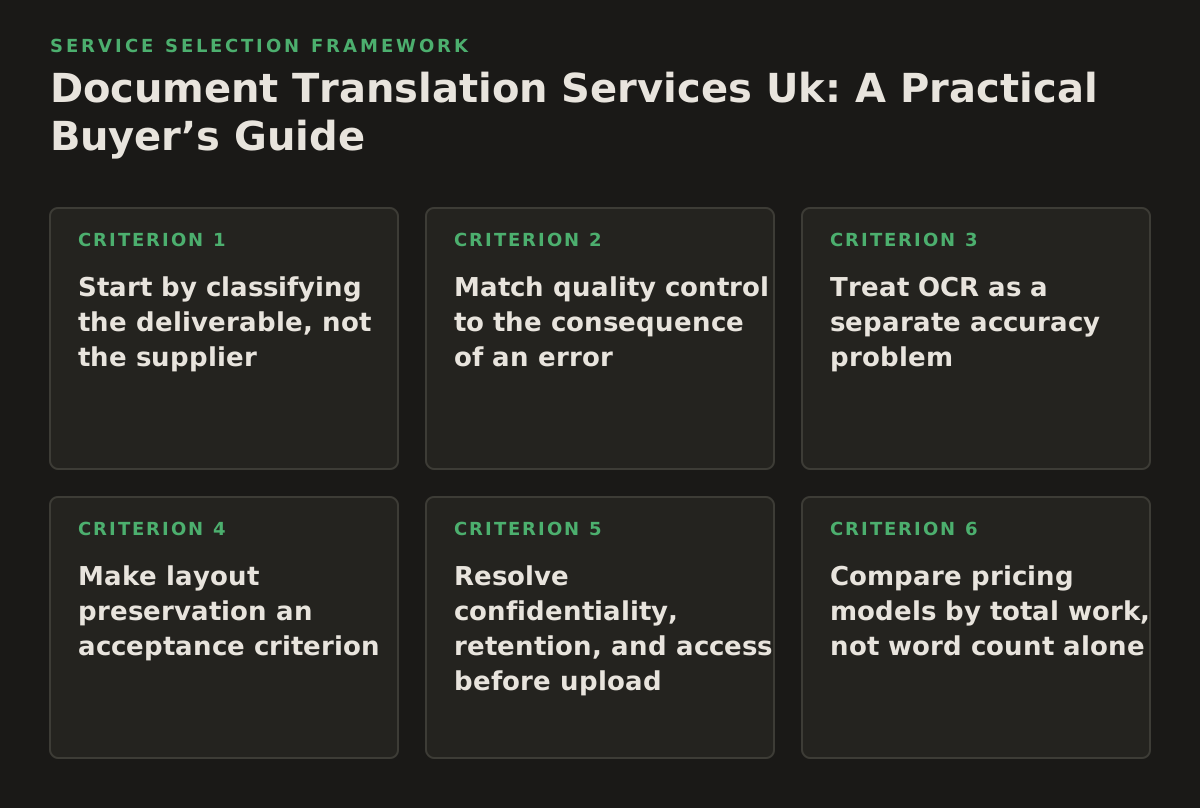
1. Start by classifying the deliverable, not the supplier
When requesting quotes, buyers often describe a file as “a PDF” or “a PowerPoint.” That is not enough. A digitally generated PDF, a scanned court bundle, a slide deck with embedded diagrams, and an EPUB book each create different technical and editorial risks. Classify the job before you compare providers.
Four practical service categories
- Text-only translation: suitable when the output can be delivered as plain text or a basic editable file and visual fidelity is unimportant. This can suit internal notes, early research, or content that will be redesigned later.
- Layout-preserving document translation: suitable when the translated PDF, DOCX, or presentation must retain headings, tables, page structure, images, and captions. It reduces reformatting work but requires document reconstruction and visual quality assurance.
- OCR-assisted scanned-document translation: suitable for scans, photographs, faxed records, or image-only PDFs. The workflow must extract text before translation and then account for recognition errors, stamps, handwriting, skew, and illegible sections.
- Reviewed or certified translation: suitable when a court, regulator, customer, publisher, or internal governance process requires human review, a statement of accuracy, terminology control, or a traceable approval record. “Certified” has a specific meaning in some institutions, so confirm the receiving body’s rules rather than assuming a provider’s label is sufficient.
For UK administrative use, check the receiving organisation’s instructions before ordering. The UK government’s guidance on certifying a document explains that certification requirements depend on the organisation requesting the document; that is a useful reminder that a translation provider cannot decide acceptance criteria on the recipient’s behalf.
| Buyer need | Best-fit service type | Trade-off | Acceptance test |
|---|---|---|---|
| Internal report where layout will be rebuilt later | Text-only or editable-file translation | Lower production burden, but formatting work moves to your team | Key terms, figures, headings, and references match the source |
| Contract or policy that must remain easy to compare page by page | Layout-preserving DOCX or PDF translation with human review | More quality-control work and potentially more revision cycles | Parallel review confirms clauses, numbering, tables, and defined terms |
| Scanned court, medical, or archival record | OCR-assisted translation with image-to-text validation | Unclear characters may require manual intervention or source clarification | Every page is accounted for and uncertain text is flagged, not silently guessed |
| Investor, regulator, or court submission | Reviewed translation with recipient-specific certification check | Formal review and documentation add delivery coordination | Receiving body confirms the format, declaration, and translator requirements |
| Training deck or multilingual course material | PowerPoint translation with layout and overflow inspection | Text expansion can require slide redesign | No clipped text, broken diagrams, or untranslated speaker notes |
| Book or long-form educational content | EPUB or editable manuscript translation with editorial review | More terminology and style management across chapters | Navigation, metadata, footnotes, links, and chapter structure work in an EPUB reader |
Failure mode: selecting a “PDF translation” service without asking whether the PDF contains selectable text. A scan may return an incomplete or malformed result if OCR is not a deliberate stage. For a file with selectable text, you can translate PDF documents; for image-only pages, use a workflow designed to translate scanned PDFs.
Implementation example: a university research office receives a 180-page scanned thesis in German. It should request OCR extraction, German-to-English translation, preservation of page references, and a list of uncertain characters. It should not request “English PDF” as the only specification.
2. Match quality control to the consequence of an error
There is no single useful meaning of “accurate.” A wrong decimal in a financial schedule, a mistranslated negation in a consent form, and an inconsistent product name have different consequences. Define the errors you cannot tolerate, then buy the review process that addresses them.
A risk-based review ladder
- Automated draft: appropriate for triage, comprehension, internal discovery, or deciding which documents deserve deeper work. The output should be treated as a draft, especially where source structure is uncertain.
- Machine translation plus terminology control: appropriate for recurring business content where approved names, product terms, legal entities, and abbreviations matter. Supply a glossary and test representative passages before processing the full set.
- Human bilingual review: appropriate for external communications, research publication drafts, contracts, policies, and customer-facing materials. The reviewer should inspect meaning, omissions, terminology, and formatting—not merely run spellcheck.
- Specialist review and formal sign-off: appropriate for regulated, legal, clinical, or high-consequence documents. Confirm who is qualified to review the subject matter and what evidence the receiving organisation expects.
Use a risk register by document element. Rank clauses, tables, warnings, dosage instructions, names, dates, numbers, and references separately. A long background section may tolerate a draft; a two-line indemnity clause may not. For AI-assisted work, NIST’s AI Risk Management Framework provides a useful general model of managing risks through governance, mapping, measurement, and management rather than treating an AI output as self-validating.
Failure mode: assuming that fluent prose proves correctness. Translation systems can produce smooth sentences while changing a defined term, dropping a footnote, or interpreting a blurry scan as a different word. Fluency is a presentation property, not an acceptance test.
Implementation example: a legal team translating a supply agreement creates a review sheet with the source clause, translated clause, defined terms, numbers, governing-law references, and reviewer decision. It sends only the high-risk clauses for specialist legal review if budget or time prevents a full second pass. That is a defensible allocation decision; silently treating every paragraph as equal is not.
3. Treat OCR as a separate accuracy problem
Scanned-document translation combines two transformations: image to text, then text to another language. Errors in the first stage can become invisible in the second. A missing decimal, mistaken character, or misread table cell may be translated consistently and still be wrong.
What to inspect before translation
- Whether each page has a text layer or is only an image.
- Scan resolution, skew, contrast, shadows, stamps, handwriting, and marginal notes.
- Language mix, including Latin abbreviations, names, serial numbers, and historical spelling.
- Tables, columns, headers, footers, signatures, seals, and handwritten amendments.
- Pages that are missing, duplicated, rotated, blank, or out of order.
Request an OCR confidence or exception workflow even if the provider does not expose a numerical confidence score. You need to know how uncertain text is surfaced. A sensible process preserves the original page image, marks unresolved characters, and lets a reviewer compare the extracted text with the scan.
Failure mode: accepting a clean-looking translated PDF without page-level reconciliation. A document can have the right page count while omitting a faint annex or translating a table as a paragraph.
Implementation example: a healthcare team processes a scanned referral packet. It requires page thumbnails, extracted text for review, explicit flags for illegible patient identifiers, and a final check of names, dates, units, and dosage instructions against the image. It does not permit the translator to infer missing clinical information.
For archival and academic work, keep the source scan and translated output together under stable filenames. If a researcher later challenges a quotation, the team can return to the exact page image rather than relying on a regenerated OCR result.
4. Make layout preservation an acceptance criterion
Layout is not decoration. It carries relationships: a number belongs to a row, a footnote belongs to a claim, a warning belongs to an image, and a signature block belongs to a party. Translation changes word length and line breaks, so preserving the source layout may require controlled compromises.
Inspect the elements most likely to fail
- Tables: check row alignment, merged cells, units, totals, and repeated headers.
- PowerPoint slides: check text overflow, speaker notes, chart labels, SmartArt, and text inside images.
- DOCX files: check styles, tracked changes, headers, cross-references, fields, and section breaks.
- PDFs: check selectable text, bookmarks, reading order, links, page numbers, and copied text.
- EPUB books: check navigation, reflow, metadata, chapter headings, footnotes, links, and image alternatives.
Do not promise identical pagination across languages as an absolute requirement. German, French, Arabic, and many other languages can expand or change direction, while scripts may require different fonts and line-breaking rules. Define what must remain stable: section order, table relationships, figure placement, numbering, and navigability. For EPUB production, the W3C EPUB 3.3 specification documents the standard’s publication structure and navigation concepts, making it a useful reference when a supplier claims to deliver a functioning EPUB rather than a renamed document.
Failure mode: judging layout from the first page only. A title page may look fine while later slides clip translated text, a long table splits incorrectly, or footnotes disappear from the reading order.
Implementation example: a publisher translates a 12-chapter EPUB. Its acceptance checklist opens the file in more than one reading environment, tests the table of contents and internal links, checks every chapter heading, and samples image captions and footnotes. It commissions editorial review separately from technical validation because a valid EPUB can still contain poor translation.
5. Resolve confidentiality, retention, and access before upload
Legal, government, healthcare, and commercial documents often contain personal data, privileged material, trade secrets, or information subject to contractual restrictions. A provider’s translation quality does not answer whether your organisation is permitted to upload the file or whether the output will be retained.
Questions for the data-handling review
- What data is sent to the service, and which subcontractors or model providers process it?
- Is the file used for service improvement or model training, and can that use be disabled?
- How long are source files, extracted text, intermediate files, and translated outputs retained?
- Who can access the files, and how are accounts, links, exports, and administrator permissions controlled?
- Where is processing performed, and what transfer mechanism applies to personal data?
- How are deletion requests, accidental uploads, and incident notifications handled?
For UK personal data, involve the organisation’s privacy or security owner rather than relying on a marketing statement. The ICO’s UK GDPR guidance and resources covers controller and processor responsibilities, contracts, security, and international data transfers. The practical implication is simple: document the processing decision and obtain the contractual assurances your organisation requires before uploading sensitive material.
Failure mode: confusing encrypted transmission with complete confidentiality. Encryption in transit may protect a connection, but it does not explain retention, staff access, subprocessors, prompt logging, or training use.
Implementation example: a public-sector procurement team creates a pre-upload gate. Files containing special-category data require an approved processing agreement, a named business owner, a retention setting or written deletion commitment, and a redacted sample test before the full document is submitted.
If a supplier cannot answer these questions precisely, use a less sensitive sample or stop the procurement. “Our platform is secure” is not an implementation detail, a contractual term, or evidence that the service fits your data classification.
6. Compare pricing models by total work, not word count alone
Translation quotes may be based on source words, pages, files, characters, minutes of review, or a project fee. A low apparent unit cost can become expensive when OCR cleanup, table reconstruction, terminology work, human review, certification, or reformatting is added later.
Build a complete cost question
- Is the billable quantity calculated from the source language, extracted text, or output language?
- How are scanned pages, image text, handwritten content, tables, and diagrams treated?
- Does the quote include layout reconstruction and visual QA?
- Are glossary preparation, reviewer comments, revisions, and rush handling included?
- Are certification, declarations, notarisation, delivery, or secure transfer separate services?
- What happens when the source file changes after translation begins?
Ask for a line-item statement of work, not only a total. Separate translation, OCR, review, desktop publishing, technical validation, and project management. For an internal report, a draft-plus-targeted-review model may be sensible. For a court filing, the cost of a formal review and recipient acceptance may matter more than the initial translation charge.
Do not invent a universal budget or page rate: document complexity, language pair, review level, and delivery format vary too widely. Instead, set an illustrative internal policy. For example, a research department might require three comparable quotes for a multi-file project, a sample page before approval, and a contingency line for OCR exceptions. That is a starting policy, not a market benchmark.
Failure mode: approving the cheapest quote that excludes the work your team cannot perform. If nobody in-house can rebuild a damaged PowerPoint or verify a legal terminology set, the excluded task is part of the real budget.
Implementation example: a business team compares two proposals for a 60-slide investor presentation. Proposal A includes translation only; Proposal B includes slide rebuilding, speaker notes, glossary alignment, and two review rounds. The team calculates internal design hours and investor deadline risk before comparing totals.
7. Test the supplier through a controlled pilot and interview
A pilot should resemble the final work. A generic paragraph proves little; a representative contract clause, dense table, scanned page, slide with a chart, or EPUB chapter exposes the actual failure modes.
Vendor interview checklist
- Which service category do you recommend for this file, and what evidence supports that recommendation?
- How do you identify image-only pages and handle OCR uncertainty?
- How are tables, text embedded in images, charts, footnotes, speaker notes, and tracked changes handled?
- Who performs review, and what subject-matter or language qualifications are relevant?
- How do you preserve terminology across a document set?
- What files will we receive: translated output, extracted text, glossary, QA report, or exception list?
- What are the retention, deletion, access, subprocessors, and model-training terms?
- How are revisions, source-file changes, and disputed translations managed?
- Can you support the required output format without converting it into an unusable image?
- What acceptance criteria do you suggest, and what defects will you correct without a new charge?
Score answers against your workflow, not their confidence. A good response names a mechanism: page-level OCR review, glossary import, visual inspection, tracked exceptions, or a defined approval stage. A weak response uses adjectives such as “seamless,” “perfect,” or “instant” without stating what is checked.
Failure mode: piloting an easy file and assuming the result generalises. If the production set contains scans, bilingual tables, right-to-left text, or embedded graphics, the pilot must contain those features.
Implementation example: a government team selects three sample files: a searchable policy PDF, a scanned form with a stamp, and a PowerPoint with charts. It scores each output for meaning, omissions, layout, accessibility, metadata, and delivery documentation. It records defects by category so suppliers are compared on the same evidence.
Practical rule: never approve a provider solely because the translated paragraph reads well. Approve the provider only when the proposed process can produce, inspect, secure, and revise the file you actually need.
8. Define measurable acceptance criteria before work begins
“High quality” becomes an argument after delivery unless it is converted into observable checks. Acceptance criteria should reflect the document’s purpose and should be agreed before the supplier starts.
Useful criteria by audience
- Legal: no omitted clauses; defined terms remain consistent; names, dates, amounts, numbering, signatures, and cross-references reconcile with the source.
- Research: quotations, citations, equations, figure labels, references, and page references remain traceable; uncertain OCR is identified.
- Business: figures, units, currencies, product names, headings, and action items are correct; the file can be edited by the intended team.
- Publishing and education: chapter structure, navigation, captions, links, exercises, and glossary terms work in the target format; language level matches the audience.
- Government and healthcare: sensitive identifiers and warnings are checked against the source; accessibility, privacy, and recipient-specific submission requirements are addressed.
Use a source-to-output reconciliation log for consequential documents. It can record page count, missing pages, unresolved OCR items, terminology decisions, reviewer initials, revision status, and final approval. This is more useful than a vague “proofread complete” checkbox.
Failure mode: using automated spellcheck as the only quality gate. Spellcheck cannot determine whether a translated dosage, legal obligation, table total, or citation has changed meaning.
Implementation example: a healthcare communications team defines a release gate requiring two people to verify patient-facing warnings and numerical instructions, one person to inspect every page visually, and the content owner to approve terminology. The exact staffing is an illustrative control design; each organisation should adapt it to its risk assessment.
Accessibility can also be part of acceptance. A translated document may preserve visual appearance while damaging reading order, alternative text, headings, or selectable text. If the output will be published digitally, include the target audience’s accessibility requirements in the specification rather than treating them as post-production polish. UK public-sector teams can consult the government’s accessibility requirements guidance when deciding how digital materials should be evaluated.
Implementation plan: move from inventory to approved delivery
Use the following sequence for a 2026 procurement or internal rollout. Adjust the governance steps to the sensitivity and consequence of the documents.
- Inventory the files. Record file type, page or slide count, source and target languages, selectable-text status, tables, images, handwritten content, and required output format.
- Assign a risk tier. Mark documents as internal-draft, external-facing, legally consequential, regulated, or publication-critical. Identify the specific errors that would cause rejection or harm.
- Confirm the recipient’s rules. Ask the court, regulator, university, publisher, customer, or internal governance owner whether certification, declarations, accessibility, file formats, or human review are required.
- Choose the service category. Decide between text-only, layout-preserving, OCR-assisted, reviewed, or formal/certification-oriented delivery. Do not let a provider’s default package make this decision for you.
- Prepare a representative pilot. Include the hardest page, table, slide, image, or EPUB element. Supply a glossary of names, terms, abbreviations, and prohibited translations.
- Complete privacy and security checks. Confirm the lawful and contractual basis for processing, retention, access, deletion, subprocessors, and any use of content for system improvement.
- Request comparable proposals. Give each supplier the same files and specification. Require line items for OCR, translation, review, layout, QA, revisions, and delivery.
- Score the pilot. Evaluate meaning, omissions, terminology, OCR exceptions, visual fidelity, file usability, accessibility, security answers, and documentation. Keep evidence of defects and resolutions.
- Agree the statement of work. Define input files, output formats, review roles, acceptance criteria, revision rights, delivery milestones, retention terms, and escalation contacts.
- Run production in controlled batches. Approve a first batch before releasing the rest. Preserve source versions and use stable filenames so revisions do not overwrite the audit trail.
- Perform final acceptance. Reconcile high-risk content, inspect the complete output visually, test links and navigation, review OCR exceptions, and obtain the named business owner’s sign-off.
- Review the process after delivery. Record recurring terminology issues, formatting failures, avoidable source problems, and supplier response times. Update the glossary and specification before the next project.
This process keeps the buying decision tied to the job: a searchable research archive, a reviewable legal instrument, a usable presentation, a publishable book, or a controlled sensitive-document workflow. InOtherWord.AI is an option for translating PDFs, scanned PDFs, DOCX files, PowerPoint presentations, and EPUB books while preserving document structure, layout, tables, and images; use InOtherWord.AI after confirming that its workflow and data terms meet your project’s acceptance criteria.
Authored with NotFair SEO
Related guides
Keep researching the right workflow
These pages help move from general document-translation research into the specific file format or workflow you need.
A practical workflow for translating scanned PDFs with OCR while preserving enough structure for real review, sharing, and downstream editing.
Explore pageHow to translate PPT and PPTX decks without breaking slide layouts, charts, and speaker-ready formatting.
Explore pageThe best AI PDF translator is not just about language quality. It also needs OCR, layout preservation, and reviewable output for real files.
Explore pageCommercial pages
Ready to translate the actual file?
Jump from the guide into the product page that fits your document type, then continue into pricing when you are ready.
Format page
Translate PDF Documents
Translate PDF files while preserving layout, tables, and page structure.
Explore pageFormat page
Translate Scanned PDFs
OCR and translate scanned PDFs without rebuilding the layout by hand.
Explore pageFormat page
Translate PowerPoint Presentations
Translate PPT and PPTX decks while preserving slide layouts, tables, and speaker-ready formatting.
Explore pageTranslate layout-heavy PDF reports, manuals, forms, and client-ready files while keeping tables, headings, and images readable.
Explore page