Medical Document Translation: A Practical Guide for Accurate, Secure Workflows
Published Tue Aug 18 2026 | 17 min read
Learn how medical document translation handles OCR, terminology, formatting, review, and privacy across clinical, research, legal, and regulatory files.
Medical document translation is the process of converting healthcare-related content from one language into another while preserving its clinical meaning, document structure, and intended use. It can include patient records, informed-consent forms, laboratory reports, discharge summaries, clinical-trial materials, medical-device instructions, insurance records, and public-health guidance.
That definition matters because a medical file is not simply prose in a different language. It is often a combination of narrative, abbreviations, dosage units, tables, signatures, handwritten notes, diagrams, stamps, and legally significant wording. A translation that sounds fluent but changes a decimal, drops a negation, or detaches a footnote from a contraindication can create more risk than an untranslated document. The practical goal is therefore meaning preservation under clinical and operational constraints, not word substitution.
What Medical Document Translation includes
Healthcare organizations use translation at several points in the document lifecycle. A hospital may need a patient’s prior records before treatment. A university may translate an article or protocol for a multinational study. A manufacturer may prepare instructions for use in another market. A legal team may need translated records as evidence, while a government agency may publish multilingual health guidance.
These jobs look similar from a distance, but their quality requirements differ. A patient-facing consent form must be understandable to its intended audience. A regulatory submission must preserve controlled terminology and references. A scanned pathology report may first require optical character recognition (OCR) before translation is possible. A research paper may need its tables, citations, equations, and figure labels retained exactly.
Common document classes
- Clinical records: referral letters, encounter notes, discharge summaries, medication histories, imaging reports, and laboratory results.
- Patient communications: consent forms, appointment instructions, aftercare guidance, questionnaires, and patient-education leaflets.
- Research materials: protocols, investigator brochures, case-report forms, journal articles, abstracts, and adverse-event narratives.
- Regulatory and product files: labels, package inserts, safety information, device manuals, technical files, and submission correspondence.
- Administrative and legal files: insurance documentation, disability records, expert reports, employment medical records, and court exhibits.
The source format changes the workflow. A searchable DOCX usually exposes its text cleanly. A PDF may contain selectable text, a page image, or a mixture of both. A scanned PDF may have skewed pages, faint ink, handwritten additions, seals, or multi-column layouts. For those files, OCR is a recognition step, not a translation step: it creates machine-readable text, but it does not decide whether “mg” was read correctly or whether a clinical abbreviation has the right interpretation.
For organizations working with existing reports, a useful starting point is to translate PDF documents. When the source consists of image-only pages, the separate workflow to translate scanned PDFs is more appropriate because text extraction and visual verification become central to the job.
Translation versus localization versus interpretation
Translation creates a written target-language document. Localization adapts content to a particular country, convention, or healthcare system, which may affect date formats, decimal notation, units, medicine names, and references to local services. Interpretation transfers spoken language in real time or near real time. These services may overlap in a project, but they are not interchangeable.
A translated medication instruction, for example, can preserve the source dose while still requiring a local review of how the medicine is named or dispensed. A translated clinical-trial form can preserve the protocol’s meaning while requiring a study-specific review of participant-facing language. Defining the deliverable before uploading files prevents the common mistake of asking for “translation” when the actual requirement is translation plus localization, certification, terminology review, or desktop publishing.
Why accuracy involves more than fluent language
Medical text has a high density of terms whose small differences matter. “Acute” and “chronic,” “positive” and “negative,” “once daily” and “every six hours,” or “may” and “must not” can produce different clinical actions. The risk is not limited to difficult vocabulary. A familiar phrase can be dangerous when its scope, qualifier, or unit is lost.
Healthcare communication also has an audience problem. A specialist may understand an abbreviation that a patient should never be expected to decode. A literal translation can preserve sentence structure while making instructions less usable. The right target is audience-appropriate clarity without unauthorized simplification.
Where meaning is most vulnerable
- Negation and qualifiers: “no evidence of,” “not recommended,” “unless,” and “with caution” must remain attached to the correct finding or instruction.
- Numbers and units: decimal separators, ranges, percentages, concentrations, temperature scales, and dosage units require deliberate checking.
- Abbreviations: an acronym may represent different concepts across specialties or countries.
- Names and identifiers: patient names, specimen IDs, accession numbers, study codes, and product names should not be casually translated or normalized.
- Tables and references: a row shift or misplaced footnote can change which result belongs to which test.
- Handwriting and marks: signatures, checkboxes, arrows, corrections, and marginal notes can be clinically relevant even when they are not part of the main text.
Official health communication guidance also emphasizes adapting information to the audience’s ability to understand and use it. The U.S. National Institutes of Health describes plain-language principles such as organizing information around the reader’s needs and choosing familiar words; that guidance is relevant when translating patient materials, but it does not authorize a translator to alter clinical content or omit required detail (NIH plain-language guidance).
There is a related access obligation in many healthcare settings. The U.S. Department of Health and Human Services explains that covered entities may have responsibilities concerning meaningful access for people with limited English proficiency, subject to the applicable rules and facts of the situation (HHS Section 1557 information). Translation planning should therefore involve the organization’s compliance or legal team rather than treating language access as a purely cosmetic publishing choice.
A worked example of error propagation
Consider a one-page laboratory summary that contains 12 analyte rows, 3 reference ranges, 2 footnotes, and 1 handwritten correction. If OCR misreads one decimal point, translation changes one unit abbreviation, and the final layout moves a footnote beneath the wrong row, the output can be linguistically polished while containing three independent sources of operational risk.
- Source inspection: identify whether the value is printed, handwritten, or stamped and record the page location.
- Extraction check: compare the recognized value with the visible scan, especially decimal points, minus signs, and superscripts.
- Terminology check: confirm the analyte name and unit against the project glossary or approved source.
- Layout check: verify that the value, range, footnote, and sample identifier remain associated in the translated file.
This is why “accuracy” should be defined as a set of checks tied to the document’s use. A patient leaflet may prioritize readability and clear action steps. A court exhibit may prioritize faithful reproduction, traceability, and visible distinctions between typed and handwritten content. A trial protocol may prioritize controlled terminology, version alignment, and reviewable changes.
How an AI-assisted workflow handles a medical file
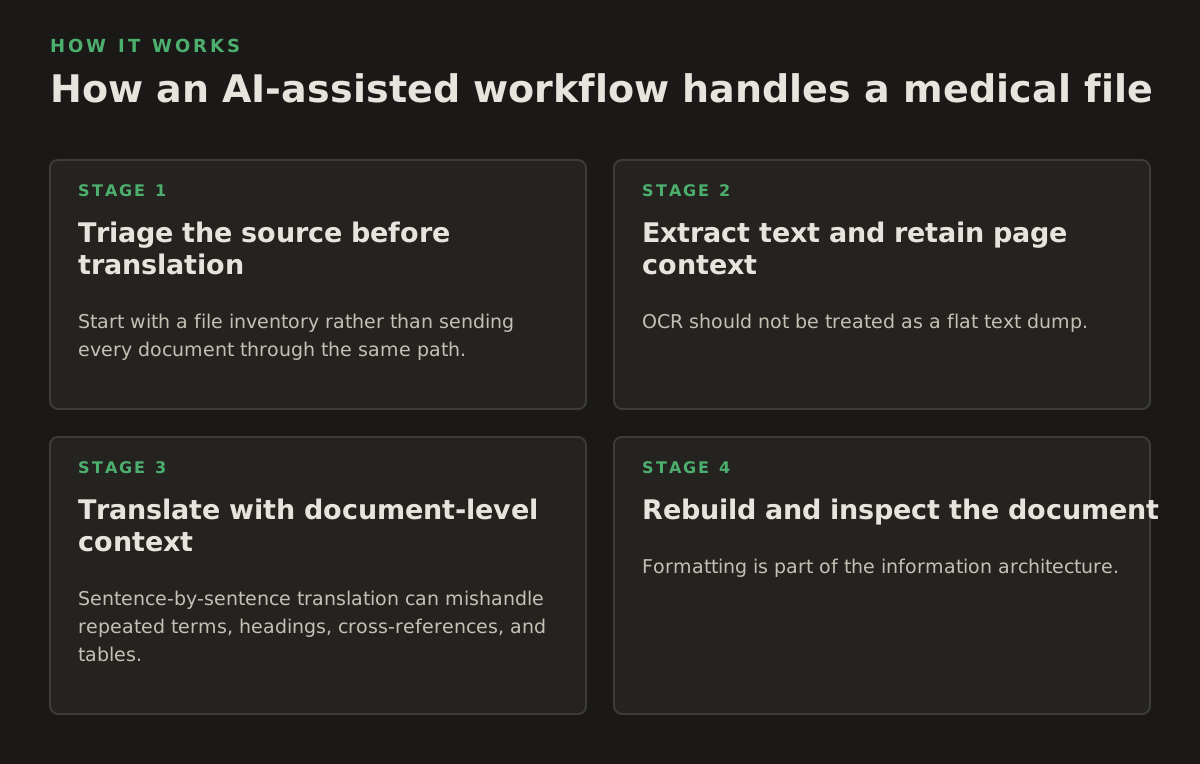
An AI document translation workflow is best understood as a pipeline with handoff points. Each stage produces a different kind of output, and each can fail independently. Treating the process as one black-box action makes it harder to identify whether a problem came from image recognition, language generation, formatting reconstruction, or review.
1. Triage the source before translation
Start with a file inventory rather than sending every document through the same path. Record the file type, page count, language pair, intended audience, sensitivity, deadline, and required output. Then inspect representative pages, including the worst-looking page rather than only the cover.
- Is the text selectable, or is the document image-only?
- Are pages rotated, skewed, faint, cropped, or double-sided?
- Are there tables, columns, diagrams, stamps, signatures, or handwriting?
- Does the file contain comments, tracked changes, hidden text, or embedded attachments?
- Must the output preserve page numbering, headers, footers, form fields, or signatures?
This triage determines whether the task is ordinary text translation, OCR-assisted translation, or a reconstruction job. It also identifies pages that deserve separate review. For instance, a 40-page clinical report may be straightforward except for two scanned referral letters and one table whose columns are encoded as positioned text.
2. Extract text and retain page context
OCR should not be treated as a flat text dump. The system needs to retain page number, reading order, table boundaries, headings, captions, and the relationship between labels and values. A line such as “Right: 12 mm; Left: 8 mm” becomes unsafe if extraction interleaves it with a neighboring column.
Recognition quality is affected by resolution, contrast, font, skew, compression, background noise, and handwriting. A practical process marks uncertain regions for review instead of silently converting them into confident-looking text. Where the source is genuinely ambiguous, the correct action may be to ask the document owner for clarification or preserve an uncertainty note, not to guess.
3. Translate with document-level context
Sentence-by-sentence translation can mishandle repeated terms, headings, cross-references, and tables. A document-level process should identify recurring terminology and preserve consistent translations for items such as procedure names, anatomical structures, adverse-event terms, and study arms.
Terminology resources can include a sponsor-approved glossary, product label, institutional vocabulary, prior approved translations, or a style guide. The glossary should distinguish terms that look similar but are not interchangeable. It should also state what remains unchanged, including study identifiers, brand names, chemical formulas, gene symbols, and measurement units where required by the project.
AI can accelerate the first translation and help preserve structure, but the source of truth remains the approved medical and project terminology. A general-language model may select a plausible synonym that is unacceptable in a controlled document. That is a reason to use terminology constraints and targeted review, not a reason to assume that fluency equals approval.
4. Rebuild and inspect the document
Formatting is part of the information architecture. A translated sentence may expand, causing a heading to wrap, a table row to grow, or a warning box to move to another page. Rebuilding the file should preserve the relationships that help a user navigate it:
- headings and section hierarchy;
- tables, row labels, column headers, and footnotes;
- page numbers, headers, and document version information;
- callouts, warning symbols, captions, and cross-references;
- images, diagrams, form fields, and signature areas.
Visual inspection should be performed in the final output format, not only in an editor view. Check for clipped text, missing glyphs, substituted fonts, overlapping objects, broken links, orphaned headings, blank pages, and tables that have become unreadable. In a regulatory or legal workflow, retain the original and translated files as separate artifacts and define how revisions are identified.
5. Review according to risk
Not every sentence requires the same review intensity. A useful review plan assigns more scrutiny to content that can change treatment, eligibility, consent, safety, legal interpretation, or the identity of a person or product.
| Content type | Primary risk | Review emphasis |
|---|---|---|
| Dosage and administration | Number, unit, frequency, or route changes | Compare against the source and approved terminology |
| Laboratory and imaging results | Value, qualifier, range, or table association changes | Check each value, sign, unit, row, and footnote |
| Consent and patient instructions | Unclear action, omitted risk, or inappropriate reading level | Use clinical and audience review without changing scope |
| Legal or regulatory text | Version, obligation, definition, or evidence issue | Maintain traceability and obtain the required formal review |
| Scanned handwritten material | OCR misread or uncertain mark | Compare visually and escalate ambiguity |
For high-consequence files, define who can approve the final text. A translator, clinician, study manager, regulatory specialist, or legal reviewer may each catch different defects. AI output can be a productive draft or processing layer, but an organization should not imply that an automated result is clinically approved merely because it retains the original layout.
Where medical translation workflows break
The hardest problems are often not rare diseases or exotic languages. They are ordinary production conditions: low-quality scans, inconsistent source documents, missing context, and pressure to deliver a file that looks finished before it has been checked.
OCR uncertainty and damaged sources
OCR commonly struggles with faint photocopies, fax artifacts, superscripts, subscripts, hyphenated terms, mixed alphabets, and handwriting. A scan may also contain a stamp over a result or a correction written beside the original value. If the text layer is wrong, a later translation stage can only reproduce the wrong input more elegantly.
Use a page-level exception list. For each uncertain item, capture the page, region, extracted text, visible text, and disposition. That record is more useful than a vague note saying “OCR checked,” particularly when a second reviewer must revisit the file.
Abbreviations, symbols, and units
Medical abbreviations depend on specialty and context. “MS” might refer to a disease, a specialty, or a unit-related notation. Symbols may be lost during conversion, and decimal conventions vary by language. Date formats can also create ambiguity: a sequence such as 03/04/2026 cannot safely be interpreted without knowing the source convention and document context.
- Keep a project rule for dates, times, decimal separators, and thousands separators.
- Decide whether units are preserved, converted, or shown in both forms.
- Do not expand an abbreviation unless the source or approved glossary supports the expansion.
- Flag symbols that could affect dosage, direction, laterality, or measurement.
- Compare translated tables cell by cell when values drive a decision.
Names, medicines, and local conventions
A medicine may have a brand name in one market and a different brand name elsewhere, while the active ingredient remains the stable reference. The same issue appears with medical devices, hospitals, departments, qualifications, and public authorities. Translation teams should establish whether proper names are retained, transliterated, translated, or accompanied by an explanatory form.
Regulatory product information is especially sensitive to controlled wording and versioning. The European Medicines Agency publishes requirements and templates for human-medicine product information, illustrating why a translation project may need to align with an official product-information structure rather than rely on general linguistic preference (EMA product-information requirements). The applicable authority and market should be confirmed for the specific file; one jurisdiction’s convention should not be assumed to govern another.
Privacy and data handling
Medical documents can contain direct identifiers, dates, diagnoses, images, addresses, insurance details, and free-text notes. Before using an external translation workflow, the organization should establish what data may be uploaded, who may access it, how long files are retained, and whether the processing arrangement is permitted by its policies and applicable law.
De-identification can reduce exposure, but it must be done carefully. Replacing a patient name may not be enough if the document still contains a rare date, facility, accession number, or narrative combination that identifies the person. The privacy assessment belongs with the organization’s privacy, security, procurement, or compliance owners. HHS provides a starting point for understanding HIPAA’s privacy framework and protected health information, but the applicable obligations depend on the parties and processing arrangement (HHS HIPAA Privacy Rule information).
Unsupported certainty
The most dangerous workflow behavior is silent confidence. If a scan is illegible, the output should not present a guessed value as certain. If a term has two plausible meanings, the ambiguity should be escalated. If a table cannot be reconstructed reliably, the project owner should know before the translated file is distributed.
A simple status model helps:
- Verified: source text and translation have been checked for the defined risk level.
- Needs review: an OCR, terminology, layout, or context issue remains open.
- Not translatable from source: the original is too ambiguous or incomplete to support a reliable result.
- Approved for stated use: the designated reviewer has accepted the file for its specific audience and purpose.
How practitioners apply it by document purpose
The same platform can support several teams, but the operating procedure should begin with the job the document must perform. Ask who will read it, what decision it supports, what must remain visually identical, and who has authority to approve the translated version.
Clinical operations and patient care
For a patient record, preserve chronology, authorship, dates, identifiers, and distinctions between observation, diagnosis, recommendation, and patient statement. Do not rewrite a clinician’s uncertainty into a definitive finding. If the output is for patient use, separate translation from any plain-language adaptation and label the deliverable clearly.
For patient instructions, review action verbs, timing, warning signs, contact details, and navigation cues. A readable translation that hides a warning in a dense paragraph is not operationally successful. Use the final rendered file to confirm that headings and callouts still draw attention to the intended actions.
Clinical research and universities
Research teams should align the translation with the protocol version and study terminology. Maintain consistency across the protocol, consent materials, case-report forms, recruitment content, and investigator documents. A changed term can make cross-document review harder even when each individual sentence is understandable.
For academic papers, retain citations, figure references, equations, tables, and supplementary labels. Researchers may need a translated working copy for collaboration rather than a publication-ready version. State that distinction at intake. It affects how much attention is given to journal style, bibliographic conventions, and final typesetting.
Manufacturers and regulatory teams
Manufacturers should treat labels, instructions for use, safety notices, and technical documentation as controlled artifacts. The working file should identify the source version, target market, language, reviewer, and approval state. A layout-preserving translation is useful because it lets reviewers compare warnings, diagrams, and table positions, but visual similarity does not replace content review.
Use a structured handoff with at least these fields:
- source filename and version;
- target language and market;
- intended audience and permitted use;
- glossary or reference terminology;
- pages or regions requiring OCR review;
- required output format;
- reviewers and approval conditions;
- known exclusions, ambiguities, or unresolved questions.
Legal teams and government organizations
For court records, affidavits, insurance files, or government submissions, preserve the evidentiary character of the source. Distinguish typed text, stamps, signatures, annotations, and translator notes. Do not remove an error from the original by silently correcting it in translation. If certification, notarization, a sworn statement, or a specific chain of custody is required, treat that as a separate requirement from AI-assisted document processing.
Government health materials often combine public-facing language with formal policy language. Reviewers should check whether names of programs, agencies, phone numbers, eligibility rules, and links are current for the target jurisdiction. A translation workflow can preserve the document, but it cannot independently decide whether a local service reference is still valid.
Publishers and healthcare businesses
Publishers, medical associations, and businesses often process long reports, ebooks, presentations, and training materials. Their main risks are consistency and production quality: repeated terms drift, charts become detached from captions, and translated text changes pagination. Establish a house glossary, define whether the output is a translation or adaptation, and inspect a representative sample of every document type before scaling the workflow.
For presentations, check speaker notes, chart labels, footers, and text embedded inside images. For EPUB or other reflowable formats, inspect the reading experience at different display sizes because a page-perfect approach does not apply in the same way. For PDFs, compare the rendered pages, not just the extracted text.
A defensible starting policy for 2026
Organizations do not need one universal workflow for every medical file. They need a decision policy that matches review effort to consequence. The following is an illustrative starting policy, not a universal benchmark:
- Low-consequence internal material: AI-assisted translation, terminology spot checks, and visual inspection of the final file.
- Patient-facing instructions: OCR review where needed, terminology review, readability review, and clinical-owner approval.
- Clinical-trial or regulatory material: controlled glossary, source-version tracking, targeted bilingual review, and documented approval.
- Legal or evidentiary material: source preservation, page-level traceability, handling of annotations, and any certification process required by counsel or the receiving authority.
- Unreadable or ambiguous content: stop and obtain clarification rather than allowing an automated system to fill the gap silently.
Set acceptance criteria before processing. For example, a team might require that every page be present, every table be visually checked, all dosage and date fields be compared with the source, and all unresolved OCR items be listed. Those are example controls; the responsible clinical, legal, regulatory, or privacy owner should decide which controls are mandatory for the use case.
Questions to ask before selecting a workflow
- Is the source text born-digital, scanned, or mixed?
- What errors would cause the greatest harm or rework?
- Which terms, units, names, and identifiers must remain unchanged?
- Does the output need the original layout, or only a reliable text version?
- Who will review clinical meaning, and who will review formatting?
- What privacy rules and internal policies govern the file?
- How will revisions, source versions, and approval status be recorded?
- What happens when the source is ambiguous?
The strongest recommendation is to pilot the workflow on a representative sample that includes the hardest pages, not just clean text. Include one table, one image-heavy page, one page with headers and footers, and any recurring form or report type. Measure success against the project’s acceptance criteria: preserved structure, correct terminology, visible uncertainty, and reviewer approval. Do not use a visually polished output as evidence that the medical content is safe.
InOtherWord.AI is designed for document translation across PDFs, scanned PDFs, DOCX files, PowerPoint presentations, and EPUB books, with formatting, layout, tables, and images kept in view. For teams planning a repeatable workflow, InOtherWord.AI can be a practical starting point for evaluating how AI-assisted file translation fits alongside clinical, legal, regulatory, and privacy review.
Authored with NotFair SEO
Related guides
Keep researching the right workflow
These pages help move from general document-translation research into the specific file format or workflow you need.
A practical workflow for translating scanned PDFs with OCR while preserving enough structure for real review, sharing, and downstream editing.
Explore pageHow to translate PPT and PPTX decks without breaking slide layouts, charts, and speaker-ready formatting.
Explore pageThe best AI PDF translator is not just about language quality. It also needs OCR, layout preservation, and reviewable output for real files.
Explore pageCommercial pages
Ready to translate the actual file?
Jump from the guide into the product page that fits your document type, then continue into pricing when you are ready.
Format page
Translate PDF Documents
Translate PDF files while preserving layout, tables, and page structure.
Explore pageFormat page
Translate Scanned PDFs
OCR and translate scanned PDFs without rebuilding the layout by hand.
Explore pageFormat page
Translate PowerPoint Presentations
Translate PPT and PPTX decks while preserving slide layouts, tables, and speaker-ready formatting.
Explore pageTranslate layout-heavy PDF reports, manuals, forms, and client-ready files while keeping tables, headings, and images readable.
Explore page