Translation Tests Examples: A Practical QA Guide
Published Sun Oct 04 2026 | 11 min read
Translation tests examples for legal, research, business, and health documents: reusable checks for meaning, terminology, numbers, layout, and review.
Translation tests examples are reusable source-and-target checks that show whether a translated document preserves meaning, required terminology, numbers, tone, and usable formatting. For a contract, research paper, report, or patient handout, start with a small set of consequential passages, define what must be true in the translation, and record what would count as a failure. The examples below help teams choose checks that match the risk of each document—not just whether the target text sounds fluent.
A useful test does not demand one exact translation when several are acceptable. It identifies the source meaning, the context that matters, and observable pass/fail conditions. That distinction lets reviewers catch substantive errors without rejecting valid wording differences. The examples are illustrative, not approved legal, clinical, or jurisdiction-specific translations; have a qualified reviewer confirm wording before relying on it.
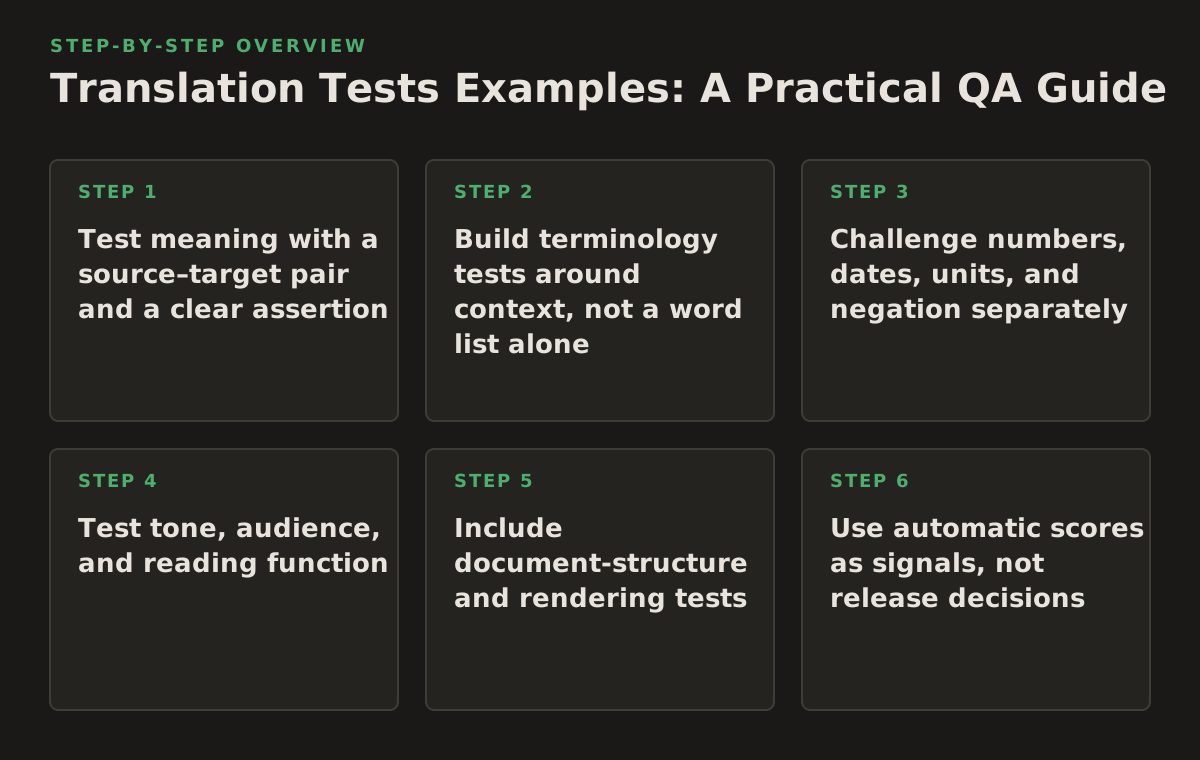
1. Test meaning with a source–target pair and a clear assertion
Use this test when a sentence contains a decision, obligation, or claim that could be changed by a mistranslation. It works because the reviewer judges the effect on meaning rather than matching words one by one. A common failure is writing an “expected answer” so narrowly that a correct paraphrase fails—or so vaguely that a serious omission passes.
Example: a contract obligation
Source: “The supplier shall notify the customer within five business days after discovering the breach.”
Test assertions: The target retains the supplier as the responsible party; notification is mandatory; the deadline is five business days; and the deadline begins after discovery of the breach.
This test demonstrates how to break one sentence into independently reviewable obligations. It works even when the target-language sentence structure differs from the English. Adapt it by identifying the actor, action, condition, deadline, and exception in each high-impact clause. For legal use, a bilingual legal reviewer should confirm that the target wording preserves the intended obligation under the relevant jurisdiction; a general language check cannot establish that.
- Store the source passage and its surrounding paragraph.
- Write the meaning assertions before reviewing the translation.
- Record each failed assertion and the corrected target wording.
Failure mode: Testing only sentence-level fluency can miss who must act or when. Include context where a pronoun, defined term, or cross-reference depends on nearby text. A quality framework such as MQM’s translation-quality issue categories can help teams name and classify errors instead of recording only “bad translation.”
2. Build terminology tests around context, not a word list alone
Use terminology tests when one term has a controlled meaning across a contract, study, product, or publication. They work by checking whether a preferred term is used in the right context and whether competing terms create confusion. A glossary-only test can fail if it flags an acceptable inflection, or if it treats a term as fixed when the source uses it in a different sense.
Example: a research term with a defined meaning
Source: “The study reports the confidence interval for the primary outcome.”
Test: In the target passage, the term for “confidence interval” must match the project glossary’s approved term. It must not be replaced with wording that means “confidence level” or “range of certainty” if that would change the statistical concept.
The example shows why a term needs a definition and domain context, not just a preferred equivalent. Adapt it by recording the source term, approved target term, definition, disallowed alternatives if necessary, and an example sentence. The W3C’s Internationalization Tag Set 2.0 describes mechanisms for marking localization-related information, including terminology, in content workflows; teams can use that kind of structured information to keep instructions attached to the text.
For terminology features or processes, verify the exact behavior in the documentation for the tool your team actually uses. For example, Google Cloud’s glossary documentation describes glossary resources for controlling translations of specified terms. That supports a terminology workflow; it does not prove that every preferred term is contextually correct.
- Test a term in a sentence, not only as a standalone pair.
- Include a “do not use” alternative only when it prevents a meaningful error.
- Assign a glossary owner who can approve changes and preserve version history.
Failure mode: A glossary can become stale as a project changes. Tie each entry to an owner and review point, especially when a legal definition, study protocol, or product label is revised.
3. Challenge numbers, dates, units, and negation separately
Use contrastive tests for details that can reverse a decision: an amount, date, dosage, measurement, condition, or negative instruction. They work because they ask the reviewer to compare the source and target fact by fact, rather than assume that fluent prose is faithful. A frequent failure is checking only that a number appears somewhere, without checking its unit, sign, date convention, or relationship to the surrounding phrase.
Example: a clinical instruction
Source: “Do not take more than 2 tablets in 24 hours.”
Test assertions: The prohibition remains explicit; “2” remains the maximum; the unit is tablets; and the 24-hour period is retained.
This is a high-risk example because dropping “not,” changing the maximum, or weakening the time window changes the instruction. Adapt the format for a financial report (“€1.5 million,” including currency and decimal convention), a filing deadline, or a laboratory unit. A reviewer should compare the rendered target against the source, not rely on a back-translation to certify correctness.
Make the test record explicit about formatting rules where they matter. For instance, note whether the target locale expects a different decimal separator or date order, while preserving the underlying value. Ask a subject-matter reviewer to decide if unit conversion is permitted; do not silently convert units simply because a target audience commonly uses another system.
- Mark negatives, ranges, percentages, currencies, and units for direct comparison.
- Check that a date’s day, month, and year remain the same even if display order changes.
- For high-risk instructions, require independent confirmation by a qualified reviewer.
Failure mode: Blindly matching characters can reject valid localized formatting; checking only semantic similarity can miss a changed value. Use separate assertions for the value and its acceptable target-language presentation.
4. Test tone, audience, and reading function
Use a tone test when the document must prompt a particular response, such as complying with a notice, understanding a health instruction, or following a course activity. It works by defining the relationship with the reader and the action the text should support. A failure is asking reviewers to rate tone as “good” or “natural” without describing the audience or purpose.
Example: a public-facing instruction
Source: “Please submit the completed form before your appointment.”
Test: The target remains a courteous, direct request; it still asks the reader to submit the completed form; and it retains the “before the appointment” deadline.
Adapt this test for an educator’s assignment, a government notice, or a publisher’s reader-facing introduction. Specify whether the target should be formal, plain-language, encouraging, or strictly procedural, and name the intended reader. Microsoft’s localization style guides offer language-specific guidance that teams can consult when setting conventions such as tone, punctuation, and address. Use the relevant guide as a reference, not as a substitute for the organization’s own audience requirements.
Failure mode: A tone preference can override content. A reviewer may make a sentence warmer by softening a mandatory instruction. Keep the action, obligation, and deadline as pass/fail requirements; assess tone only after checking those essentials.
5. Include document-structure and rendering tests
Use structure tests when meaning depends on layout, such as a table heading, footnote, slide label, or text paired with an image. They work by checking whether content remains associated with the right label and appears in a usable reading order. A translation can be accurate sentence by sentence yet fail as a document if a translated table header no longer maps to the correct column.
Example: a results table
Source check: A table has columns labeled “Measure,” “Baseline,” and “Follow-up.”
Test assertions: All three labels are translated; each label remains above the corresponding data column; the values remain under the correct headings; and footnotes still point to the intended rows.
Adapt the same logic to slides: verify that a chart title, axis labels, legend, and footnote still describe the displayed data. For right-to-left languages, inspect reading order and punctuation in the rendered file as well as in extracted text. The Unicode Bidirectional Algorithm explains how bidirectional text ordering is handled; visual inspection remains important because a technically valid text sequence can still be confusing in a particular layout.
Failure mode: A text-only review misses overflow, misplaced labels, broken line breaks, and image text that was never extracted. For scanned documents, confirm that the recognized text is complete before judging its translation. If the input is a scan, see how to translate scanned PDFs; for born-digital files, the translate PDF documents page is the relevant starting point. These page labels identify the subject of the pages, not a guarantee that a particular file will preserve every layout element.
| Test category | Prioritize when | Pass condition | Typical reviewer |
|---|---|---|---|
| Meaning and obligations | Contracts, policies, consent forms | Actors, duties, conditions, and exceptions are retained | Bilingual subject-matter reviewer |
| Terminology | Research, products, recurring publications | Approved terms fit their context | Terminology owner or domain reviewer |
| Numbers and negation | Clinical, financial, technical, legal content | Value, unit, direction, and prohibition are unchanged | Subject-matter reviewer |
| Tone and function | Public notices, education, reader-facing material | Target suits the audience without weakening content | Language reviewer and content owner |
| Structure and rendering | Tables, slides, scans, forms, image-heavy files | Labels, values, order, and references remain usable | Document reviewer |
6. Use automatic scores as signals, not release decisions
Use automatic metrics to compare outputs or spot candidates for review, not to declare a consequential document correct. They work best when the team understands what the metric measures and has human checks for the errors it cannot resolve. A common failure is treating a single score as proof that obligations, terminology, or clinical meaning are intact.
For example, a reference-based metric may assign different scores to two valid translations because they use different wording. The original BLEU paper describes a method based on matching word sequences against reference translations; that makes it useful as a comparison signal, but a match score is not a direct assessment of legal effect or factual accuracy. See the paper in the ACL Anthology and keep human review for meaning-sensitive passages.
Failure mode: A high aggregate score can conceal one dangerous sentence among many routine sentences. Use a risk-weighted review queue: automatically flag suspicious values or missing terms, then send high-consequence passages to a qualified reviewer regardless of the overall score. For lower-risk prose, sample according to a documented policy and expand review when a defect appears.
7. Turn examples into a maintained test set
Use a maintained test set when documents recur, such as contract templates, annual reports, course materials, or a series of publications. It works because each correction can prevent the same class of error from slipping through a later revision. The failure mode is accumulating examples without ownership: outdated passages then test the old document rather than the current one.
Example: a versioned report test
For a quarterly report, retain one approved passage for terminology, one for number formatting, one for a table, and one for a claim whose meaning must not shift. When the source changes, update the affected test and note why. Label each example by language pair, subject, source version, expected behavior, reviewer, and date reviewed. If the source context changes enough to alter meaning, retire or rewrite the test instead of carrying it forward unchanged.
Keep a short defect log with the passage, issue category, severity, correction, and whether the test set was updated. A practical starting policy—not a universal benchmark—is to review every high-risk defect and its related tests before the next release, while assigning an owner to decide whether low-impact style preferences belong in the suite. This makes test maintenance a controlled decision rather than an endless collection of subjective edits.
Implementation plan: build, review, and release in sequence
- Choose the risk-bearing content. List the document types and passages where an error could change an obligation, decision, amount, instruction, or reader action. Do not spend equal review effort on every sentence.
- Write test assertions before reviewing output. For each selected passage, record the source context, intended meaning, must-keep details, acceptable variation, and likely failure. Use the table above to assign the right reviewer.
- Review content and document separately. First check meaning, terminology, numbers, and tone. Then inspect the rendered document for tables, labels, reading order, overflow, and missing text. Record defects distinctly so a layout issue is not mistaken for a translation issue.
- Correct and preserve the lesson. When a defect appears, fix the target and decide whether the example should become a permanent regression test. Assign an owner and review date so the test remains relevant to the source version.
- Make a documented release decision. Resolve every high-risk failure, note accepted lower-risk issues and their rationale, and identify who approved the release. A test suite supports judgment; it does not replace the accountable subject-matter reviewer.
InOtherWord.AI describes a platform for translating PDFs, scanned PDFs, DOCX files, PowerPoint presentations, and EPUB books while preserving document elements such as layout and tables. If you are preparing a document workflow, explore InOtherWord.AI alongside a review plan that checks the passages and rendered files that matter for your audience.
Authored with NotFair SEO
Related guides
Keep researching the right workflow
These pages help move from general document-translation research into the specific file format or workflow you need.
A practical workflow for translating scanned PDFs with OCR while preserving enough structure for real review, sharing, and downstream editing.
Explore pageHow to translate PPT and PPTX decks without breaking slide layouts, charts, and speaker-ready formatting.
Explore pageThe best AI PDF translator is not just about language quality. It also needs OCR, layout preservation, and reviewable output for real files.
Explore pageCommercial pages
Ready to translate the actual file?
Jump from the guide into the product page that fits your document type, then continue into pricing when you are ready.
Format page
Translate PDF Documents
Translate PDF files while preserving layout, tables, and page structure.
Explore pageFormat page
Translate Scanned PDFs
OCR and translate scanned PDFs without rebuilding the layout by hand.
Explore pageFormat page
Translate PowerPoint Presentations
Translate PPT and PPTX decks while preserving slide layouts, tables, and speaker-ready formatting.
Explore pageTranslate layout-heavy PDF reports, manuals, forms, and client-ready files while keeping tables, headings, and images readable.
Explore page