Translation And Transcription Services: A Practical Buyer’s Guide for Document Teams
Published Sun Aug 30 2026 | 17 min read
Compare translation and transcription services by workflow, accuracy, security, pricing model, and review needs for legal, research, business, and public teams.
When a legal team receives a recorded deposition, a university acquires foreign-language journals, or a healthcare department must process scanned forms, translation and transcription services solve related but different problems. This guide helps you decide whether you need transcription, translation, OCR, localization, human review, or a combination—and how to specify the work so the delivered files are usable rather than merely readable.
The important decision is not “Which provider has the best translation?” It is which workflow matches the source material, risk level, output format, and review capacity. A clean DOCX contract, a handwritten scan, a multilingual PowerPoint, and a two-hour interview should not be purchased or measured in the same way.
1. Separate the service categories before requesting quotes
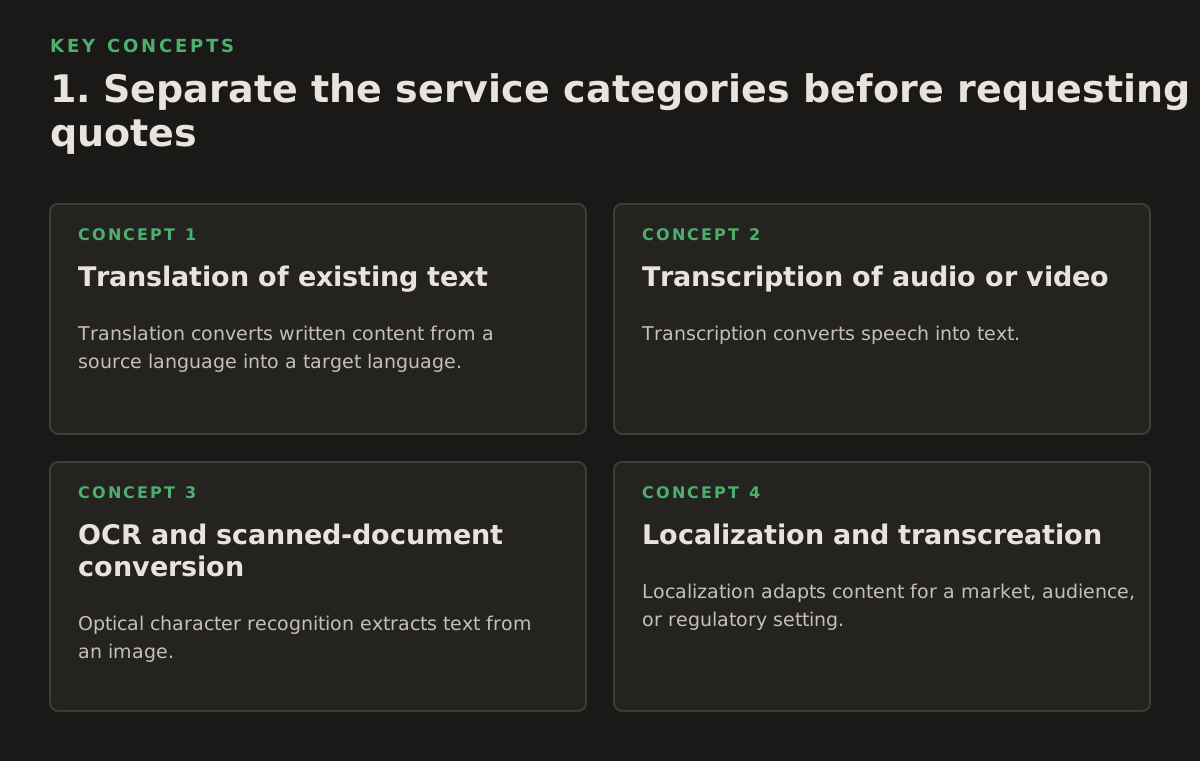
Many procurement mistakes begin with one broad request for “translation.” Vendors may interpret that request as text conversion, audio transcription, OCR, localization, or a bundle of all four. Define the service by the transformation your source requires.
Translation of existing text
Translation converts written content from a source language into a target language. It suits contracts, policies, research articles, reports, books, presentations, and correspondence where the words already exist in machine-readable or visually readable form. The deliverable may be plain text, a DOCX, a PDF, a slide deck, or an EPUB.
For document-heavy work, ask whether the provider preserves tables, footnotes, headers, page breaks, images, and reading order. A linguistically correct translation that destroys a court exhibit’s pagination or a financial report’s columns may still fail its operational purpose. If your source is a standard PDF, the document workflow described at translate PDF documents is more relevant than a generic paragraph translation tool.
Transcription of audio or video
Transcription converts speech into text. It serves interviews, hearings, depositions, lectures, focus groups, podcasts, medical dictation, and recorded meetings. The specification should state whether you need verbatim speech, edited readable prose, speaker labels, timestamps, non-speech events, or translation after transcription.
Transcription is not translation. A Spanish interview transcribed in Spanish remains a Spanish transcript. If an English-language record is required, the workflow is usually transcription first, translation second, followed by review of names, technical terms, and ambiguous speech.
OCR and scanned-document conversion
Optical character recognition extracts text from an image. It is necessary when a PDF contains scanned pages, photographed forms, fax artifacts, marginal notes, seals, or typewritten material. OCR may be an intermediate step before translation, or it may be the principal deliverable if the buyer needs searchable text.
OCR quality depends on the source, not only the software. Skew, low contrast, handwriting, stamps over text, unusual fonts, tables, and mixed scripts can create errors that ordinary spell-checking will not detect. A scanned contract with a missing “not” is a risk event, not a cosmetic defect. For this class of source, translate scanned PDFs addresses the distinct scanned-PDF workflow.
Localization and transcreation
Localization adapts content for a market, audience, or regulatory setting. It can include date and number formats, currency, terminology, examples, user-interface limits, and culturally appropriate phrasing. Transcreation goes further when the persuasive effect matters, such as campaign copy, fundraising materials, or educational titles.
Use localization when the reader must act naturally in the target market. Use close translation when legal fidelity, archival traceability, or scholarly quotation is more important than idiomatic style. A provider that offers only one undifferentiated “accuracy” level is making a decision that belongs to the buyer.
Human review and certification
Review can mean bilingual proofreading, terminology validation, legal comparison, subject-matter editing, or certification by an authorized professional. These are different services. Ask exactly who reviews the output, against what source, and what evidence of review is delivered.
ISO 17100 describes requirements for core processes and resources in human translation services, including competence and workflow considerations; it does not make every translation suitable for every legal or regulatory purpose. Treat the standard as one evaluation input rather than a substitute for checking the provider’s actual process. See the official ISO record for the scope of ISO 17100:2015: ISO 17100.
2. Match the workflow to the source and the consequence of error
The same language pair can require radically different handling. Start with a source inventory and a consequence-of-error assessment before discussing tools or rates.
Classify the source
- Structured digital text: DOCX, editable slides, HTML, or EPUB with selectable text.
- Fixed-layout text: native PDFs where pagination, exhibits, and visual comparison matter.
- Image-only documents: scanned PDFs, photographs, faxes, and forms requiring OCR.
- Audio or video: recordings with variable sound quality, several speakers, or overlapping speech.
- Mixed packages: appendices, charts, handwritten annotations, embedded images, and multiple file types.
Then classify the consequence if an error survives review. A typo in an internal brainstorming memo is different from a mistranslated dosage instruction, a missing contract exception, or an incorrect party name in a filing. Risk should determine review depth, not the file extension.
Use a risk matrix
| Buyer need | Best-fit service type | Primary trade-off | Acceptance evidence |
|---|---|---|---|
| Searchable text from a clean scan | OCR with layout-aware export | Speed and scale versus recognition errors in tables, stamps, or unusual fonts | Sampled comparison against page images; search and copy tests |
| Readable internal understanding of a digital report | Machine-assisted document translation with light human review | Lower delivery burden versus terminology and formatting risk | Glossary check, target-language review, and visual inspection |
| Contract, court exhibit, or regulated record | Human translation with subject-matter review and controlled files | More coordination and review effort versus stronger accountability | Terminology log, tracked corrections, source-target comparison, and required certification |
| Interview or hearing recording | Speaker-labeled transcription, optionally followed by translation | Audio ambiguity and timestamp effort versus a usable evidentiary record | Speaker identification, timestamp sampling, inaudible markers, and terminology review |
| Public campaign or learner-facing content | Localization or transcreation with audience review | Natural impact versus reduced word-for-word traceability | Audience review, style guide adherence, and functional display checks |
| Accessible video or lecture archive | Transcription plus caption-ready time alignment and translation if needed | More timing and formatting work versus better access and reuse | Caption timing, speaker changes, terminology, and accessibility checks |
The matrix is a starting policy, not a universal rule. A research archive may prioritize faithful preservation of quotations, while a sales team may prioritize natural phrasing. Record the decision in the statement of work so a later reviewer knows why the workflow was selected.
Worked example: a scanned court exhibit
Suppose counsel has a 70-page scanned exhibit in Portuguese and needs an English working copy. The sensible sequence is image inspection, OCR, bilingual translation, visual comparison, and attorney review of names, dates, monetary amounts, negations, and handwritten annotations. A provider that returns only a fluent DOCX has not demonstrated that the exhibit’s page-level meaning survived.
Failure mode: treating OCR confidence as translation accuracy. OCR can misread the source before translation begins. Require the vendor to preserve page references and flag uncertain text rather than silently normalizing it.
3. Specify quality as observable checks, not a promise of “accuracy”
“Accurate” is too vague to manage. A usable specification turns quality into tests tied to the buyer’s purpose.
Define the quality dimensions
- Semantic fidelity: meaning, negation, conditions, quantities, names, dates, and legal effect remain correct.
- Terminology consistency: approved terms, product names, defined terms, and institutional vocabulary are used consistently.
- Completeness: headings, captions, footnotes, appendices, speaker turns, and visible text are not omitted.
- Layout integrity: tables, page order, charts, formulas, and reading sequence remain usable.
- Audience fit: tone, register, regional conventions, and reading level suit the intended audience.
- Traceability: reviewers can map a target passage to the source page, timestamp, paragraph, or segment.
For accessibility work, do not assume that a transcript is automatically a caption file. WCAG 2.2 distinguishes captions for prerecorded synchronized media as an accessibility requirement under its success criteria; the W3C specification explains the requirement and its conditions at WCAG 2.2, Captions (Prerecorded). Your acceptance test should therefore include timing, speaker changes, and meaningful non-speech information where applicable.
Build an acceptance sample
Before full production, select representative pages or minutes of audio. Include the difficult material, not just the clean opening pages:
- a dense table with merged cells;
- a page containing a stamp, signature, or handwritten note;
- a paragraph with defined terms and cross-references;
- an audio segment with overlapping speakers or background noise;
- a slide containing charts, text inside images, and small labels;
- a bibliography, footnote, formula, or citation-heavy section.
Compare the output against the source using a written checklist. For a legal document, record whether party names, dates, amounts, obligations, exceptions, and exhibit references match. For a journal article, check citations, figure labels, units, and terminology. For a PowerPoint, inspect every slide at normal presentation size rather than only reading the extracted text.
Choose measurable success criteria
Use criteria the buyer can actually verify. Examples include:
- all pages are present and remain in source order;
- all named speakers are labeled consistently or marked unknown;
- every approved glossary term is used as specified;
- all figures and tables have corresponding translated labels;
- uncertain audio or unreadable source text is explicitly marked;
- the target file opens, searches, exports, and renders in the required software;
- corrections are returned in a documented revision cycle.
These are acceptance tests, not invented accuracy percentages. If a vendor proposes a numeric quality threshold, ask how it is measured, who samples the work, and what happens when the threshold is missed.
Failure mode: sampling only fluent paragraphs. Smooth prose can hide omitted footnotes, altered numbers, or layout failures. Make the sample deliberately adversarial.
4. Treat privacy, security, and retention as procurement requirements
Translation and transcription workflows often expose contracts, health information, personnel records, research participants’ statements, or government material to software and human reviewers. “Confidential” in a sales conversation is not a control. Ask where files go, who can access them, how long they remain available, and whether they can be used to improve a system.
Map the data before uploading it
Create a short data-flow record covering:
- source files and embedded metadata;
- personal, financial, health, legal, or export-controlled information;
- subprocessors, human linguists, and automated systems involved;
- storage locations and transfer mechanisms;
- retention, deletion, backup, and account-access practices;
- return format and whether temporary working files are included.
For European personal data, special categories include information such as health data and biometric data under Article 9 of the GDPR, subject to the regulation’s conditions and exceptions. Do not infer that a translation provider is permitted to process such information merely because the service is technically capable; involve your privacy or procurement function. The official text is available through Regulation (EU) 2016/679.
For broader AI-assisted workflows, NIST’s AI Risk Management Framework organizes risk work around governing, mapping, measuring, and managing. It is a useful structure for asking what the system does with your content and how risks are monitored, but it is not a certification of a particular provider. See the framework at NIST AI RMF.
Ask precise security questions
- Is customer content used for model training, service improvement, or human quality review?
- Can the buyer disable secondary use, and is that restriction contractual?
- What personnel or subprocessors can view source and target files?
- What are the retention and deletion rules for active files, logs, and backups?
- Can the provider support access controls, audit records, and required data-location terms?
- How are confidential files transferred and returned?
- What happens if a file contains malware, hidden comments, or embedded personal data?
Failure mode: evaluating only the final download. A secure-looking output says nothing about temporary copies, reviewer access, or retention. Require answers for the entire processing chain and make unresolved items approval blockers for sensitive material.
5. Compare delivery burden and pricing models before comparing bids
A quote is not comparable unless the work definition is comparable. One provider may price by source word, another by page, audio minute, file, project, review hour, or a combined package. None of those models is inherently better; each shifts uncertainty to a different part of the project.
Questions about pricing structure
- Is the billable unit a source word, target word, page, audio minute, slide, file, or project?
- How are scanned pages, handwritten text, tables, poor audio, and diagrams treated?
- Are OCR, formatting reconstruction, terminology preparation, review, certification, and revisions included?
- Does rush handling, multiple speakers, specialist terminology, or a second language change the quote?
- What minimum charge or file-preparation charge applies?
- What happens when the page count or audio quality differs from the estimate?
- Are taxes, platform fees, storage, export, and long-term access separate?
Ask for an itemized statement of work, not only a total. A lower apparent price may exclude the work that makes the deliverable usable, such as rebuilding a table or reviewing a scan against the image.
Match the model to uncertainty
Per-word pricing can be easy to forecast for clean, editable text but less useful when OCR is required. Per-page pricing may suit fixed-layout documents, though a page with a single paragraph and a page packed with tables are not equivalent. Per-audio-minute pricing is straightforward for clear recordings but can conceal the burden of speaker identification, timestamps, crosstalk, and inaudible segments.
For mixed or high-risk work, request a paid or unpaid pilot only under clear terms: sample size, deliverables, review method, ownership, and whether the pilot is representative. Do not treat an unusually easy sample as evidence for the whole archive.
Budget questions for internal approval
Instead of inventing a universal budget, document your own cost drivers:
- number and type of files;
- source and target languages;
- OCR or audio cleanup required;
- human review level;
- layout reconstruction and output formats;
- security, retention, and procurement requirements;
- deadline and revision allowance.
If finance needs a planning figure, label it as an illustrative starting estimate based on a representative sample and the quoted billable unit. Reforecast after the sample reveals the actual page density, audio clarity, or formatting burden.
Failure mode: choosing the lowest headline rate. The buyer later pays internally for cleanup, terminology repair, slide rebuilding, or rework. Compare total cost to an accepted deliverable, including staff review time.
6. Use a vendor interview and red-flag checklist
A vendor interview should expose process details that a feature list hides. Ask the same core questions of every finalist and require written answers for sensitive or high-consequence work.
Vendor interview checklist
- What service category do you recommend for each source type, and why?
- How do you detect whether a PDF is text-based, image-only, or mixed?
- How are OCR uncertainties, inaudible passages, and ambiguous speaker identities marked?
- Who performs linguistic review, and what subject-matter expertise is relevant to this project?
- How do you handle names, defined terms, citations, formulas, units, and approved glossaries?
- Can you return the required format while preserving tables, page references, slide structure, or timestamps?
- What is included in the quoted unit, and what events trigger a change order?
- What are the retention, deletion, access, subprocessors, and model-training terms?
- What evidence will accompany delivery: change log, QA report, glossary, source-target comparison, or issue list?
- How are corrections handled, within what stated period, and at whose cost when the specification was met?
Red flags that should change the award decision
- Guaranteed perfection without a measurement method.
- No distinction between OCR, translation, transcription, and localization.
- A refusal to describe retention, human access, or secondary use of content.
- A sample that excludes tables, poor scans, technical terms, or difficult audio.
- Claims that formatting is preserved without naming supported output types or exceptions.
- No process for marking unreadable text, uncertainty, or missing source material.
- A quote that bundles review and certification without identifying who performs them.
- Pressure to upload sensitive files before security and contractual questions are answered.
Ask finalists to demonstrate the workflow on a redacted, representative sample. The demonstration should show ingestion, text extraction, translation or transcription, review, export, and correction handling—not just the final polished page.
Failure mode: treating a tool demo as a production plan. A fluent demo may not reveal queueing, file-size limits, difficult layouts, reviewer capacity, or output defects. Make the provider explain how the demonstrated process scales to your actual package.
7. Design the handoff so the result survives downstream use
The handoff is part of the service. Legal teams need version and exhibit traceability. Researchers need citations and stable terminology. Publishers need flowing text and metadata. Educators need accessible materials. Government and healthcare teams need controlled distribution and clear ownership of corrections.
Specify the delivery package
Depending on the project, request some combination of:
- translated or transcribed final files;
- source-page or timestamp references;
- OCR text layer or searchable PDF;
- terminology list and style notes;
- list of unresolved ambiguities and unreadable sections;
- visual QA record for pages, slides, tables, and images;
- revision history and named approver;
- accessible alternatives or caption-ready files where required.
For a research group translating a 300-page archive, preservation may matter more than visual redesign. Keep the original scans unchanged, assign stable page identifiers, and store the translated text with a mapping back to each page. For a publisher converting an EPUB, inspect reflow, chapter navigation, footnotes, and embedded text in cover or illustration assets. For a business PowerPoint, review overflow and text expansion at presentation size.
Assign ownership and review gates
Use named gates rather than a single “approved” status:
- Source gate: files are complete, readable, and classified.
- Terminology gate: names, defined terms, and preferred equivalents are supplied.
- Production gate: the selected service and output format are confirmed.
- Linguistic gate: target-language meaning and register are reviewed.
- Visual or temporal gate: layout, tables, captions, timestamps, and reading order are checked.
- Release gate: privacy, certification, version, and downstream delivery requirements are satisfied.
Give the reviewer authority to reject a file for missing content, not only obvious language mistakes. A controlled rejection is cheaper than downstream ambiguity, especially when the target file will become evidence, a published record, or a patient-facing instruction.
Implementation plan: move from intake to an accepted deliverable
Use the following sequence for a new project in 2026. Adjust the order only when a legal, privacy, or deadline constraint requires it.
- Inventory the source package. Record file types, page or duration counts, languages, scan quality, audio conditions, embedded images, tables, and required outputs. Identify duplicates and missing appendices before requesting a quote.
- Classify consequence of error. Mark each file as low, moderate, or high consequence under your organization’s own policy. Escalate contracts, court materials, health information, public instructions, and documents affecting rights or payments.
- Choose the service chain. Decide whether the job is translation, transcription, OCR, localization, or a sequence such as OCR → translation → human review → layout QA. Write down why.
- Prepare the language controls. Supply a glossary, names list, style guide, jurisdictional preferences, audience, citation rules, and examples of previously approved wording. If none exists, make the provider identify terminology decisions during the pilot.
- Redact and clear the data path. Remove unnecessary personal data where possible. Confirm retention, access, subprocessors, secondary use, deletion, and required contractual terms before uploading sensitive source files.
- Request comparable proposals. Give each vendor the same representative sample and specification. Require the billable unit, inclusions, exclusions, review level, output format, change-order triggers, and correction policy in writing.
- Run an adversarial sample. Include difficult pages, tables, names, formulas, stamps, overlapping speech, or dense slides. Evaluate against the acceptance checklist rather than general impressions of fluency.
- Approve the statement of work. Include source and target languages, service chain, output files, quality gates, security terms, delivery milestones, reviewer responsibilities, and the definition of acceptance.
- Review in stages. Check extraction or transcription first, terminology and meaning second, and layout or timing third. Do not wait until the final PDF or video to discover that source text was omitted.
- Release and retain the evidence. Store the accepted output, source version, glossary, issue log, approval record, and any required certification according to your records policy. Delete temporary copies when the agreed retention period ends.
For teams that need one workflow across PDFs, scanned PDFs, DOCX files, presentations, and EPUB books, InOtherWord.AI provides AI-powered document translation designed to preserve formatting, layout, tables, and images. Review the service against the source classification and acceptance gates above at InOtherWord.AI, especially when your deliverable must remain a usable document rather than become plain translated text.
Authored with NotFair SEO
Related guides
Keep researching the right workflow
These pages help move from general document-translation research into the specific file format or workflow you need.
A practical workflow for translating scanned PDFs with OCR while preserving enough structure for real review, sharing, and downstream editing.
Explore pageHow to translate PPT and PPTX decks without breaking slide layouts, charts, and speaker-ready formatting.
Explore pageThe best AI PDF translator is not just about language quality. It also needs OCR, layout preservation, and reviewable output for real files.
Explore pageCommercial pages
Ready to translate the actual file?
Jump from the guide into the product page that fits your document type, then continue into pricing when you are ready.
Format page
Translate PDF Documents
Translate PDF files while preserving layout, tables, and page structure.
Explore pageFormat page
Translate Scanned PDFs
OCR and translate scanned PDFs without rebuilding the layout by hand.
Explore pageFormat page
Translate PowerPoint Presentations
Translate PPT and PPTX decks while preserving slide layouts, tables, and speaker-ready formatting.
Explore pageTranslate layout-heavy PDF reports, manuals, forms, and client-ready files while keeping tables, headings, and images readable.
Explore page