7 Official Document Translation Services Compared for Legal, Government, and Business Work
Published Sat Sep 19 2026 | 13 min read
Compare 7 official document translation services by certification, OCR, workflow, pricing model, implementation effort, and fit for sensitive files.
Official document translation services fall into three different buying categories: human translation agencies for certified or legally defensible work, translation APIs for teams building a workflow, and document platforms for quickly translating files while retaining layout. This comparison covers seven credible options and evaluates them by document fidelity, review and certification controls, implementation burden, and commercial model. The right choice depends on whether your deliverable is a court-ready translation, a repeatable internal process, or a usable translated PDF, DOCX, PowerPoint, or EPUB.
A birth certificate submitted to an immigration authority is not the same job as translating a 300-page research archive for internal reading. Before requesting quotes, identify the required output, source-file condition, review standard, language pair, confidentiality requirements, and deadline. In particular, ask whether “certified” means a translator’s signed statement, a notarized package, an agency certification, or simply a quality review. Those terms are not interchangeable.
How the categories differ
Human translation agencies assign work to translators, editors, and sometimes specialist reviewers. They are the most natural category for court filings, immigration documents, contracts, medical records, and government submissions where a human certification or documented review process matters.
Translation APIs are infrastructure rather than a finished translation desk. Google Cloud Translation and Microsoft Azure AI Translator can fit a software team that needs to send files through an automated pipeline, but the buyer remains responsible for interface design, access control, quality review, and any certification requirement.
Document and localization platforms sit between those models. They can manage files, translation jobs, terminology, reviewers, and delivery. Some are designed for recurring multilingual content programs; others are designed for an individual team that needs a translated document without building software.
Evaluation method
- Output suitability: Can the option support a certified submission, an editable working file, or only machine-generated text?
- Document handling: How much does the buyer need to do with OCR, file preparation, layout repair, tables, and images?
- Review controls: Can translators, editors, subject experts, or internal approvers participate in the workflow?
- Implementation and price logic: Is the service quote-based, usage-based, subscription-based, or dependent on a custom workflow?
- Risk fit: Can it meet the organization’s privacy, retention, accessibility, and audit requirements after verification?
1. TransPerfect
TransPerfect is a large language-services agency suited to organizations that want a managed human workflow rather than a self-service translation tool. Its translation offering is relevant to legal and regulated documents, multilingual business materials, and projects requiring coordination across many languages or specialist domains. The exact certification, notarization, and review package must be confirmed for the destination authority and language pair.
Where it fits
- Best for: Legal teams, global businesses, publishers, and government suppliers that need project management and human review.
- Standout: A managed agency relationship can consolidate translation, editing, terminology decisions, and delivery requirements.
- Does not suit: A developer seeking a lightweight API or a small team wanting an immediate self-service result without a sales process.
Implementation and commercial model
Implementation is usually a briefing and production process: provide source files, language pairs, intended use, reference material, terminology, and deadline; then review a quotation and delivery plan. Agencies commonly price by language pair, word or page volume, service level, formatting complexity, and requested review or certification. Do not infer a final price from a homepage. Ask whether OCR, desktop publishing, stamps, signatures, rush work, and revisions are included. TransPerfect’s translation services page supports its identity as a translation provider, but a buyer should still verify the exact deliverable in writing.
2. LanguageLine Solutions
LanguageLine Solutions is a managed language-services provider with particular relevance to healthcare, public services, and organizations handling communication with people across many languages. Its translation work may suit sensitive records and institutional materials, but “translation” should not be assumed to include a court-accepted certification, notarization, or preservation of complex page design.
Where it fits
- Best for: Healthcare and government teams that value a structured language-services relationship and subject-area context.
- Standout: Its positioning around language access can be relevant when document work sits alongside broader communication needs.
- Does not suit: Teams that only need an automated batch pipeline or publishers requiring hands-on control of every layout element.
Implementation and commercial model
The burden is moderate: procurement normally involves describing document types, languages, security expectations, turnaround, and any certification or formatting requirement. Commercial terms are typically quote-based, with cost affected by volume, language, urgency, file condition, and review level. Its translation page is a useful starting point, but request a sample workflow for scanned files and a written explanation of how certification is supplied. That distinction matters for a hospital record or government form where the translated wording and the presentation both become part of the submission.
3. Gengo

Gengo is a human-translation marketplace designed for ordering translation through an online workflow. It can be attractive for business documents, research material, product content, and projects where a buyer wants a digital ordering process rather than a traditional agency engagement. It is not automatically a certified-translation provider for every jurisdiction, so the requesting authority’s rules must be checked before use.
Where it fits
- Best for: Teams needing human translation for routine digital content with a relatively direct ordering experience.
- Standout: An online marketplace model can reduce the coordination overhead of a conventional project brief.
- Does not suit: A court or immigration filing that requires a named translator, notarization, or a specific certification format unless Gengo confirms it in advance.
Implementation and commercial model
Implementation is lighter than a custom agency program: upload or submit the material, select languages and service requirements, and clarify whether formatting must be reproduced. Pricing is generally order- or volume-based rather than a long-term enterprise subscription, but current quotes depend on the job. Gengo’s translation services information should be checked alongside the file-specific order terms. Ask who handles tables, footnotes, handwritten marks, and post-delivery corrections; a translated text layer is not necessarily a finished official document.
4. Google Cloud Translation
Google Cloud Translation is an API and cloud service, not a staffed certification agency. Its Document Translation documentation describes support for translating document content while retaining some formatting, but the practical result depends on file type, language pair, and the implementation around the API. The official document-translation documentation is the appropriate place to verify current formats and limitations.
Where it fits
- Best for: Engineering teams automating high-volume first-pass translation inside an existing application or data pipeline.
- Standout: Programmatic processing can make repeatable batch workflows possible without manually ordering every file.
- Does not suit: A legal team that needs a signed human certification or a nontechnical department with no owner for API integration and review.
Implementation and commercial model
Implementation is substantial. A team must handle authentication, file transfer, storage, permissions, retries, source-language detection, quality checks, exception handling, and delivery. The commercial model is usage-based cloud billing rather than a conventional per-project agency quote; verify current rates on the official pricing page instead of relying on a static estimate. Budget for engineering and human review, not only translation requests. For an official filing, machine output should be treated as a draft unless an appropriately qualified reviewer validates and certifies it.
5. Microsoft Azure AI Translator
Microsoft Azure AI Translator provides machine translation capabilities through Azure. Its Document Translation service is aimed at translating files through a cloud workflow, making it a candidate for organizations already operating in Azure. Microsoft’s Document Translation overview should be consulted for supported inputs, storage arrangements, and current implementation details.
Where it fits
- Best for: Enterprises with Azure administrators, repeatable document flows, and an internal review layer.
- Standout: An API-led approach can connect translation to existing business systems rather than creating a separate manual queue.
- Does not suit: Buyers who need an agency to certify a court document or a simple upload-and-download experience with no technical setup.
Implementation and commercial model
The implementation burden includes Azure resource configuration, permissions, storage, file orchestration, monitoring, and quality assurance. Pricing follows cloud usage and should be checked against Microsoft’s current calculator and service terms; do not treat API cost as the total project cost. Add allowances for OCR, terminology review, human post-editing, and layout repair where applicable. Before procurement, ask whether the proposed architecture keeps source and translated files in the required region and how deleted files, logs, and failed jobs are handled.
6. Smartling
Smartling is a translation-management and localization platform, better suited to recurring multilingual programs than to a one-off certified birth certificate. It can help coordinate content, translators, terminology, approvals, and delivery across an organization. Its platform overview supports that positioning, while specific document connectors, workflows, and service options should be confirmed during evaluation.
Where it fits
- Best for: Publishers, software companies, and enterprise teams managing a continuing stream of multilingual content.
- Standout: Centralized workflow and terminology management can reduce inconsistent decisions across repeated projects.
- Does not suit: A small legal team with one urgent filing or a buyer who does not need a localization-management layer.
Implementation and commercial model
Implementation can be heavy because the value depends on configuring users, roles, content sources, terminology, review stages, and delivery destinations. Commercial arrangements may combine platform access with translation services or usage, so request a complete proposal that separates recurring software costs from language work. Ask for a document-specific demonstration using a table-heavy PDF or an editable presentation. A localization platform can organize the process, but it does not by itself make a machine translation certified or guarantee that a complex layout will survive unchanged.
7. InOtherWord.AI
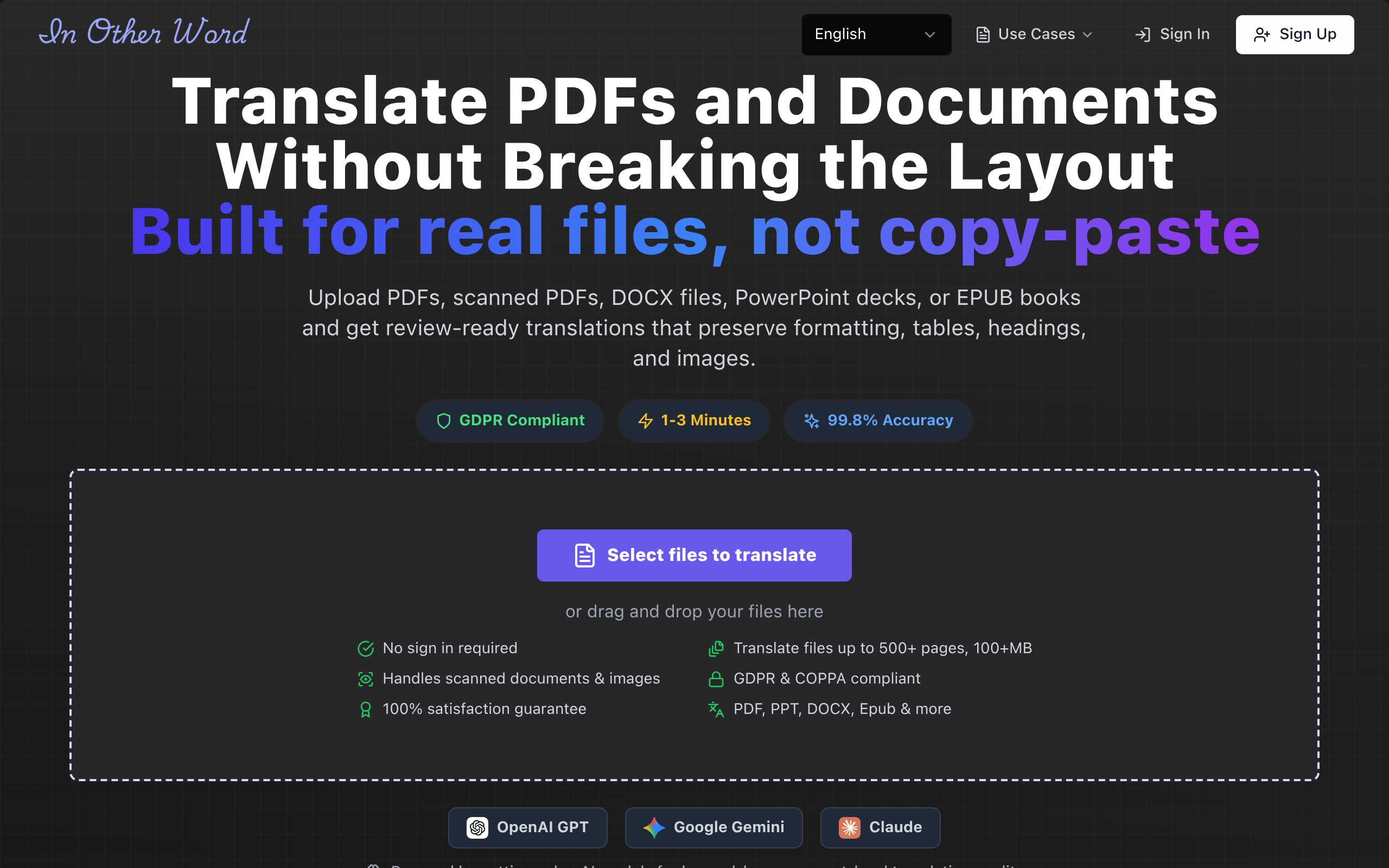
InOtherWord.AI is an AI-powered document translation platform for PDFs, scanned PDFs, DOCX files, PowerPoint presentations, and EPUB books. Its stated focus is preserving formatting, layout, tables, and images, which makes it relevant when a business, university, publisher, or internal legal team needs a usable translated file rather than an API response.
Where it fits
- Best for: Teams translating working documents, reports, course materials, research papers, presentations, and books while retaining document structure.
- Standout: A file-oriented workflow can be simpler than engineering an API, particularly when the source is a scanned PDF requiring OCR.
- Does not suit: A government or court submission that requires a human translator’s certification unless the buyer adds an appropriate qualified review and confirms acceptance with the authority.
Implementation and commercial model
Implementation is comparatively light for a document team: prepare the source, identify the target language, inspect the output, and route sensitive or high-consequence files for review. Commercial terms and current limits should be verified on the official site rather than assumed. Ask about file retention, access controls, OCR quality for poor scans, editable-output expectations, and how corrections are handled. For a scanned archive, first assess whether the source text is legible; OCR cannot reliably reconstruct missing characters, marginal notes, or illegible stamps.
Comparison
The table separates the buyer’s core job from the tool category. “Certification fit” means potential suitability for a certified workflow, not a promise that an authority will accept the result.
| Service | Primary category | Best document job | Implementation burden | Commercial model | Certification and review fit |
|---|---|---|---|---|---|
| TransPerfect | Managed human agency | Legal, government, business, and specialist projects | Low to moderate for buyer; agency-led | Quote-based project or program | Strong potential; confirm certification and notarization |
| LanguageLine Solutions | Managed language-services provider | Healthcare, public-sector, and institutional documents | Moderate procurement and briefing | Quote-based | Confirm document certification and formatting scope |
| Gengo | Online human-translation marketplace | Routine digital business and research content | Low to moderate | Order- or volume-based | Do not assume certification; verify per job |
| Google Cloud Translation | Machine-translation API | Automated, repeatable document pipelines | High; engineering required | Usage-based cloud billing | Human review must be added; no inherent certification |
| Microsoft Azure AI Translator | Machine-translation API | Azure-connected document workflows | High; cloud configuration required | Usage-based cloud billing | Human review must be added; no inherent certification |
| Smartling | Translation-management platform | Recurring multilingual content programs | Moderate to high | Platform and/or service proposal | Workflow support; certification depends on delivery model |
| InOtherWord.AI | AI document-translation platform | Layout-preserving PDFs, scans, office files, and EPUBs | Low to moderate; verify output | Verify current plan or usage terms | Useful for drafts and working files; add qualified certification review |
Decision guide: match the buyer need to the service type
| Buyer need | Most suitable service type | Main trade-off |
|---|---|---|
| Immigration, court, or regulatory submission | Human agency with confirmed certification | More expensive and slower than unreviewed machine translation |
| Internal understanding of a scanned record | AI document platform with OCR, followed by human checking where needed | Scan quality and layout artifacts can affect accuracy |
| Thousands of recurring files in an application | Cloud translation API with an engineered review workflow | Integration, security, monitoring, and review become the buyer’s responsibility |
| Ongoing multilingual publishing program | Translation-management platform or managed localization provider | Setup and recurring platform overhead may exceed the value of a single project |
| Editable translated report or presentation | Document translation platform or agency with layout production | Machine output may need terminology and visual inspection |
Quality, risk, and budget questions to ask
Use measurable acceptance criteria rather than asking a vendor whether its translation is “accurate.” A practical statement might require every page to be present, tables to remain readable, headings and footnotes to map correctly, names and dates to be checked against the source, and terminology to follow an approved glossary. For a filing, add the exact certification wording, signature method, translator identification, and notarization requirements supplied by the receiving authority.
- File integrity: Are page count, orientation, bookmarks, hyperlinks, tables, and images preserved?
- Text accuracy: Who reviews names, numbers, legal defined terms, dosage instructions, citations, and handwritten content?
- OCR handling: Does the workflow flag low-confidence text instead of silently translating it?
- Privacy: Where are source files stored, who can access them, and when are working copies deleted?
- Commercial clarity: Are formatting, OCR, certification, rush delivery, revisions, and minimum charges included?
- Acceptance: What happens when the buyer identifies a mistranslated term or a broken page after delivery?
Pricing questions should reflect the real cost structure. Agencies may quote by word, page, language, review stage, and deadline. APIs may appear inexpensive per request but require engineering, cloud storage, monitoring, and post-editing. Platforms may add subscription or workflow costs. Treat any internal budget as an illustrative starting policy, not a market benchmark: compare at least one representative file, one difficult scan, and one table-heavy document under the same acceptance criteria.
Vendor interview checklist
Send the same short brief to each finalist. Include a redacted sample, the target audience, language pair, file formats, deadline, expected output, and whether certification is required. Then ask:
- What exact deliverable will be returned: translated text, a rebuilt file, a signed certificate, a notarized package, or several of these?
- How are scanned pages, stamps, handwritten notes, diagrams, formulas, tables, and embedded images handled?
- Which stages are machine-assisted, human-translated, edited, reviewed, or approved?
- Can the provider demonstrate the workflow on a representative sample without making unsupported accuracy claims?
- What are the retention, deletion, access, and subcontracting policies for sensitive documents?
- Which costs are excluded from the first quote, and how are revisions or source-file changes charged?
- What measurable service-level commitments apply to delivery, corrections, and escalation?
Choose by consequence, not convenience
For a document that an authority may reject, choose a human provider only after confirming the required certification format and review chain. For recurring multilingual operations, compare the total ownership cost of an API or localization platform, including engineering and governance. For teams that primarily need readable, layout-preserving working files, an AI document platform can remove unnecessary setup, but high-consequence content still needs qualified review.
Before uploading a complex source, run a controlled sample containing the hardest page, not only a clean cover sheet. If your team needs to translate PDF documents or translate scanned PDFs while retaining useful structure, InOtherWord.AI is one option to evaluate alongside the human and infrastructure categories above: learn what InOtherWord.AI offers.
Authored with NotFair SEO
Related guides
Keep researching the right workflow
These pages help move from general document-translation research into the specific file format or workflow you need.
A practical workflow for translating scanned PDFs with OCR while preserving enough structure for real review, sharing, and downstream editing.
Explore pageHow to translate PPT and PPTX decks without breaking slide layouts, charts, and speaker-ready formatting.
Explore pageThe best AI PDF translator is not just about language quality. It also needs OCR, layout preservation, and reviewable output for real files.
Explore pageCommercial pages
Ready to translate the actual file?
Jump from the guide into the product page that fits your document type, then continue into pricing when you are ready.
Format page
Translate PDF Documents
Translate PDF files while preserving layout, tables, and page structure.
Explore pageFormat page
Translate Scanned PDFs
OCR and translate scanned PDFs without rebuilding the layout by hand.
Explore pageFormat page
Translate PowerPoint Presentations
Translate PPT and PPTX decks while preserving slide layouts, tables, and speaker-ready formatting.
Explore pageTranslate layout-heavy PDF reports, manuals, forms, and client-ready files while keeping tables, headings, and images readable.
Explore page