Translation And Apostille: What Documents Need and How the Process Works
Published Sun Sep 20 2026 | 12 min read
Translation and apostille explained for legal, academic, business, and government documents, including certification, OCR, workflow, and common rejection risks.
Translation and apostille are separate steps: a translation converts the document into another language, while an apostille authenticates the origin of a public document for use in another participating country. The apostille usually does not certify that the translation is accurate. For a 2026 filing, confirm the destination authority’s rules, identify whether the original or translated document must be apostilled, and arrange any required translator certification before submission.
What Translation And Apostille actually mean
The phrase often describes a document package prepared for cross-border use. It does not name one universal service or one universal certificate. The correct workflow depends on four variables: the document’s issuing country, the destination country, the document type, and the receiving authority.
An apostille is a certificate issued under the 1961 Hague Apostille Convention. It authenticates the origin of a public document by confirming the authenticity of the signature, the capacity in which the signer acted, and, where applicable, the identity of the seal or stamp. The Hague Conference on Private International Law explains the Convention and its purpose on its official apostille page: HCCH Apostille Convention information.
That function is narrower than many applicants expect. An apostille does not normally verify the document’s factual statements, approve the underlying transaction, or certify a translated version. A birth certificate with an apostille is still a birth certificate; the apostille confirms the authority of the issuing signature or seal.
A translation is a different layer of evidence. It reproduces the meaning and, for formal document work, often the structure of the source. The translator may also provide a declaration that the translation is complete and accurate. Some authorities require a sworn translator, court-authorized translator, notarized translator statement, or a particular certification wording. Others accept a qualified translator’s signed certification without notarization.
The three documents people confuse
- Original public document: for example, a civil-status certificate, court judgment, university diploma, or government-issued registry extract.
- Apostille certificate: attached to or associated with the public document by the competent authority in the place of issuance.
- Translated document: a target-language rendering of the original, the apostille, or both, depending on the receiving authority’s instructions.
These may travel as one packet, but they remain legally distinct. A translation provider can translate the document and its attached apostille while having no authority to issue the apostille itself. Conversely, the government office issuing the apostille generally does not perform the translation.
Why the distinction matters in real filings
The main risk is not poor vocabulary. It is submitting a technically polished package in the wrong order or with the wrong form of certification. A consulate, court, university, immigration office, registry, or employer may reject a document because the wrong page was apostilled, the translation was not certified in the required way, or the destination authority could not match the translation to the original.
Consider a university researcher submitting a degree certificate to a foreign ministry. The ministry may require:
- the original diploma or an officially issued duplicate;
- authentication by the competent authority in the issuing jurisdiction;
- an apostille on the original or certified copy;
- a translation into the ministry’s official language;
- the apostille text translated as part of the complete submission; and
- a translator declaration containing a name, signature, date, and contact details.
Changing even one of those requirements can change the workflow. A business registering a branch may need a commercial registry extract rather than a contract. A hospital may need a credential or medical record translated under privacy controls. A court may require a certified translation of every exhibit, including stamps, handwritten annotations, and seals.
Original-first versus translation-first
In many cases, the safer default is to apostille the original or properly certified copy first, then translate the complete packet. This lets the translator reproduce the apostille number, issuing authority, seals, and attachment language. However, some receiving authorities ask for the translation to be certified or notarized and then apostilled in its own right. That can create a second authentication chain.
Do not infer the required order from the word “apostille” alone. The UK government’s guidance, for example, distinguishes legalising a UK document from preparing documents for an overseas authority and directs applicants to check the requirements of the destination country: GOV.UK: Get a document legalised. The practical lesson is to obtain written instructions from the receiving authority before paying for certification.
How the process works from source file to accepted packet
A dependable workflow treats document translation as a chain of custody, not a simple upload-and-download task. The following sequence works as a starting process for legal, academic, corporate, and public-sector teams.
- Identify the receiving authority. Name the court, consulate, university, registry, employer, or agency that will review the document. “The destination country” is not specific enough.
- Classify the source. Determine whether it is a public document, private document, notarized document, certified copy, electronic record, or scanned image.
- Confirm the authentication path. Ask which authority issues the apostille and whether the destination accepts an apostille for this document type.
- Prepare the clearest source. Use the original digital file or a high-resolution scan. Include every page, attachment, seal, stamp, marginal note, and reverse side.
- Translate the complete evidentiary set. Decide whether the apostille, notarial block, stamps, signatures, and handwritten content must also be translated.
- Apply the required certification. Add the translator’s declaration, notarization, sworn-translator status, or other required credential only after confirming the receiving authority’s rule.
- Perform a submission check. Compare names, dates, document numbers, page counts, signatures, and attachment references against the source.
Where OCR and layout preservation fit
Many official records arrive as scans rather than searchable PDFs. Optical character recognition can make a scanned certificate or court bundle usable for translation, but OCR is an extraction step, not proof that the extracted text is correct. A blurred number, accent, date, or handwritten surname can change the legal identity of a document.
For scanned material, teams should review OCR against the image and retain the original scan as the controlling source. A platform designed to translate scanned PDFs can help convert image-based pages into a workable translation while preserving page order, but a human reviewer still needs to inspect seals, marginal text, handwriting, and low-contrast areas.
For born-digital files, preserving layout has a different purpose. A translated contract, judgment, or academic transcript should keep headings, tables, footnotes, page labels, and exhibit references aligned so the reviewer can compare versions. When the source is a PDF, teams can use a workflow to translate PDF documents while maintaining the visual relationship between the source and target files.
What should be translated
There is no universal rule that every mark on an apostille must be translated, but omission is risky when the receiving office must verify the chain. A complete translation package commonly addresses:
- the document title and body text;
- certification, notarization, and issuing-authority language;
- seals, stamps, embossed text, and handwritten annotations, identified in brackets where they cannot be reproduced;
- the apostille heading, fields, certificate number, and issuing office;
- tables, dates, names, addresses, registration numbers, and abbreviations; and
- page labels and references to attachments.
A translator should not silently “correct” a name or date to match another record. If the source contains an apparent error, the translation should preserve it and, if appropriate, describe the issue in a translator’s note. Legal reviewers can then decide whether an amended original is needed.
Certification, notarization, and apostille: choosing the right layer
Translator certification is a statement about the translation’s completeness and accuracy. Notarization generally verifies the identity or signature of the person making a statement; it does not automatically verify language quality. Apostille authenticates the relevant public signature, seal, or official capacity. These layers can appear together, but one does not automatically replace another.
For example, if a translator signs a certification before a notary, the notary may authenticate the translator’s signature. If that notarized certification is then apostilled, the apostille may authenticate the notary’s signature. That does not necessarily mean the apostille authenticates the translator’s linguistic competence or the accuracy of every translated sentence.
U.S. immigration filings illustrate why the receiving authority’s rule controls. The relevant regulation, 8 CFR § 103.2(b)(3), requires a foreign-language document submitted to U.S. Citizenship and Immigration Services to be accompanied by a full English translation and a translator certification stating that the translation is complete and accurate and that the translator is competent to translate. That is a translation requirement; it is not a general instruction to apostille every translated document.
For documents used in the United States, the authentication route can also differ by issuing authority. The U.S. Department of State explains its authentication services and limitations in its official guidance on authenticating documents. A state-issued record, a federal record, and a document issued by a foreign government may follow different procedures.
A practical decision table
| Question | If yes | Action to verify |
|---|---|---|
| Is the source a public document issued by a participating jurisdiction? | An apostille may be available. | Find the competent authority for the place of issuance. |
| Does the receiving office require a certified translation? | The translation needs specified certification wording or status. | Obtain the office’s current translator requirements in writing. |
| Is the document private, electronic, or notarized rather than government-issued? | The authentication chain may begin with notarization or another certification. | Ask whether the private document must be notarized before authentication. |
| Does the source contain an apostille or legalization page? | The authentication text may need translation too. | Confirm whether the receiving reviewer needs every page translated. |
If the destination is not covered by the Apostille Convention, the equivalent process may be called legalization, consular legalization, authentication, or diplomatic certification. Do not use “apostille” as a generic synonym for all document authentication.
Where the workflow breaks—and how to prevent rejection
The most expensive errors tend to occur at interfaces: between a scan and OCR, between a translator and a notary, or between an issuing office and a foreign reviewer. Each interface needs a specific control.
- Incomplete source: a scan omits the back of a certificate or an attachment. Use page counts and visual thumbnails to confirm completeness.
- Unreadable identity data: OCR misreads a passport number, diacritic, or date. Compare every high-risk field with the image.
- Wrong authentication jurisdiction: an apostille is requested from the destination country instead of the authority where the document was issued. Confirm the issuing jurisdiction first.
- Mismatch in names: transliteration choices vary across passports, diplomas, and civil records. Preserve the source and flag discrepancies rather than harmonizing them silently.
- Missing non-text content: seals, stamps, signatures, and marginal notes are left untranslated. Mark them accurately, even if the mark is illegible.
- Layout damage: tables or exhibit labels move during conversion. Use visual comparison, not just spell-checking.
- Unclear certification: the translator signs a generic statement that does not meet the recipient’s required wording. Use the recipient’s template when one exists.
Numbers deserve special treatment. A date such as 03/04/2026 can mean 3 April or March 4 depending on convention. A decimal comma can become a decimal point. A company registration number can be mistaken for a tax number. In a certified translation, preserve the source format where possible and add an unambiguous explanatory format only when the receiving authority permits it.
Privacy is another operational constraint. Legal files may contain privileged material; healthcare records may contain protected health information; employee records may include identity documents. Before uploading anything, establish who may access the source, where working files are retained, how downloads are controlled, and when temporary files are deleted. If a platform’s current security or retention terms matter to the engagement, review its current documentation rather than relying on a general marketing statement.
How practitioners apply it by document type
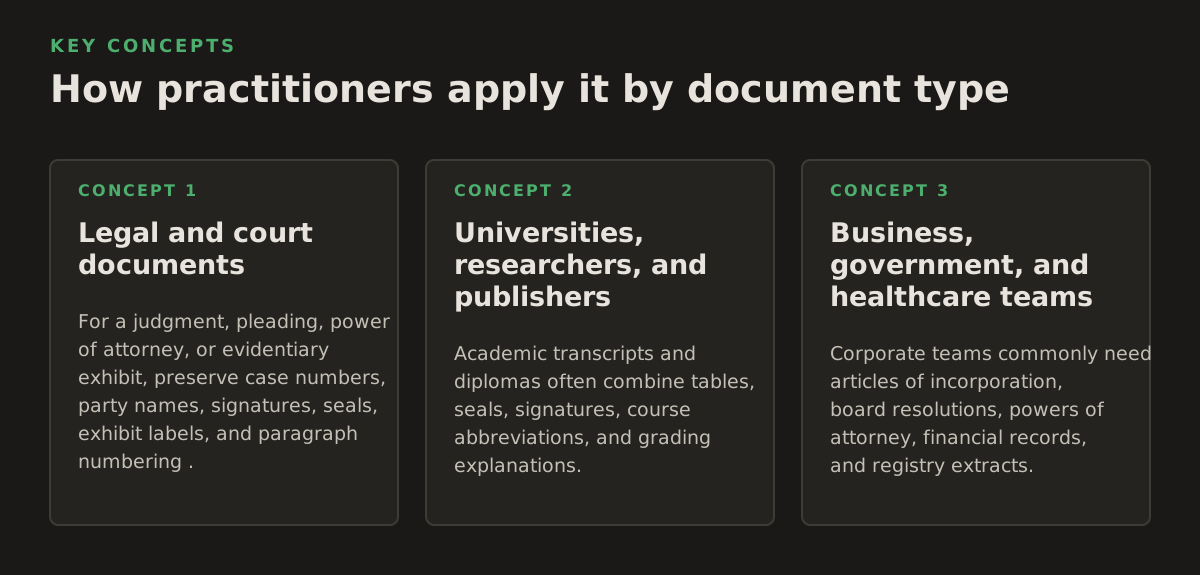
The same principles produce different checklists in different departments. The job is to identify what the reviewer must verify, then preserve the evidence needed for that verification.
Legal and court documents
For a judgment, pleading, power of attorney, or evidentiary exhibit, preserve case numbers, party names, signatures, seals, exhibit labels, and paragraph numbering. Ask whether the court wants one bilingual packet, a target-language translation attached to the source, or a separate certification page. Translate captions and certificates, not merely the substantive paragraphs.
A legal team should also decide whether quoted authorities, statutory citations, and defined terms remain in the original language. A translated defined term may be useful for the court, but changing a citation or case name can make verification harder. Maintain a terminology sheet for recurring names and legal concepts across the case bundle.
Universities, researchers, and publishers
Academic transcripts and diplomas often combine tables, seals, signatures, course abbreviations, and grading explanations. Preserve the original course titles and provide explanatory translations where needed. For journal articles and books, an apostille is usually not relevant unless a separate official credential, declaration, or publication record is being submitted; do not attach authentication steps to ordinary editorial translation without a stated requirement.
Publishers and educators should distinguish between translation for comprehension and certified translation for formal submission. The former can prioritize readability and house style. The latter must preserve source evidence, certification language, and traceability.
Business, government, and healthcare teams
Corporate teams commonly need articles of incorporation, board resolutions, powers of attorney, financial records, and registry extracts. Keep entity names and registration identifiers consistent across all documents. A translated internal report may not require an apostille at all; an official filing or authority-issued extract may.
Government and healthcare teams should establish a controlled intake process:
- assign a document owner and approved recipient;
- record the source language, target language, and required certification;
- restrict access to the minimum necessary personnel;
- review names, dates, numbers, and clinical or legal terminology separately; and
- archive the source, final translation, certification, and submission instructions together.
A defensible 2026 operating policy
For recurring work, create a one-page intake form rather than asking translators to infer requirements from an email. At minimum, capture:
- issuing country and issuing authority;
- destination country and receiving organization;
- document type and whether the source is original, certified copy, or scan;
- required target language and deadline;
- whether the apostille or legalization page must be translated;
- required translator status, certification, notarization, or sworn signature; and
- the person authorized to approve names, dates, and unresolved source ambiguities.
Use a two-reviewer model for high-consequence documents: one reviewer checks language and terminology, while another checks visual fidelity and source-to-target identity fields. This is especially valuable for scanned PDFs, multi-page court records, transcripts, and documents containing tables. The second reviewer should compare against the image, not only against OCR text.
The best recommendation is simple: get the receiving authority’s checklist before translation, authenticate the correct source document through the competent authority, and treat the apostille, translation, and translator certification as separate deliverables that must agree. InOtherWord.AI can help teams translate PDFs, scanned PDFs, DOCX files, presentations, and EPUB books while preserving formatting and document structure; use InOtherWord.AI when the translation workflow needs that layout-aware approach.
Authored with NotFair SEO
Related guides
Keep researching the right workflow
These pages help move from general document-translation research into the specific file format or workflow you need.
A practical workflow for translating scanned PDFs with OCR while preserving enough structure for real review, sharing, and downstream editing.
Explore pageHow to translate PPT and PPTX decks without breaking slide layouts, charts, and speaker-ready formatting.
Explore pageThe best AI PDF translator is not just about language quality. It also needs OCR, layout preservation, and reviewable output for real files.
Explore pageCommercial pages
Ready to translate the actual file?
Jump from the guide into the product page that fits your document type, then continue into pricing when you are ready.
Format page
Translate PDF Documents
Translate PDF files while preserving layout, tables, and page structure.
Explore pageFormat page
Translate Scanned PDFs
OCR and translate scanned PDFs without rebuilding the layout by hand.
Explore pageFormat page
Translate PowerPoint Presentations
Translate PPT and PPTX decks while preserving slide layouts, tables, and speaker-ready formatting.
Explore pageTranslate layout-heavy PDF reports, manuals, forms, and client-ready files while keeping tables, headings, and images readable.
Explore page